How to cut compressed air energy costs.
To cut compressed air energy costs, check eight things in this order: how much air and power you use, leaks and avoidable uses, pressure, speed control, several compressors, drying and filtration, heat recovery and upkeep.
Eight questions before you spend.
Work through the same eight questions with your own team, your auditor and every supplier, and compare the answers. The table of where the savings are follows the checks.
| Check | What to ask or measure |
|---|---|
| 1. Measure first | What does the plant use in power, pressure and flow over a full production cycle? |
| 2. Leaks and avoidable uses | What share of the output is leakage, and which uses of air could be done another way? |
| 3. System pressure | What is the lowest pressure the end uses need, and how much is lost on the way? |
| 4. Speed control | How much does demand vary, and what does the compressor draw when demand is low? |
| 5. Several compressors | Do they run at full load except one, and does storage ride out the peaks? |
| 6. Dryers and filters | What does the treatment cost in pressure and purge air, and is the air treated more than the use needs? |
| 7. Heat recovery | What could the heat warm on your site, and what would it replace? |
| 8. Upkeep | Which readings show the efficiency slipping, and who looks at them? |
Measure the air and the power first.
You cannot cut what you have not measured: start from a baseline of power, pressure and flow.
Compressed Air Challenge Fact Sheet #9 (May 2026) says electricity is by far the largest expense of owning and operating a compressed air system, and that many facilities have no idea what their system costs each year. Its simple estimate multiplies the motor’s full-load brake horsepower by 0.746 kW per hp, divides by 0.9 for motor efficiency, and multiplies by the annual hours and the price of electricity. For a 100 hp (about 75 kW) compressor running 8,760 hours a year at $0.10 per kWh it gives about $72,600 a year, which the sheet calls a good estimate, not an exact number.
A measured figure is better. The same fact sheet takes the full-load amps, the volts and the power factor, and says that when the savings from a measure are worked out, the real marginal cost of electricity has to include demand charges, seasonal rates and different rates for different levels of consumption.
Compressed Air Challenge Fact Sheet #3 (May 2026) says the load profile is established by measuring flow and pressure across the system under different demand conditions while watching the load on the compressors, over 24 hours or even several days if demand varies a lot, sometimes with data loggers for both demand and power. A facility with a varying profile will likely benefit from advanced control strategies, and one with short periods of heavy demand may benefit from storage. Once the profile is known, our guide to sizing an air compressor shows how to read it.
The same fact sheet says an audit should look at both the supply of air and its use, and that independent auditors should give recommendations that are system-neutral and commercially impartial, and neither specify nor recommend any particular make of equipment. It adds that audits are also carried out by electric utilities, equipment distributors, equipment makers, energy service companies and engineering firms, so ask who is doing yours.
- What to send us
- Tell us about your site, the air demand and the working pressure.
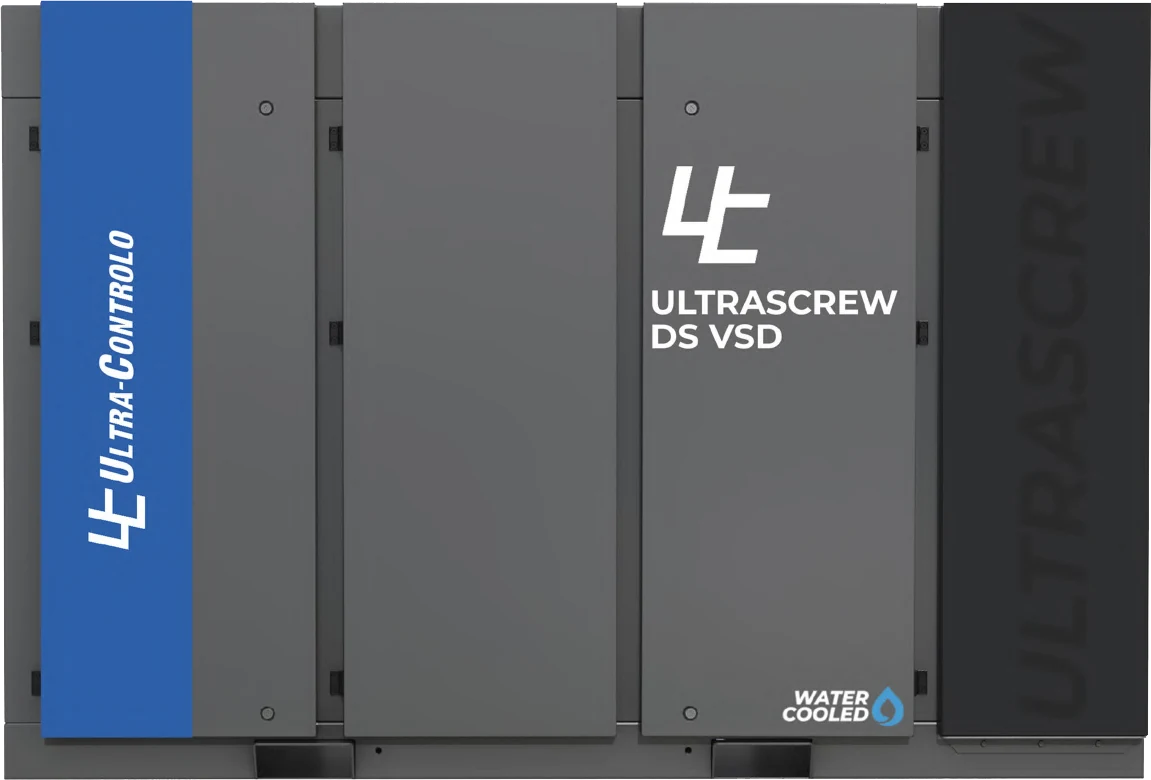
- ULTRASCREW DS VSD
- The Ultra Controlo engineering team sizes the configuration and sends a quote.
Leaks and avoidable uses of air.
Ask what share of the compressor’s output is lost to leaks, and which uses of air could be done another way.
Compressed Air Challenge Fact Sheet #7 (May 2026) says the percentage lost to leakage should be less than 10% in a well-maintained system, and that proactive leak detection and repair can bring leaks below 10% of compressor output. The most common problems are couplings, hoses, tubes and fittings, pressure regulators, open condensate traps and shut-off valves, and pipe joints, disconnects and thread sealants. The table of leak sizes shows what a small hole costs.
To estimate leakage on a compressor with start/stop controls, start it when no air-operated equipment is running and time the load and unload periods: leakage in per cent is T × 100 ÷ (T + t), where T is the on-load time and t the off-load time, in minutes. With other controls the sheet times how long a known system volume takes to fall from the normal operating pressure to about half of it. It says to repeat the test quarterly, and that a result above 10% means the system can likely be improved.
The saving is only realised in full if the compressors are adjusted afterwards: the sheet says that once leaks have been repaired the compressor control system should be re-evaluated. It also says that reduced system pressure means reduced leakage, because the lower the pressure difference across a hole, the lower the flow. The sheet names an ultrasonic acoustic detector as the best way to find leaks, and soapy water as a simpler but slower one. How leaks are handled in routine upkeep is on our compressor maintenance page.
Some air should not be compressed at all. Compressed Air Challenge Fact Sheet #2 (May 2026) says compressed air is often the most expensive form of energy used in a plant, that its overall efficiency is typically around 10%, and that users should consider more cost-effective forms of power first. It suggests fans or air conditioning for electrical cabinets, a vacuum system in place of compressed air venturis, and blowers in place of compressed air for cooling, aspirating, agitating, mixing or inflating packaging. It also says to stop the air to abandoned equipment, as far back in the distribution system as possible, and that a tool without a regulator uses full system pressure. For the blower option, read how to choose an industrial blower.
- Open condensate traps
- ULTRASEC drains the condensate with an electronically controlled drain.
Three hole sizes, one year.
Leak flow rises with the square of the hole diameter, so a small leak costs a fraction of a large one. Flow: US Department of Energy Compressed Air Tip Sheet #3 (August 2004), for approximately equivalent orifice sizes at 100 psig (about 6.9 bar g); it says to multiply by 0.97 for well-rounded orifices and by 0.61 for sharp ones. Cost: Compressed Air Challenge Fact Sheet #7 (May 2026), at $0.10 per kWh, constant operation and an efficient compressor, so scale it to your own tariff. The metric figures are our rounded conversions.
| Hole size | Flow at 100 psig | Cost per year |
|---|---|---|
| 1/16 in (about 1.6 mm) | 6.31 cfm (about 11 m³/h) | $1,046 |
| 1/8 in (about 3.2 mm) | 25.22 cfm (about 43 m³/h) | $4,190 |
| 1/4 in (about 6.4 mm) | 100.9 cfm (about 171 m³/h) | $16,764 |
System pressure.
Ask for the lowest pressure the end uses need, and measure what is lost between the compressor and the tool.
Compressed Air Challenge Fact Sheet #4 (May 2026) says many plant compressors run at a full-load pressure of 100 psig (about 6.9 bar g) and an unload pressure of 110 psig or higher, while many machines and tools work efficiently with 80 psig (about 5.5 bar g) or less at the point of use. If the discharge pressure can come down, it says, significant savings can be achieved.
Higher pressure costs twice. On top of the usual rule of thumb of about 1% more energy for each 2 psi (about 0.14 bar) in a system around 100 psig, the US Department of Energy sourcebook (third edition, 2016) says that raising the pressure also raises every unregulated use of air, such as leaks and open blowing, which it says can be as high as 30 to 50% of demand. In that case it puts the total at about 1.6 to 2% for each 2 psi. It calls the extra air consumed artificial demand.
Fact Sheet #4 says that reducing and controlling the pressure downstream of the primary receiver can cut energy use by up to 10% or more even though the compressor discharge pressure has not changed, and that lower pressure also reduces leakage and stress on components. It warns that large changes in demand can pull the pressure at the points of use below the minimum, which careful matching of components, controls and storage avoids.
Between the compressor and the tool, it gives a typical pressure differential of 7 psid for a filter, a regulator and a hose together, and says it can be much higher in a poorly designed or maintained system. If the pressure at a point of use must go up, it says to reduce the pressure drops before adding capacity or raising the system pressure. For equipment that uses a lot of air, it recommends specifying lower operating pressure: the added cost of parts such as larger air cylinders is usually recouped quickly.
- ULTRASEC
- The ULTRASEC datasheet estimates about 7% of the installed motor power for each extra bar on the compressor.
- ULTRASCREW VSD
- The variable speed version operates at constant output pressure over a range of 5 to 14 bar, with a smooth start.
- ULTRASCREW FSD
- ULTRASCREW 37 FSD lists 322 Nm³/h at 10 bar and 265 Nm³/h at 13 bar in the ULTRAAR ME datasheet (2026).
Speed control and part load.
Ask how much your demand varies, and what the compressor draws when demand is low.
The US Department of Energy sourcebook (third edition, 2016) describes variable speed as an efficient means of rotary compressor capacity control. The drive adjusts the motor speed continuously, with an almost one to one relationship between demand and power, and holds the discharge pressure within 1 or 2 psi over a wide range of capacity.
It also sets out the limits. At or near full output a variable speed compressor uses more input power than a comparable fixed speed unit, because of drive losses, and at low speeds the efficiency of the package falls off, so continuous running at full or minimum speed should be avoided. Best efficiency is between 30 and 80% of speed for most of the operating hours, and the best savings come where running hours are long and a high proportion of them are at mid to low capacity.
Below its minimum speed a variable speed compressor typically loads and unloads or starts and stops. The sourcebook says long running below minimum speed should be avoided on lubricated screw compressors, to keep condensate out of the lubricant, and that proper storage is needed so that the speed is not ramped up and down continuously, which may damage the driver.
Fixed speed with load/unload control can also work. The sourcebook says it is claimed to be the most efficient on some lubricated screw compressors, but that this can mislead, because an adequate receiver volume is essential to obtain any real savings. Compressed Air Challenge Fact Sheet #11 (May 2026) adds that two-stage rotary screw compressors are more efficient than single-stage units.
- ULTRASCREW VSD
- Up to 55% electricity savings compared with fixed speed, according to the Industrial 2026 catalogue.
- ULTRASCREW DS VSD
- Two-stage compression with a variable speed drive that follows air demand. Up to 65% electricity savings compared with fixed speed, according to the Industrial 2026 catalogue.
- How to read them
- Upper values: the saving on your plant depends on how much its demand varies.
- ULTRASCREW FSD
- Runs at fixed speed with a star delta starter.
- Gardner Denver
- On the Gardner Denver EMEIA site, ESM models are fixed speed and VS models are variable speed lubricated screw compressors. Ultra Controlo distributes and services Gardner Denver compressors and compressed air filters, and its UltraCare programme covers Ultra Controlo equipment and partner brands.
Several compressors and storage.
Ask how the compressors are switched on and off together, and how much air is held in storage.
Controls match the supply of air to the demand, and Compressed Air Challenge Fact Sheet #6 (May 2026) calls them one of the most important determinants of overall system energy efficiency. Its aim is to shut off unneeded compressors, or to delay bringing on additional ones until needed. How the controllers work together is set out in our guide to choosing a screw air compressor; here the question is what they save.
The sheet explains where the saving comes from. The control range, the gap between the pressure at which output is cut and the pressure at which it is raised again, can be anywhere from 2 to 20 psi depending on demand. Slow, imprecise controls gave wide pressure swings, so set points were kept higher than needed; faster microprocessor controls with tighter ranges allow a lower set point, and every 2 psi of pressure difference is equal to about a 1% change in energy consumption.
The US Department of Energy sourcebook (third edition, 2016) says that when a variable speed compressor shares a header with fixed speed compressors, it should always be the trim compressor, whatever number of fixed speed units is running. It adds that care is needed in sizing, because some models have limited ranges, and that the integration should be done in consultation with the compressor’s maker or a compressed air system expert.
Storage does part of the work. Fact Sheet #6 says the goal is to run the demand side at the lowest possible pressure, to support transient events as much as possible with air held in storage and to take as long as possible to refill it, and that strategic storage can sometimes allow a compressor that is modulating to support demand events to be turned off. Compressed Air Challenge Fact Sheet #11 (May 2026) says a larger receiver for occasional peaks can even allow a smaller compressor.
- ULTRASCREW DS VSD
- Several compressors can run as a group without an external master controller.
- Control
- LED display with integrated driver and controller, Modbus TCP and dual PID control of pressure and temperature at the same time.
Dryers, filters and what they cost.
Ask what the treatment costs in pressure and in purge air, and whether the air is treated more than the use needs.
Compressed Air Challenge Fact Sheet #11 (May 2026) says drying should only be done to the degree needed for the proper functioning of the equipment and the end use, because dryers add capital and operating costs, including energy. It lists what to count on each type.
A refrigerant-type dryer has a pressure drop of usually 3 to 5 psid, and the energy of its refrigerant compressor must be added; some can cycle on and off with air flow, which may save energy. A twin tower desiccant dryer has a purge air requirement that can range from 10 to 18% of the total air flow, depending on the type, and that loss comes on top of the pressure drop. The heated type needs less purge air but adds heater energy. A heat-of-compression dryer, used with a lubricant-free compressor whose discharge is hot enough, does not reduce air capacity. Vacuum-assisted regeneration is typically the most efficient, and unheated purge air flow the least efficient.
Filtration follows the same rule: filtering only to the level each application requires minimises pressure drop and energy use. The order of the filters, the element changes and the pressure drop are set out in our guide to choosing compressed air filters, and the dryer types in our guide to choosing a compressed air dryer.
- ULTRASEC
- Hot gas bypass valve designed to provide a constant dew point.
- ULTRASEC pressure drop
- Low pressure drop even with load variations.
- ULTRADRY
- A control of the actual water load adjusts the adsorption cycles.
Heat recovery.
Ask what the compressor’s heat could warm on your site, and what it would replace.
Compressed Air Challenge Fact Sheet #10 (May 2026) says that on an air-cooled packaged rotary screw compressor the only changes needed to recover heat as hot air are ducting and another fan, and that a thermostatically controlled hinged vent can send the hot air outside when heating is not wanted, such as in summer. As a rule of thumb, about 50,000 Btu per hour is available for each 100 cfm of capacity at full load (about 14.7 kW for each 170 m³/h). The air comes out 30 to 40 °F (about 17 to 22 °C) above the cooling air inlet temperature, and recovery efficiencies of 80 to 90% are common.
With a heat exchanger, the same sheet says waste heat can also be taken from the lubricant coolers of packaged water-cooled reciprocating or rotary screw compressors to produce hot water, for central heating or boiler systems, industrial cleaning, plating, heat pumps or laundries, and that heat exchangers allow the ratio of hot air to hot water to be varied. Heat recovery for space heating is less common with water-cooled compressors, because the heat is at a lower temperature; typical recovery efficiencies are 50 to 60%. The recovered heat is generally not hot enough to be used directly for steam.
To judge the payback, the sheet says to compare with the current source of heat, which may be a low-price fossil fuel such as natural gas. Compressed Air Challenge Fact Sheet #11 (May 2026) says most systems do not use heat recovery even though the economics can be good, with typical paybacks of less than one year. Fact Sheet #10 cautions that if the compressor does not take its air from outside and the heated air is used in another space, the cabinet static pressure can fall and reduce the efficiency of the compressor. The first answers to ask for are in our guide to choosing a screw air compressor.
- ULTRASCREW DS VSD
- An optional oil/water exchanger recovers compressor heat as hot water for facility use, or as heated air for space heating.
Upkeep that protects efficiency.
Ask which readings show the efficiency slipping, and who looks at them.
Compressed Air Challenge Fact Sheet #5 (May 2026) says one way to tell whether a system is being maintained well is to benchmark it periodically by tracking power, pressure and flow, and that if the power used at a given pressure and flow goes up, the efficiency of the system is degrading.
Compressed Air Challenge Fact Sheet #11 (May 2026) gives two readings for a lubricant-cooled rotary screw compressor. Its air/lubricant separator starts with a pressure drop of 2 to 3 psid at full load when new, and maintenance manuals usually suggest changing it at 10 to 12 psid, but in many cases an earlier replacement makes sense, especially if electricity prices are high. The sheet also says v-belts should be inspected and tensioned to the specification of the compressor’s maker, to avoid higher power transmission losses.
The routine tasks, the intervals, the spare parts and what a service contract should say are on our compressor maintenance page, and are not repeated here.
- UltraCare
- UltraCare covers preventive and corrective maintenance, original spare parts and emergency support for Ultra Controlo equipment and partner brands.
- Maintenance contracts
- Scheduled preventive maintenance plans, adapted to each installation, as the Industrial 2026 catalogue lists them (p. 24).
From the meter to the compressor room.
Five stages, each building on the one before. The order follows the Compressed Air Challenge fact sheets: cut the demand first, then retune the supply.
Measure
Record power, pressure and flow, and the load profile over a full production cycle.
Cut waste
Find and repair leaks, and take the avoidable uses of air off the compressors.
Lower the pressure
Reduce the pressure drops, then lower and control the pressure the end uses see.
Retune the supply
Once demand pressure is reduced and controlled, optimise the compressor set points, speed control and storage. That may let a compressor unload or shut down.
Recover and watch
Put the compressor heat to use, and keep benchmarking power, pressure and flow.
Seven measures, side by side.
What the public guidance says about each measure, and what we supply for it. The figures come from US documents and depend on each plant, so measure your own.
| Measure | What the public guidance says | What we supply |
|---|---|---|
| Leaks and avoidable uses | Less than 10% of compressor output in a well-maintained system; stop the air to abandoned equipment (Compressed Air Challenge Fact Sheets #7 and #2, May 2026) | ULTRASEC with an electronically controlled condensate drain |
| System pressure | Up to 10% or more from reducing and controlling the pressure downstream of the primary receiver (Fact Sheet #4, May 2026) | ULTRASCREW VSD at constant output pressure over 5 to 14 bar |
| Speed control | The best savings come with long running hours and a high proportion at mid to low capacity (US DOE sourcebook, 2016) | ULTRASCREW VSD and ULTRASCREW DS VSD, as in check 4 |
| Several compressors | Tighter control ranges allow a lower pressure set point, and every 2 psi is about 1% of energy (Fact Sheet #6, May 2026) | ULTRASCREW DS VSD runs as a group without an external master controller |
| Drying and filtration | Purge air of 10 to 18% of the total flow on twin tower desiccant dryers (Fact Sheet #11, May 2026) | ULTRADRY, with a control of the actual water load, and ULTRASEC |
| Heat recovery | 50 to 90% of the thermal energy can often be captured (Fact Sheet #10, May 2026) | ULTRASCREW DS VSD with the optional oil/water exchanger |
| Upkeep | Rising power at a given pressure and flow means the efficiency is degrading (Fact Sheet #5, May 2026) | UltraCare |
Where the energy checks meet the range.
Variable speed ULTRASCREW
ULTRASCREW VSD uses direct drive and variable speed control, and the variable speed version operates at constant output pressure over a range of 5 to 14 bar.
Two-stage, with heat recovery
ULTRASCREW DS VSD is for industrial operations where compressed air demand fluctuates: two-stage screw compression with a variable speed drive that follows air demand, with an optional integrated dryer and heat recovery.
Treatment and service
ULTRASEC and ULTRADRY dryers take the water out of compressed air, and UltraCare covers preventive and corrective maintenance for Ultra Controlo equipment and partner brands.
Common questions about cutting energy costs.
Questions buyers ask about the energy cost of compressed air.
How can I cut compressed air energy costs?
Start by measuring power, pressure and flow, then work through leaks and avoidable uses of air, system pressure, speed control, the control of several compressors, drying and filtration, heat recovery and upkeep.
Compressed Air Challenge Fact Sheet #9 (May 2026) says a system that has undergone numerous modifications and been maintained only enough to keep it running can frequently achieve energy savings of 20 to 50% or more.
How much does a compressed air leak cost?
Compressed Air Challenge Fact Sheet #7 (May 2026) gives $1,046 a year for a 1/16 inch leak, $4,190 for 1/8 inch and $16,764 for 1/4 inch, at $0.10 per kWh with constant operation and an efficient compressor. The US Department of Energy tip sheet (August 2004) says leak flow is proportional to the square of the hole diameter and rises with pressure.
What leak rate is acceptable?
Compressed Air Challenge Fact Sheet #7 (May 2026) says leakage should be less than 10% of compressor output in a well-maintained system, and that a result above 10% means the system can likely be improved. It says to test quarterly.
How much energy does higher pressure cost?
About 1% more operating energy cost for each 2 psi (about 0.14 bar) in a system around 100 psig, says Compressed Air Challenge Fact Sheet #9 (May 2026). The US Department of Energy sourcebook (third edition, 2016) puts the total at about 1.6 to 2% for each 2 psi where 30 to 50% of the air is used unregulated.
How much can a variable speed compressor save?
It depends on how much demand varies. The Industrial 2026 catalogue gives up to 55% electricity savings for ULTRASCREW VSD and up to 65% for ULTRASCREW DS VSD, compared with fixed speed.
The US Department of Energy sourcebook (third edition, 2016) says the best savings come where running hours are long and a high proportion of them are at mid to low capacity.
How do I know whether heat recovery pays?
Compare it with the heat you buy today. Compressed Air Challenge Fact Sheet #10 (May 2026) says to compare with the current source of heat, which may be a low-price fossil fuel such as natural gas, and Fact Sheet #11 says typical paybacks are less than one year. The recovered heat is generally not hot enough for steam.
In what order should the savings be tackled?
Fix leaks and lower and control the demand pressure first. Compressed Air Challenge Fact Sheet #4 (May 2026) says that once demand pressure has been reduced and controlled, attention should shift to optimising the compressor set points, which may allow a compressor to be unloaded or shut down, and Fact Sheet #7 says to re-evaluate the controls once leaks are repaired.
Does Ultra Controlo supply variable speed compressors?
Yes. ULTRASCREW compressors are supplied by Ultra Controlo in fixed speed (FSD) and variable speed (VSD) versions, and ULTRASCREW DS VSD is a two-stage compressor with a variable speed drive for fluctuating demand.
Ultra Controlo distributes and services Gardner Denver compressors and compressed air filters, and its UltraCare programme covers Ultra Controlo equipment and partner brands. On the Gardner Denver EMEIA site, ESM models are fixed speed and VS models are variable speed lubricated screw compressors.
Ready to discuss compressed air energy costs?
Tell us about your site, the air demand and the working pressure. Our engineering team sizes the configuration and sends a quote.