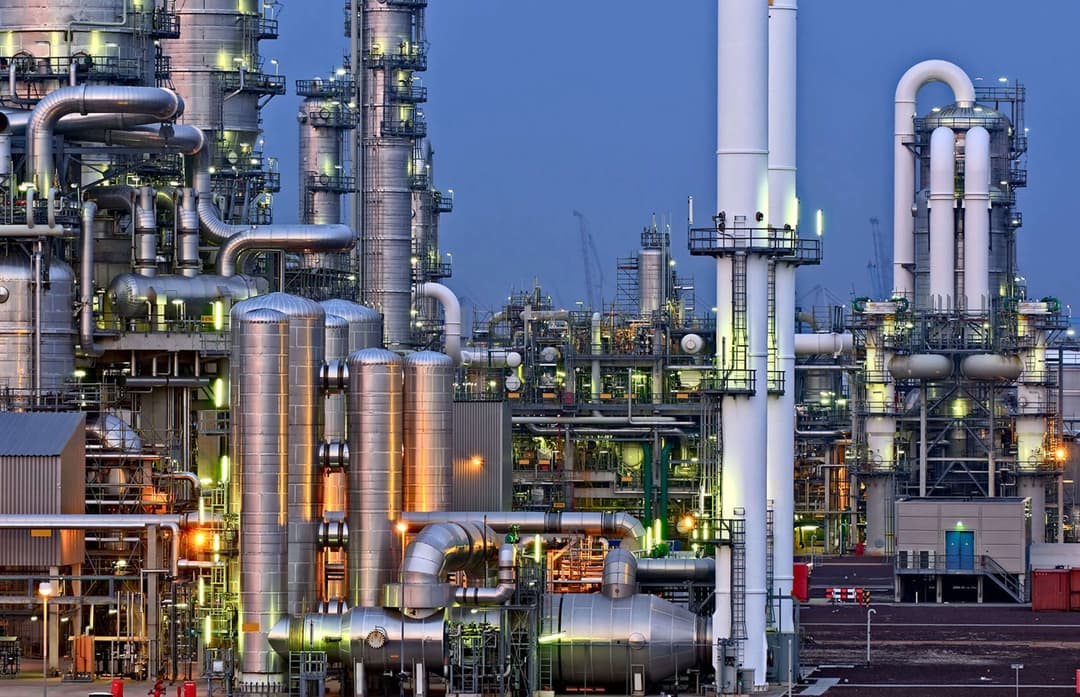
Chemical and petrochemical. Instrument air, conveying and process vacuum.
The US Department of Energy lists process gas compressing and controls and actuators as compressed air uses in petroleum, and conveying and controls and actuators in chemicals. The Ultra Controlo Industrial 2026 catalogue describes instrument gas, air for pneumatic valves and process control for refineries, terminals and power plants that cannot stop, and the Ultra Controlo industrial brochure lists chemicals and petrochemicals among the uses of the ULTRAK carbon tower.
Supply pressure most dense-phase conveying makers specify, per DOE
02
30–45psig
Pressure the pad and transport air typically need, per DOE
03
−40°F
Typical pressure dew point rating of twin-tower desiccant dryers, per DOE
04
<0.003mg/m³
Oil vapour after an ULTRAK carbon tower, per catalogue
Where the air goes
Where a chemical plant or refinery uses air.
The US Department of Energy and the Ultra Controlo catalogue describe these uses of compressed air in chemicals, petroleum and energy.
Petroleum
Process gas compressing
Compressing process gas, listed by the DOE for petroleum.
Control
Instrument gas and valve air
Instrument gas, air for pneumatic valves and process control in critical environments, as the Ultra Controlo catalogue describes for petrochemicals and energy.
All plants
Controls and actuators
Pneumatic controls and actuators, listed by the DOE for both chemicals and petroleum.
Chemicals
Conveying solids
Dense-phase transport of solids such as carbon black: the batch is padded with compressed air in a transport vessel and moved through the line as a plug.
Chemicals
Unloading tanks and tank cars
Padding, air dispensed over the material to move liquids and light solids over short distances; the DOE suggests slow-to-medium pressure blowers instead.
Process
Oxidation and fractionation
The DOE says many manufacturing industries use compressed air and gas for process operations such as oxidation, fractionation, refrigeration and filtration, and that for some of these uses other sources of power may be more cost effective.
Sources: US Department of Energy and Compressed Air Challenge, Improving Compressed Air System Performance: A Sourcebook for Industry, third edition (2016), Section 1, Table 1.1 and Fact Sheet 2; Ultra Controlo Industrial 2026 catalogue, p. 6.
Dry air outdoors
Choosing the dryer for instrument air.
Where instrument air piping runs outdoors, the choice of dryer matters. The DOE sourcebook (2016) and the Compressed Air Challenge Fact Sheet #11 (May 2026) give these rules.
Refrigerant dryers
35 to 39 °F
The Compressed Air Challenge Fact Sheet #11 (May 2026) says refrigerant-type dryers provide a pressure dew point of 35 to 39 °F. The DOE says they are not recommended in sub-freezing ambient temperatures, where the moisture can freeze and damage the dryer.
Sources: Compressed Air Challenge Fact Sheet #11 (May 2026); DOE sourcebook (2016), Section 1.
Desiccant dryers
−40 °F
Twin-tower desiccant dryers are the most effective at removing moisture and are typically rated at a pressure dew point of −40 °F.
Source: DOE sourcebook (2016), Fact Sheet 7.
Only what is needed
The required dew point
Where a pressure dew point below 35 °F is required, a refrigerant dryer cannot be used. Compressed air should be dried only where necessary and only to the pressure dew point required.
Source: DOE sourcebook (2016), Fact Sheet 7.
ULTRADRY adsorption dryers reach a dew point down to −70 °C (catalogue p. 17); the Ultra Controlo industrial brochure lists instrumentation and outdoor installations among their uses.
Dense-phase conveying
What pressure the transport air needs.
The DOE sourcebook (2016) describes dense-phase transport, for example of carbon black, with four compressed air elements: control air, pad air, transport air and booster nozzles.
Source: US DOE and Compressed Air Challenge sourcebook (2016), Fact Sheet 2.
Element
Pressure the DOE describes
Supply line, as most makers specify
80 to 90 psig, one single line for the whole process
Control air and booster nozzles
Typically 60 to 70 psig
Pad air and transport air
Typically 30 to 45 psig actually required
Alternatives for the transport air
Two-stage positive displacement blower (28 psig) or single-stage compressor (40 to 50 psig)
What we supply
For instrument air, vacuum and dosing.
Equipment that the Ultra Controlo brochure and its partner makers tie to chemicals, petrochemicals and instrumentation.
Sources: Ultra Controlo Industrial 2026 catalogue, pp. 11, 15, 17 and 19; Ultra Controlo industrial brochure; Elmo Rietschle V-VCS, screw and claw pump pages; Thomas liquid diaphragm and SR 18 pages.
One supplier. Made and serviced in Portugal.
Ultra Controlo is a Portuguese manufacturer of compressed air, vacuum and technical gas systems, with 40 years of experience. We design, assemble and test our own compressors, dryers and carbon towers in Portugal, and supply and service five partner brands.
Our own lines
ULTRASCREW compressors, ULTRASEC and ULTRADRY dryers and ULTRAK activated carbon towers.
Preventive and corrective maintenance, original spare parts and emergency support, by our own team.
Source: Ultra Controlo Industrial 2026 catalogue, pp. 3, 10, 16, 17 and 22.
Questions
Chemical and petrochemical: questions and answers.
What is compressed air used for in chemical plants and refineries?
The US Department of Energy sourcebook (2016) lists process gas compressing and controls and actuators in petroleum, and conveying and controls and actuators in chemicals; the Ultra Controlo catalogue adds instrument gas and air for pneumatic valves and process control.
Can refrigerant dryers be used outdoors in freezing conditions?
The DOE sourcebook (2016) says refrigerant-type dryers, cycling and non-cycling, are not recommended for operation in sub-freezing ambient temperatures, because the moisture in the compressed air can freeze and damage the dryer.
What pressure does dense-phase conveying need?
The DOE sourcebook (2016) says most dense-phase manufacturers specify 80 to 90 psig, while the pad air and transport air typically need 30 to 45 psig, and the control air and booster nozzles 60 to 70 psig.
Is compressed air a good way to unload tanks?
The DOE sourcebook (2016) lists padding, using compressed air to move liquids and light solids such as when unloading tanks or tank cars, among potentially inappropriate uses, and suggests slow-to-medium pressure blowers instead.
Which Ultra Controlo equipment is listed for chemicals?
The Ultra Controlo industrial brochure lists chemicals and petrochemicals among the uses of the ULTRAK activated carbon tower, which removes oil vapours to below 0.003 mg/m³, and instrumentation among the uses of the ULTRADRY adsorption dryer.