How to choose a compressed air dryer.
To choose a compressed air dryer, start from the pressure dew point your equipment needs, then check the flow in the worst-case inlet conditions, the type of dryer, the pressure drop, the filters, the site and the condensate drains.
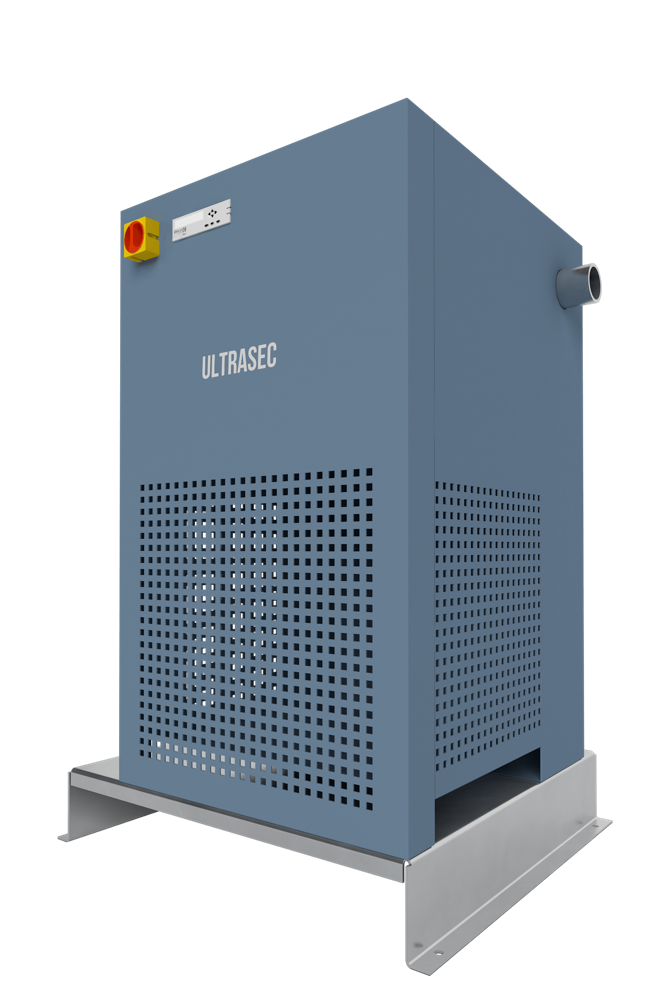
Seven questions before you buy.
Ask every compressed air dryer manufacturer the same seven questions, in writing, and compare the answers side by side.
| Check | What to ask the manufacturer |
|---|---|
| 1. Dew point | What pressure dew point does the use need, and at what pressure is it stated? |
| 2. Flow and inlet | What flow, at what inlet temperature and pressure, in the worst case? |
| 3. Dryer type | Refrigerated or adsorption? |
| 4. Pressure drop | What is the pressure drop, and what does each extra bar cost? |
| 5. Filters | Which filters go before and after the dryer? |
| 6. Site | How do heat, freezing and the receiver position change the choice? |
| 7. Drains and upkeep | How is condensate drained, and how is the dryer maintained? |
The dew point you need.
Start from the dew point your equipment and end use need, and no lower.
The US Department of Energy sourcebook (2016) says dryer selection should be based on the required pressure dew point and the estimated cost of operation, and that drying beyond the required pressure dew point results in unnecessary energy and costs.
A dew point depends on pressure: the sourcebook explains that compressing air makes the dew point at atmospheric conditions differ from the dew point at higher pressures, so ask at what pressure a dew point is stated.
The Compressed Air Challenge Fact Sheet #11 (May 2026) says refrigerant-type dryers are acceptable for many applications, and the US Department of Energy sourcebook (2016) says that where a pressure dew point of less than 35 °F (1.7 °C) is required, a refrigerant-type dryer cannot be used.
- ULTRADRY
- Pressure dew point range of −40 °C to −70 °C
- ULTRASEC
- Hot gas bypass valve designed to provide a constant dew point
Flow and the worst-case inlet.
Give the manufacturer the air flow, the working pressure and the inlet temperature in the worst case.
The US Department of Energy sourcebook (2016) says dryer ratings usually are based on standard inlet conditions, and that an increase in inlet temperature or a decrease in inlet pressure reduces the dryer’s rated capacity. Most manufacturers provide correction factors for this, and dryers must be sized for the worst case operating inlet temperature, system pressure and ambient temperature.
- ULTRADRY table
- Given at a compressed air inlet temperature of +35 °C, 7 bar g and a pressure dew point of −40 °C
- ULTRADRY pressure
- 4 to 16 bar g
- ULTRASEC
- Models USL 1 to USL 39, from 21 to 17,664 m³/h
Refrigerated or adsorption.
Cool the air until the water condenses, or let a desiccant hold on to it. Which one depends on how dry the air must be.
A refrigerated dryer cools the compressed air so that its moisture condenses and is drained. An adsorption dryer passes the air through a desiccant that adsorbs the water vapour; the ULTRADRY reaches −40 °C to −70 °C.
The US Department of Energy sourcebook (2016) says the refrigerant dryer is the most commonly used dryer in the industry, with relatively low initial and operating costs, and that twin-tower desiccant dryers are the most effective in removing moisture from the air.
- ULTRASEC
- Refrigeration dryer with an aluminium heat exchanger for inlet air up to 70 °C, and the ULTRASEC-HT up to 100 °C
- ULTRADRY
- Adsorption dryer with the desiccant in cartridges that are easy to replace
Pressure drop and energy.
Compare pressure drop: the dryer and its filters add to the pressure the compressor has to deliver.
The US Department of Energy sourcebook (2016) says the pressure drop through a compressed air dryer is typically 3 to 5 psi and should be taken into account in system requirements. Compressed Air Challenge Fact Sheet #11 (May 2026) says the complete drying, filtration and distribution system should be sized and arranged so that the total pressure drop from the compressor to the points of use is much less than 10% of the compressor discharge pressure.
The ULTRASEC datasheet estimates about 7% of the installed motor power for each extra bar on the compressor, so every bar lost in treatment counts.
- ULTRASEC
- Low pressure drop even with load variations
- ULTRADRY
- A control of the actual water load adjusts the adsorption cycles
The filters around the dryer.
Choose the filters with the dryer: a coalescing filter before a desiccant dryer and a particulate filter after it.
Compressed Air Challenge Fact Sheet #11 (May 2026) says a particulate filter is recommended after a desiccant-type dryer to remove desiccant fines, and a coalescing-type filter before it to prevent fouling of the desiccant bed. It adds that filtration only to the level required by each compressed air application will minimize pressure drop and energy consumption.
ISO 12500 is the ISO series of test methods for compressed air filters, in four parts: oil aerosols, oil vapours, particulates and water, according to iso.org.
- ULTRADRY inlet
- Coalescing filter
- ULTRADRY outlet
- Dust filter
- Filter elements
- Microprocessor control tells the operator when it is time to replace them
Heat, freezing and the receiver.
Heat, freezing and the position of the air receiver all change what a dryer can do on site.
The US Department of Energy sourcebook (2016) says an increase in inlet temperature reduces a dryer’s rated capacity, so size for the worst case.
The US Department of Energy sourcebook (2016) says refrigerant-type dryers are not recommended in sub-freezing ambient temperatures, because the moisture in the compressed air can freeze and damage the dryer.
The sources differ on where the air receiver usually sits. The sourcebook describes two points of view, before or after the dryer, and says one way to resolve it is to install storage both upstream and downstream, with the downstream storage equal to or larger than the upstream storage.
- ULTRASEC inlet
- Up to 70 °C, and the ULTRASEC-HT up to 100 °C
- ULTRADRY inlet
- +5 °C to +50 °C
These are compressed air inlet temperatures, not ambient temperatures.
Drains and upkeep.
Ask how condensate is drained and how the dryer is kept in service.
Compressed Air Challenge Fact Sheet #5 (May 2026) says a drain trap stuck in the closed position will cause condensate to back up and be carried downstream, that traps need to be inspected periodically, and that dryers, aftercoolers and separators should all be cleaned and maintained per the manufacturer’s specifications.
Fact Sheet #11 says leaving automatic condensate traps partially open at all times wastes substantial energy and should never be undertaken.
- ULTRASEC
- Condensate drain with electronic control, and a control panel with digital temperature indicator
- ULTRADRY
- Desiccant in cartridges that are easy to replace, and a display of operating status, faults and maintenance intervals
- ULTRADRY pack
- Pre-filter, downstream filter and electronic condensate trap assembled together
Where the dryers are used.
Made in Portugal
Ultra Controlo makes two kinds of compressed air dryer, the ULTRASEC refrigerated dryer and the ULTRADRY adsorption dryer. Both are designed, assembled and tested in Portugal.
In the ULTRAAR SCA plant
The ULTRAAR SCA datasheet lists an ULTRASEC high efficiency refrigeration dryer among the system components of the plant.
In the ACIH system
The ACIH industrial hospital compressed air system datasheet says it can be equipped with adsorption dryers for dew points of −20 °C or −40 °C and even with activated carbon filters.
Common questions about choosing a dryer.
Questions buyers ask us about compressed air dryers. More on the medical gas answers page.
How do I choose a compressed air dryer?
To choose a compressed air dryer, start from the pressure dew point your equipment needs, then check the flow in the worst-case inlet conditions, the type of dryer, the pressure drop, the filters, the site and the condensate drains.
Send the manufacturer the flow, the pressure, the inlet temperature and the dew point you need.
Which pressure dew point do I need?
The one your equipment and end use need, and no lower. The Compressed Air Challenge Fact Sheet #11 (May 2026) says refrigerant-type dryers are acceptable for many applications, and the US Department of Energy sourcebook (2016) says that where a pressure dew point of less than 35 °F (1.7 °C) is required, a refrigerant-type dryer cannot be used.
What is the difference between a refrigerated dryer and an adsorption dryer?
A refrigerated dryer cools the compressed air so that its moisture condenses and is drained. An adsorption dryer passes the air through a desiccant that adsorbs the water vapour; the ULTRADRY reaches −40 °C to −70 °C.
Can a refrigerated dryer take hot inlet air?
Up to its rated inlet temperature. The ULTRASEC datasheet gives a maximum inlet temperature of 70 °C, or 100 °C for the ULTRASEC-HT. The US Department of Energy sourcebook (2016) says an increase in inlet temperature reduces a dryer’s rated capacity, so size for the worst case.
Does a refrigerated dryer work in freezing conditions?
The US Department of Energy sourcebook (2016) says refrigerant-type dryers are not recommended in sub-freezing ambient temperatures, because the moisture in the compressed air can freeze and damage the dryer.
Is Ultra Controlo the manufacturer of its dryers?
Ultra Controlo makes two kinds of compressed air dryer, the ULTRASEC refrigerated dryer and the ULTRADRY adsorption dryer. Both are designed, assembled and tested in Portugal.
Ready to discuss a compressed air dryer?
Send us the flow, the pressure, the inlet temperature and the dew point you need. Our engineering team replies with the dryer that fits.