The US Department of Energy lists tool powering, clamping, controls and actuators, forming, mould press powering and injection moulding as compressed air uses in rubber and plastics, and in thermoforming a vacuum draws the heated sheet onto the mould, as US patent 8,371,837 (2013) describes. Ultra Controlo supplies ULTRASEC dryers and ULTRAK carbon towers, which its brochure lists for plastics, and the vacuum pumps of partner brand Elmo Rietschle.
Running cost of a venturi vacuum generator vs a vacuum pump, up to, per DOE
02
150mbar (abs.)
Standard ultimate vacuum of the V-VTN, listed for thermoforming, per Elmo Rietschle
03
+3°C
Stable dew point of the ULTRASEC refrigeration dryer, per catalogue
04
<0.003mg/m³
Oil vapour after an ULTRAK carbon tower, per catalogue
Where air and vacuum go
Five jobs for air and vacuum in a plastics plant.
The US Department of Energy lists the compressed air uses; patents and a UK government guide describe the vacuum in thermoforming and for polymer handling.
Moulding
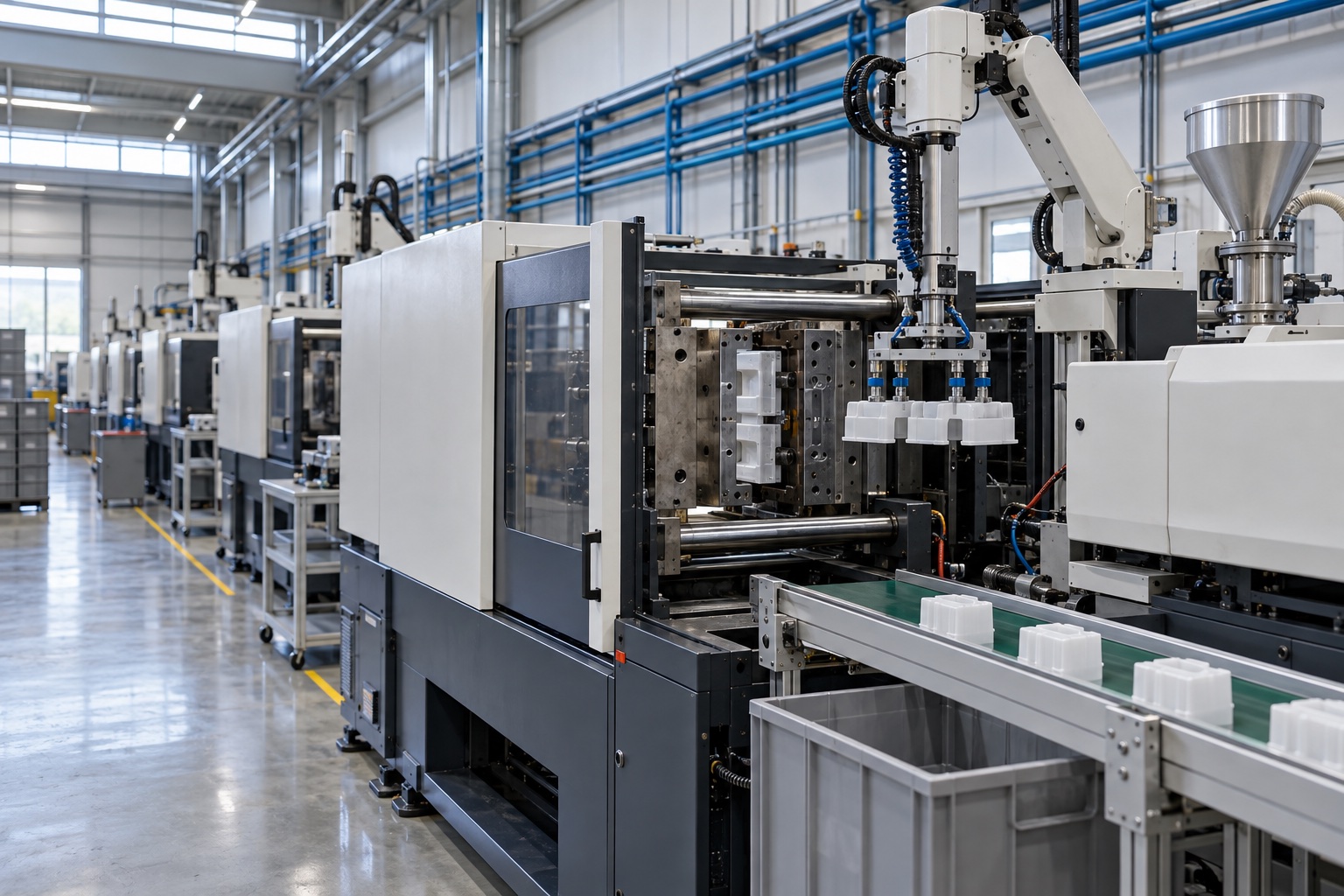
Injection moulding and mould presses
Injection moulding and mould press powering, listed by the DOE for rubber and plastics.
Machines
Clamping, tools and actuators
Clamping, tool powering, and controls and actuators on the line, also listed by the DOE.
Forming
Thermoforming vacuum
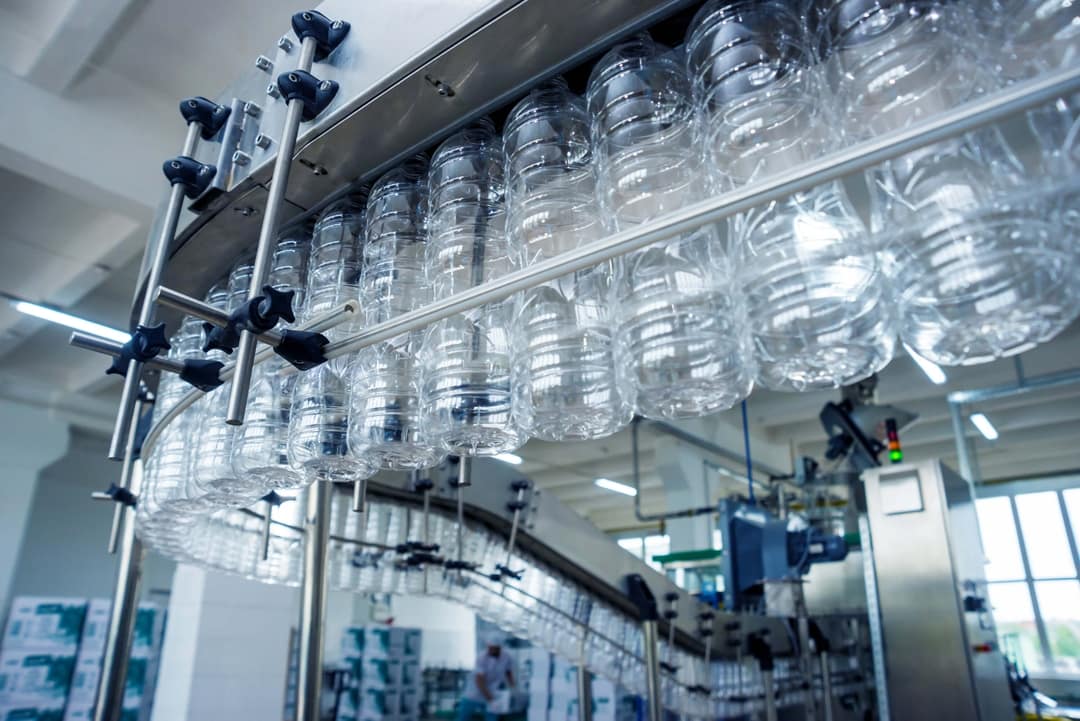
The heated thermoplastic sheet is drawn onto the shaped mould by a vacuum through perforations in the mould surface, as US patent 8,371,837 (2013) describes.
Forming
Vacuum and pressure tanks
In US patent 9,364,992 (2016), a vacuum tank with a vacuum pump reduces decompression loss, and compressed air from a pressurisation tank presses the sheet onto the base material.
Materials
Moving granules
A 1999 UK government guide warned that blasting granules with compressed air may be very costly, and suggested feeding small quantities of polymer through a central vacuum system to keep them dry.
Sources: US DOE and Compressed Air Challenge, Improving Compressed Air System Performance: A Sourcebook for Industry, third edition (2016), Table 1.1; US patents 8,371,837 B2 (2013) and 9,364,992 B2 (2016); UK Energy Efficiency Best Practice Programme, Good Practice Guide 292, Energy in plastics processing (1999).
Air quality and pressure
How clean, how dry, what pressure.
None of these sources gives one rule for a moulding plant. They give the questions to ask.
Quality level
Plant, instrument or process air
The DOE sourcebook sorts compressed air into plant air, instrument air, process air and breathing air, and says industrial applications typically use one of the first three; the higher the quality, the more the air costs to produce.
Source: DOE sourcebook (2016), Fact Sheet 1.
Oil
Lubricant-free or treated
Lubricant-free air can come from lubricant-free compressors or from lubricant-injected compressors with additional separation and filtration; the choice should weigh the risk and cost of product contamination.
Source: DOE sourcebook (2016), Fact Sheet 1.
Pressure
No higher than needed
A 1999 UK guide for plastics processors told them to check that compressed air is not generated at a higher pressure than required, and to treat the bulk of the air to the minimum quality necessary.
Source: UK Good Practice Guide 292 (1999).
Sources: US DOE and Compressed Air Challenge sourcebook (2016), Fact Sheet 1; UK Energy Efficiency Best Practice Programme, Good Practice Guide 292 (1999).
What we supply
For the compressor room and the forming line.
Equipment that the Ultra Controlo brochure and its partner makers tie to plastics, thermoforming and moulding.
Sources: Ultra Controlo Industrial 2026 catalogue, pp. 11, 13, 17 and 19; Ultra Controlo industrial brochure; Elmo Rietschle V-VTN, V-VCS and L-BV2 pages; Circutec product finder (T-1001 to T-2001); Speck Pumpen, UniVac datasheet (04/2016).
One supplier. Made and serviced in Portugal.
Ultra Controlo is a Portuguese manufacturer of compressed air, vacuum and technical gas systems, with 40 years of experience. We design, assemble and test our own compressors, dryers and carbon towers in Portugal, and supply and service five partner brands.
Our own lines
ULTRASCREW compressors, ULTRASEC and ULTRADRY dryers and ULTRAK activated carbon towers.
Preventive and corrective maintenance, original spare parts and emergency support, by our own team.
Source: Ultra Controlo Industrial 2026 catalogue, pp. 3, 10, 16, 17 and 22.
Questions
Plastics: questions and answers.
What is compressed air used for in plastics plants?
For rubber and plastics, the US Department of Energy sourcebook (2016) lists tool powering, clamping, controls and actuators, forming, mould press powering and injection moulding as example uses of compressed air.
Does an injection moulding plant need oil-free compressed air?
The DOE sourcebook (2016) sets no general rule for moulding plants; it says the choice between a lubricant-free and a lubricant-injected compressor should weigh the specific end use, including the risk and cost of product contamination.
Why does a thermoforming machine use a vacuum tank?
In the device of US patent 9,364,992 (2016), a vacuum tank with a vacuum pump performs the vacuum suction during moulding, and the patent says that providing the tank reduces the decompression loss.
Should compressed air venturis make the vacuum?
The DOE sourcebook (2016) says that, as a rule in a base load situation, vacuum generators running less than 30 percent of the time are more economical than a central vacuum system; otherwise they are less effective at pulling a vacuum and cost as much as five times more to operate than a dedicated vacuum pump.
Should compressed air be used to convey plastic granules?
A 1999 UK government guide for plastics processors warned that using compressed air as a blast for conveying granules or product may be very costly, and suggested feeding small quantities of polymer through a central vacuum system to keep it dry.