Industry Solutions

Industry · Food and beverage

Food and beverage. Compressed air that touches food, and the rest.

The US Department of Energy lists dehydration, bottling, controls and actuators, conveying, spraying coatings, cleaning and vacuum packing as food industry uses of compressed air; where air touches food, the US rule 21 CFR 117.40(g) requires it to be treated so that food is not contaminated. Ultra Controlo distributes and services Gardner Denver oil-free compressors, ISO Class 0, and makes ULTRASEC and ULTRADRY dryers and ULTRAK carbon towers, which its brochure lists for the food industry.

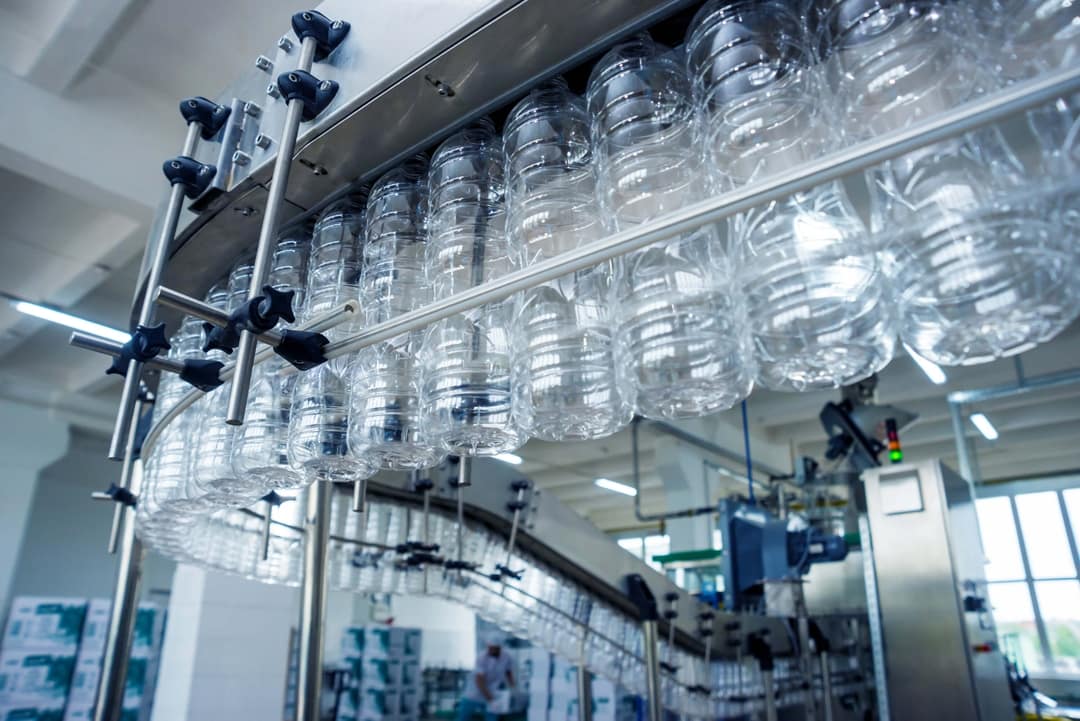
Stainless steel filling line with bottles in a beverage plant
01
Class 0
ISO 8573-1 class of Gardner Denver oil-free screw air, per our catalogue
02
−70°C
Lowest ULTRADRY pressure dew point, per our catalogue
03
0.003mg/m³
ULTRAK removes oil vapour to below this, per our catalogue
04
0.01µm
Particle removal of Gardner Denver sterile filters, per the maker
Where the air goes

Seven food plant uses, in six groups.

The US Department of Energy sourcebook lists these example uses of compressed air in the food industry.

Process

Dehydration

The first food industry use in the DOE table.

Lines

Bottling

Bottling lines, the second food industry use in the DOE table.

Automation

Controls and actuators

Valves, cylinders and actuators across the plant.

Handling

Conveying

Moving product and packaging between stations.

Process

Spraying coatings and cleaning

Two more food industry uses in the DOE table.

Packing

Vacuum packing

The last food use in the DOE table; see the packaging page for vacuum packaging.

Source: US Department of Energy and Compressed Air Challenge, Improving Compressed Air System Performance: A Sourcebook for Industry, third edition (2016), Table 1.1.

Air that touches food

The rule asks for a result, not a class.

Three sources frame the compressed air that comes into contact with food.

US rule

21 CFR 117.40(g)

Compressed air or other gases mechanically introduced into food or used to clean food-contact surfaces or equipment must be treated so that food is not contaminated with unlawful indirect food additives.

Source: eCFR, 21 CFR 117.40 Equipment and utensils, paragraph (g).
Quality level

Process air

The Compressed Air Challenge places food and pharmaceutical process air in its process air level, the third of four; the higher the quality, the more the air costs to produce.

Source: Compressed Air Challenge, Fact Sheet #1 (May 2026).

Purity classes

ISO 8573-1:2010

Specifies purity classes of compressed air for particles, water and oil; ISO says it also identifies gaseous and microbiological contaminants, and ISO 8573-7:2003 is the test method for viable microbiological contaminants.

Source: ISO, iso.org.

21 CFR 117.40(g) does not name a purity class. Sources: eCFR; Compressed Air Challenge (2026); ISO.

One supplier. Made and serviced in Portugal.

Ultra Controlo is a Portuguese manufacturer of compressed air, vacuum and technical gas systems, with 40 years of experience. We design, assemble and test our own compressors, dryers and carbon towers in Portugal, and supply and service five partner brands.

Our own lines

ULTRASCREW compressors, ULTRASEC and ULTRADRY dryers and ULTRAK activated carbon towers.

Five partner brands

Gardner Denver, Elmo Rietschle, Thomas, Speck Pumpen (Circutec) and Speck Triplex.

UltraCare, 24/7

Preventive and corrective maintenance, original spare parts and emergency support, by our own team.

Source: Ultra Controlo Industrial 2026 catalogue, pp. 3, 10, 16, 17 and 22.

Questions

Food and beverage: questions and answers.

What is compressed air used for in food plants?

The US Department of Energy sourcebook (2016), Table 1.1, lists dehydration, bottling, controls and actuators, conveying, spraying coatings, cleaning and vacuum packing as example compressed air uses in the food industry.

Does the US rule set a purity class for compressed air in food plants?

No. 21 CFR 117.40(g) requires compressed air introduced into food or used to clean food-contact surfaces to be treated so that food is not contaminated with unlawful indirect food additives, without naming a purity class.

Does food production need an oil-free compressor?

Not necessarily: the Compressed Air Challenge Fact Sheet #1 (May 2026) says lubricant-free air can also be produced with lubricant-injected compressors that have additional separation and filtration equipment, weighed against the risk and cost of product contamination.

Which ISO standard specifies compressed air purity?

ISO 8573-1:2010 specifies purity classes of compressed air for particles, water and oil; ISO lists it as current, last confirmed in 2017 and to be revised, and ISO 8573-7:2003 is the test method for viable microbiological contaminants.

What does Ultra Controlo supply for food plants?

Its Industrial 2026 catalogue lists Gardner Denver oil-free screw compressors for contaminant-free air, ISO Class 0, for food (p. 12) and the ULTRAK tower for oil vapour removal to below 0.003 mg/m³ (p. 19); its brochure lists ULTRASEC and ULTRADRY dryers for food.

Tell us about your line.

Where the air touches the product, the pressure, the flow and the hours per day. We reply with the equipment that fits.