Compressor maintenance in Portugal.
Maintaining a screw compressor means looking after the whole chain: the compressor, its lubricant and filters, the dryers and filters downstream, the drains and the leaks. This page sets out what public guidance says, what a maintenance contract should settle, and what UltraCare, the technical support programme of Ultra Controlo, covers in Portugal.
Six questions before you sign.
Ask every provider the same six questions, in writing, and compare the answers side by side.
| Check | What to ask the provider |
|---|---|
| 1. Scope | Which parts of the compressor and its drive does the work cover, and to whose specification? |
| 2. Treatment, drains and leaks | Are the dryers, filters, condensate drains and leaks in the scope? |
| 3. Preventive and corrective | Which work is scheduled, which follows a fault, and what does the price include? |
| 4. The contract | What does the agreement say about schedule, records and emergencies? |
| 5. Parts | Where do the parts and the lubricant come from? |
| 6. Who does the work | Whose technicians, trained by whom, for which brands? |
What the work covers.
Ask for the scope in writing, down to the lubricant, the filters, the belts and the drive.
The Compressed Air Challenge (Fact Sheet #5, May 2026) says industrial compressed air systems require periodic maintenance to operate at peak efficiency and minimise unscheduled downtime, and that all equipment should be maintained in accordance with the manufacturers’ specifications.
It also says that in many cases it makes sense, from efficiency and economic standpoints, to maintain equipment more frequently than the intervals manufacturers recommend, which are primarily designed to protect equipment.
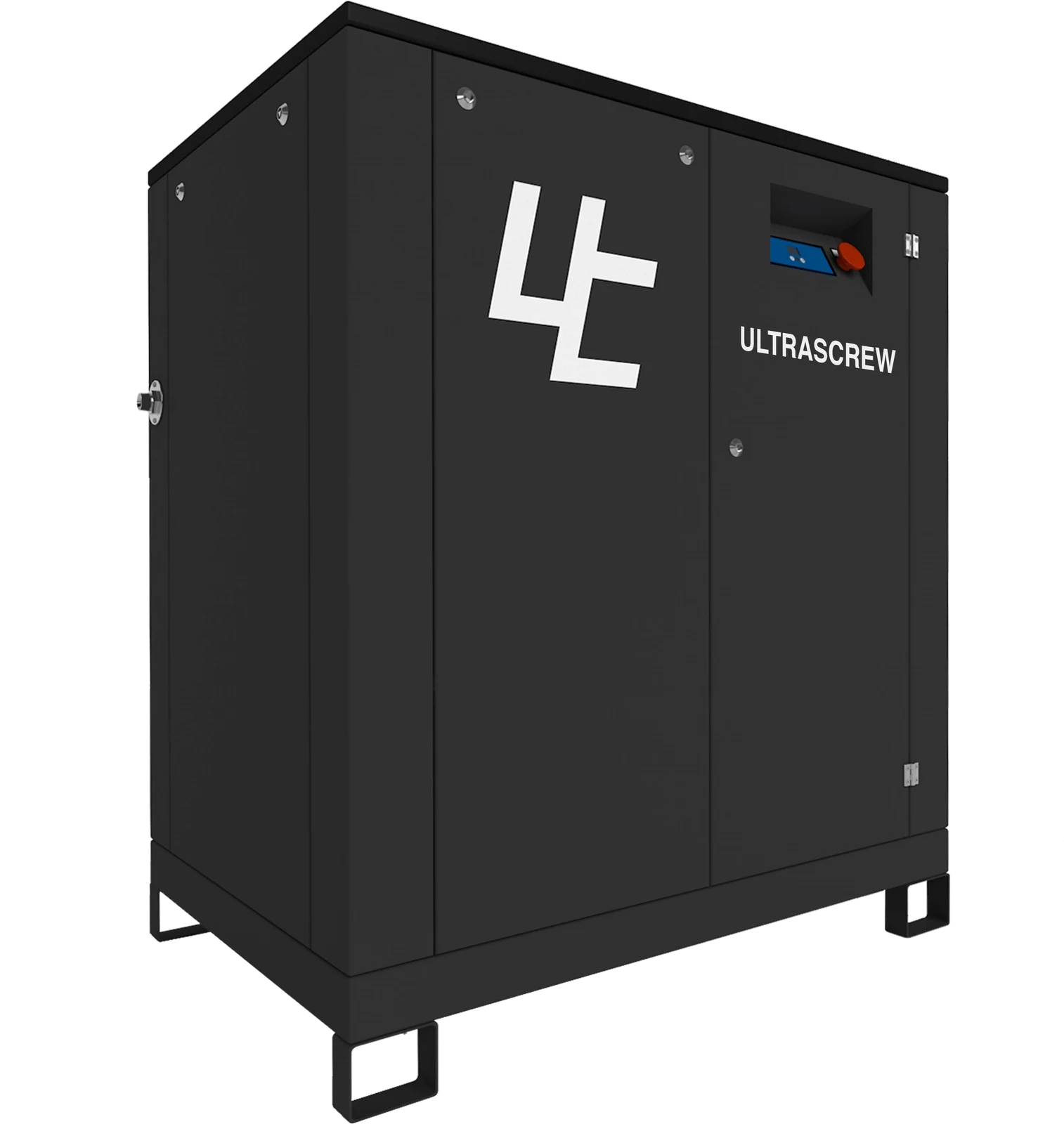
ULTRASCREW compressors are supplied by Ultra Controlo. The fixed speed ULTRASCREW is presented with a compact footprint with easy servicing.
The ULTRACECO ESW datasheet says the first maintenance is only at 10,000 hours and that the belt can be changed in 5 minutes, without disassembling the compressor. On the ULTRACECO SCA the filter elements are replaced by wing nut.
These are design statements from the datasheets, not service schedules: the manufacturer’s manual for the unit sets its schedule.
What the US Department of Energy lists.
Typical minimum routine maintenance for a lubricant-injected rotary compressor, from the sourcebook Improving Compressed Air System Performance (third edition, 2016, p. 55). The manufacturer’s manual comes first, and time frames may need to be shortened in harsher environments.
| Interval | What the sourcebook lists |
|---|---|
| Daily | Monitor all gauges and indicators; check the lubricant level and top off; check for lubricant leaks and for unusual noise or vibration; drain water from the air/lubricant reservoir; drain the control line filter |
| Monthly | Service the air filter as needed, more often in dusty conditions; check the drive motor amps at full capacity and design pressure; check the operation of all controls and of the lubricant scavenger and return system |
| Every 6 months or 1,000 to 2,000 hours | Take a lubricant sample and have it analysed; change the lubricant filter |
| Annually | Inspect the package and check all bolts; change the air/lubricant separator, the lubricant and the air filter; lubricate the motors; check the safety shutdown system |
What maintenance does an oil-injected screw compressor need?
A different list, and the manufacturer’s hands.
The sourcebook calls routine maintenance of a lubricant-free rotary screw compressor relatively minimal. After the first 50 hours of operation, the essential readings of operating conditions should be verified. Every 3,000 hours its list includes checking or changing the lubricant charge and filter element and the air filter element, and checking or cleaning the condensate drain valve (p. 56).
It adds that work on the compressor stages and gearbox must be conducted by the manufacturer’s personnel only, and that any work done by others can void the manufacturer’s warranty. Ask which of these jobs the provider is trained and equipped to do.
Treatment, drains and leaks.
Ask whether the dryers, the filters, the condensate drains and the leak checks are part of the work.
The Department of Energy sourcebook (p. 53) says fouled compressed air treatment equipment can cause excessive energy consumption as well as poor-quality air that can damage other equipment, and that dryers, aftercoolers and separators should be cleaned and maintained per the manufacturer’s specifications.
The Compressed Air Challenge says to replace the particulate and lubricant removal elements of air line filters when the pressure drop exceeds 2 to 3 psid, and to inspect all elements at least annually. An automatic drain trap stuck open leaks compressed air; one stuck closed lets condensate back up and be carried downstream.
On leaks, the Department of Energy sourcebook (p. 28) says leaks can be a significant source of wasted energy, sometimes wasting 20 to 30% of a compressor’s output, and the Carbon Trust (25 January 2012) calls reducing air leaks the single most important energy saving measure for most businesses.
When should compressed air line filter elements be replaced?
ULTRASEC keeps a constant dew point with a hot gas bypass valve and drains the condensate with an electronically controlled drain.
ULTRADRY adsorbs the water vapour, to a pressure dew point between −40 °C and −70 °C, and its desiccant is in replaceable cartridges. ULTRADRY has a coalescing filter at its inlet; ULTRAK needs one upstream.
Preventive and corrective.
Preventive work is scheduled; corrective work follows a fault. Ask which the price covers.
The Compressed Air Challenge says inadequate maintenance can have a significant impact on energy consumption through lower compression efficiency, air leakage or pressure variability, and can lead to high operating temperatures, poor moisture control and excessive contamination. Most problems are minor and can be corrected by simple adjustments, cleaning, part replacement or the elimination of adverse conditions.
The Department of Energy sourcebook (p. 51) says the combination of control panel data, frequent inspections and log sheets is needed to avoid unscheduled system shutdowns and to apply the principles of preventive and predictive maintenance.
UltraCare, our technical support programme, covers preventive and corrective maintenance, original spare parts and emergency support for Ultra Controlo equipment and partner brands.
Our own team for diagnosis, repair and maintenance on site.
What a maintenance contract should say.
Eight topics to settle before you sign, and the public guidance behind seven of them. Sources: US Department of Energy sourcebook (third edition, 2016) and Compressed Air Challenge Fact Sheet #5 (May 2026).
| Topic | What the contract should say | Where the guidance says it |
|---|---|---|
| Equipment covered | Every compressor, dryer, filter and receiver in the plant room, listed | The sourcebook says observations and meter readings should be recorded for compressors, dryers, filters and any components in the compressor plant (p. 51) |
| Schedule | The intervals and what they are based on: running hours, calendar dates, or both | Both sources say to follow the manufacturer’s schedules strictly; the sourcebook’s lists are by hours and by period (pp. 51 and 55) |
| Who does what | Which work the provider does, and which stays with your own staff | Stages and gearbox of a lubricant-free screw compressor: manufacturer’s personnel only (p. 56) |
| Leaks and efficiency | Whether leak checks and a power, pressure and flow baseline are included | Leak detection and repair is an important part of any maintenance programme (p. 53); track power, pressure and flow (Fact Sheet #5) |
| Records | A report after each visit with the date and the parts replaced or serviced | The sourcebook recommends recording the dates of all maintenance and repairs, with a list of parts replaced or serviced (p. 51) |
| Responsibility | One named person on your side for the schedule and the paperwork | One person should be responsible for maintenance being performed properly, on schedule and documented (p. 53) |
| Parts and lubricant | Which parts and lubricant are used, who supplies them, and whether they are in the price | Only a lubricant meeting the manufacturer’s specifications should be used (Fact Sheet #5) |
| Emergencies | What is included in an emergency visit, and the response time in writing | A question to put to any provider |
Scheduled plans, adapted to each installation.
The Industrial 2026 catalogue lists maintenance contracts among its services: scheduled preventive maintenance plans, adapted to each installation.
Where the parts come from.
Ask which parts and which lubricant the manufacturer specifies, and who supplies them.
The Compressed Air Challenge says only a lubricant meeting the manufacturer’s specifications should be used, that the compressor lubricant and lubricant filter need to be changed per the manufacturer’s specification, and that lubricant can become corrosive and degrade both the equipment and system efficiency.
It also says inlet filters should be maintained at least per the manufacturer’s specifications, taking into account the level of contaminants in the facility’s air.
Genuine parts in stock. Original components in stock, to keep downtime to a minimum.
Every Ultra Controlo partnership includes certification, technical training, a stock of genuine parts and UltraCare, our technical support programme.
Email leads@ultra-controlo.com with the brand, the model and the part number if you have it.
Who does the work.
Ask whose technicians will come, who trained them and which brands they cover.
The Department of Energy sourcebook (p. 56) says work on the compressor stages and gearbox of a lubricant-free screw compressor must be conducted by the manufacturer’s personnel only. Ask any provider where its technicians were trained, and on which equipment.
Ultra Controlo distributes and services Gardner Denver, Elmo Rietschle, Thomas, Speck Pumpen (Circutec) and Speck Triplex in Portugal.
Our technicians are certified and factory-trained, and each partnership includes technical training.
Ultra Controlo distributes and services Gardner Denver compressors and compressed air filters, and its UltraCare programme covers Ultra Controlo equipment and partner brands.
Ultra Controlo equipment and five partner brands.
UltraCare covers preventive and corrective maintenance, original spare parts and emergency support for Ultra Controlo equipment and partner brands. Six services, as our catalogue lists them: new pumps, spare parts, technical assistance, maintenance contracts, retrofit and stock.
ULTRASCREW
Oil-injected screw compressors, supplied by Ultra Controlo.
View ULTRASCREWAir treatment units
ULTRASEC and ULTRADRY dryers, ULTRAK carbon towers, each with its datasheet and its spare parts.
View Air treatment unitsGardner Denver
Screw compressors and integrated systems for heavy industry, oil-free or oil-lubricated, at fixed or variable speed.
View Gardner DenverElmo Rietschle
Vacuum pumps and blowers for critical processes, in vane, claw, screw and side channel technologies.
View Elmo RietschleThomas
Miniature pumps for OEM equipment, for analytical, laboratory and medical applications.
View ThomasSpeck Pumpen (Circutec)
Peripheral, side channel and centrifugal pumps for demanding hydraulic applications.
View Speck Pumpen (Circutec)Speck Triplex
High-pressure plunger pumps for industrial cleaning, washdown and process engineering.
View Speck TriplexQuestions buyers ask about compressor maintenance.
Questions about maintaining screw compressors and their air treatment in Portugal.
What does compressor maintenance include?
The Compressed Air Challenge (Fact Sheet #5, May 2026) says compressed air system maintenance is similar to that performed on cars: filters and fluids are replaced, cooling water is inspected, belts are adjusted, and leaks are identified and repaired.
Its basic maintenance checklist includes the inlet filter, the lubricant level and lubricant filter, the air/lubricant separator of lubricant-injected rotary screw compressors, belts, operating temperature, drain traps, air line filters and leaks.
How often does a screw compressor need servicing?
The manufacturer’s manual sets it. The US Department of Energy sourcebook (third edition, 2016, p. 55) lists typical minimums for a lubricant-injected rotary compressor: a lubricant sample and a new lubricant filter every 6 months or every 1,000 to 2,000 hours, and a new air/lubricant separator, lubricant and air filter annually.
Of the ULTRASCREW and ULTRACECO SCA, SCR and ESW datasheets, only the ULTRACECO ESW gives a service interval: its first maintenance is at 10,000 hours.
What is the difference between preventive and corrective maintenance?
Preventive maintenance is scheduled work, such as changing filters and lubricant and adjusting belts, done before a part fails. Corrective maintenance follows a fault.
The Department of Energy sourcebook says periodic maintenance is needed to operate at peak efficiency and minimise unscheduled downtime, and that frequent inspections, control panel data and log sheets are needed to avoid unscheduled shutdowns.
What should a compressor maintenance contract say?
At least the equipment it covers, the schedule and the basis for it (running hours or calendar dates), who does which work, which parts and lubricant are used and who supplies them, what is recorded after each visit, and what happens in an emergency.
The Department of Energy sourcebook recommends recording the dates of all maintenance and repairs and a list of the parts replaced or serviced, and giving one person responsibility for seeing that maintenance is performed on schedule and documented.
Does it matter whether spare parts are genuine?
The Compressed Air Challenge says only a lubricant meeting the manufacturer’s specifications should be used, and that filters should be maintained at least per the manufacturer’s specifications. For a lubricant-free screw compressor the Department of Energy sourcebook says work on the compressor stages and gearbox must be conducted by the manufacturer’s personnel only, and that other work can void the warranty.
Ultra Controlo keeps a stock of genuine parts, and UltraCare supplies original spare parts for Ultra Controlo equipment and partner brands.
Does Ultra Controlo offer maintenance contracts in Portugal?
Yes. The Industrial 2026 catalogue lists maintenance contracts among its services: scheduled preventive maintenance plans, adapted to each installation (p. 24). Contract terms, such as duration and what each visit includes, are not published, so ask in writing.
Which brands does UltraCare cover?
UltraCare covers Ultra Controlo equipment and the partner brands: Gardner Denver, Elmo Rietschle, Thomas, Speck Pumpen (Circutec) and Speck Triplex.
How do I ask for service or a quote?
Use the contact page, email leads@ultra-controlo.com or call +351 219 154 350 with the brand, the model, the site and the fault, or the maintenance you need.
Ready to discuss maintenance for your plant?
Send us the brand, the model and the site, or the maintenance you need. Our engineering team replies with a quote.