How to choose compressed air filters.
To choose compressed air filters, start from the ISO 8573-1 purity class the use needs, then check the order of the filters in the line, the pressure drop and its energy cost, the flow and pressure, the element changes, the condensate drains and whether oil-free air is the better answer.
Seven questions before you buy.
Ask every compressed air filter supplier the same seven questions, in writing, and compare the answers side by side. The table of filter types follows the checks.
| Check | What to ask the supplier |
|---|---|
| 1. Purity class | Which ISO 8573-1 class does the use need for particles, water and oil? |
| 2. Order in the line | Which filters go before and after the dryer, and where does the carbon go? |
| 3. Pressure drop | What is the pressure drop when new and when loaded, and what does it cost in energy? |
| 4. Flow and pressure | What flow, at what pressure and temperature, in the worst case? |
| 5. Elements | How often are the elements changed, and what tells you when? |
| 6. Condensate drains | How is condensate drained from each separator and filter? |
| 7. Oil-free air | When is an oil-free compressor a better answer than a filter? |
The ISO 8573-1 class the use needs.
Start from the air quality the process needs, written as an ISO 8573-1 purity class.
ISO 8573-1:2010 (Compressed air: contaminants and purity classes) gives compressed air one purity class for particles, one for water and one for oil, written in that order, such as [2:4:2]. Tell the supplier the three numbers your process needs.
Each number is a different job. Compressed Air Challenge Fact Sheet #11 (May 2026) says particulate filters remove solid particles, coalescing filters remove lubricant and moisture, and adsorbent filters handle vaporous contaminants.
ISO 12500 is the ISO series of test methods for compressed air filters, in four parts: oil aerosols, oil vapours, particulates and water, according to iso.org.
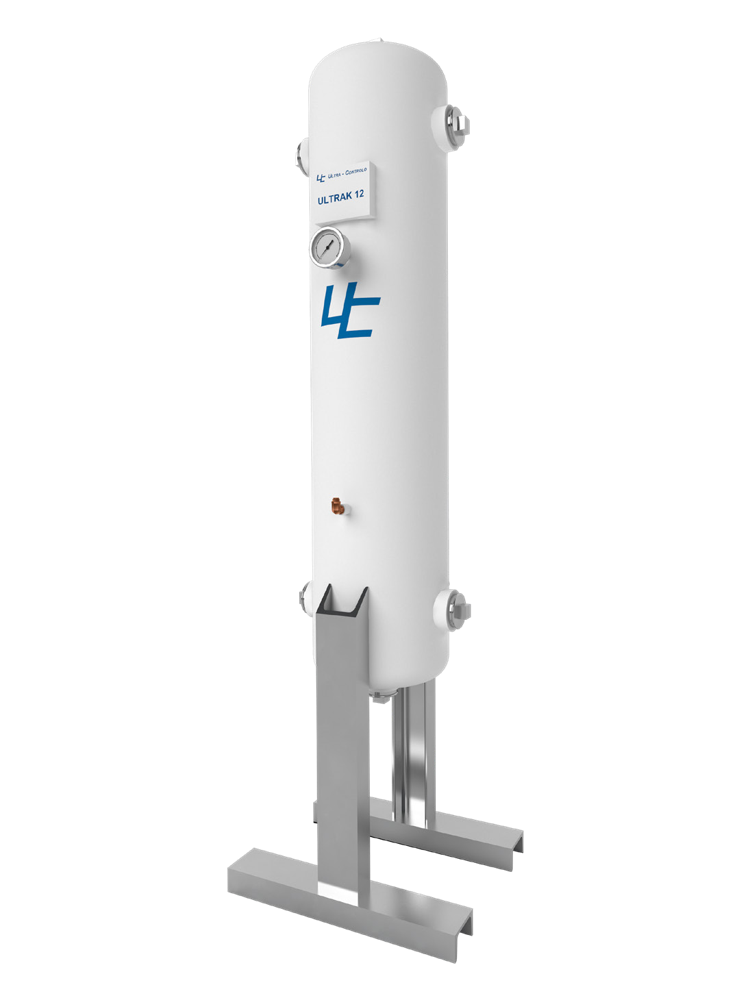
- ULTRAK oil class
- ISO 8573-1 quality class 0/1 for oils, as its datasheet prints it
- ULTRAK solids and water
- No class given: the datasheet leaves them blank
- ULTRAK oil vapour
- Nominal residual content below 0.003 mg/m³
- Gardner Denver filters
- The manufacturer says its filter range provides air as defined by ISO 8573.1:2010 and is certified by a third party under ISO 12500-1
The order of the filters.
Choose the filters with the dryer: a coalescing filter before a desiccant dryer and a particulate filter after it.
Compressed Air Challenge Fact Sheet #11 (May 2026) says a particulate filter is recommended after a desiccant-type dryer to remove desiccant fines, and a coalescing-type filter before it to prevent fouling of the desiccant bed.
Gardner Denver says its GDWS water separators remove bulk condensed water and liquid oil and are used to protect coalescing filters from bulk liquid contamination.
Activated carbon is a separate stage for oil vapour: the ULTRAK datasheet requires a coalescing filter upstream and recommends a 1 µm dust filter downstream. For a refrigerated dryer, and for where the carbon stage sits in relation to the dryer, ask the manufacturer in writing which filters go on each side.
- ULTRADRY inlet
- Coalescing filter
- ULTRADRY outlet
- Dust filter
- ULTRAK
- Coalescing filter upstream, and a 1 µm dust filter recommended downstream
- Gardner Denver
- GDWS water separators and GDF filters, supplied and serviced in Portugal
From compressor to point of use.
Five stages, each taking out one thing. Which of them you need depends on the class the air must reach.
Water separator
Removes bulk condensed water and liquid oil, and protects the coalescing filters downstream.
Coalescing filter
Removes lubricant and moisture. It goes before a desiccant dryer, to protect the desiccant bed.
Dryer
Refrigerated or adsorption, chosen for the dew point. Read our guide to choosing a compressed air dryer.
Particulate filter
Goes after a desiccant dryer, to remove desiccant fines.
Activated carbon
Where oil vapour matters. The ULTRAK needs a coalescing filter upstream, and its datasheet recommends a dust filter downstream.
Pressure drop and energy.
Compare pressure drop: the dryer and its filters add to the pressure the compressor has to deliver.
Compressed Air Challenge Fact Sheet #4 (May 2026) says that on the supply side air/lubricant separators, aftercoolers, moisture separators, dryers and filters are the main items causing significant pressure drops, and that when selecting filters you should remember that they will get dirty, so dirt loading is also an important selection criterion.
It adds that the maximum pressure drop occurs when the flow rate and temperature are highest, and that the manufacturer of each component should be asked for pressure drop information under those conditions.
The same fact sheet says the pressure rise from resistance to flow can increase the compressor drive energy by 1% of the connected power for each 2 psi (about 0.14 bar) of differential. The US Department of Energy sourcebook (third edition, 2016) gives an example: if a regulator is set at 85 psig and an upstream filter has a pressure drop of 20 psi, the system upstream has to maintain at least 105 psig.
Compressed Air Challenge Fact Sheet #11 (May 2026) says the complete drying, filtration and distribution system should be sized and arranged so that the total pressure drop from the compressor to the points of use is much less than 10% of the compressor discharge pressure.
The ULTRASEC datasheet estimates about 7% of the installed motor power for each extra bar on the compressor, so every bar lost in treatment counts.
- ULTRAK
- Pressure drop of 20 mbar when new and dry
- ULTRASEC
- Low pressure drop even with load variations
- Gardner Denver filters
- The manufacturer says design features of its filter and water separator housings minimise the differential pressure
Flow and working pressure.
Give the manufacturer the air flow, the working pressure and the temperature in the worst case.
A filter’s flow rating is given at stated conditions. Gardner Denver states its GDF flow range of 0.5 to 516 m³/min as a flow rate at 20 °C and 7 bar.
So ask for the flow at your own pressure and temperature, and not only for the figure on the label. The pressure drop is greatest at the highest flow, so ask for it at that flow.
Ask also for the maximum working pressure and temperature of the housing, and check that they are above your own.
- ULTRAK flow
- 6 to 6,500 Nm³/h at 7 bar g and 20 °C, in 24 models
- ULTRAK pressure
- Operating pressure 16 bar
- ULTRAK temperature
- Operating temperature 1.5 to 45 °C
- Gardner Denver GDF
- 0.5 to 516 m³/min at 20 °C and 7 bar, up to 80 °C
Element changes and upkeep.
Ask how often the elements are changed, and what tells you when.
Compressed Air Challenge Fact Sheet #5 (May 2026) says to replace particulate and lubricant removal elements when the pressure drop exceeds 2 to 3 psid, and to inspect all elements at least annually regardless of the pressure drop indication.
Compressed Air Challenge Fact Sheet #11 (May 2026) words it differently: elements should be replaced as indicated by pressure differential, and at least annually, to minimise pressure drop and energy consumption.
The US Department of Energy sourcebook (third edition, 2016) says filter elements should be changed when the pressure drop approaches the maximum recommended by the manufacturer, and that in many cases the element change is dictated by energy losses.
- ULTRADRY
- Microprocessor control tells the operator when it is time to replace the filter elements
- Gardner Denver filters
- The manufacturer says a pressure drop indicator shows when the pressure drop is getting too high and element replacement is recommended
Condensate drains.
Ask how condensate is drained from every separator and filter, and how the drains are checked.
Compressed Air Challenge Fact Sheet #5 (May 2026) says a drain trap stuck in the closed position will cause condensate to back up and be carried downstream, and that one stuck open will leak compressed air, so traps need to be inspected periodically.
The US Department of Energy sourcebook (third edition, 2016) lists four ways to drain condensate. It says a timed solenoid valve may not stay open long enough, and opens even when little or no condensate is present, losing compressed air; zero air-loss traps with reservoirs are the fourth method.
Fact Sheet #11 says leaving automatic condensate traps partially open at all times wastes substantial energy and should never be undertaken.
- ULTRASEC
- Condensate drain with electronic control
- ULTRADRY pack
- Pre-filter, downstream filter and electronic condensate trap assembled together
- Gardner Denver GDWS
- Water separators for bulk condensed water and liquid oil, tested in accordance with ISO 8573-9, says the manufacturer
When no filter is enough: oil-free air.
Ask whether an oil-free compressor is a better answer than a filter, and which one the end use needs.
The US Department of Energy sourcebook (third edition, 2016) says lubricant-free air can be produced with lubricant-free compressors or with lubricant-injected compressors that have additional separation and filtration equipment, and that careful consideration should be given to the specific end use, including the risk and cost associated with product contamination.
It adds that the separation and filtration equipment on a lubricant-injected compressor will cause some reduction in efficiency, particularly if the system is not properly maintained.
Oil-free compression is a property of the compressor; a purity class is a property of the air.
Gardner Denver states on its EMEIA website that its oil-free compressors are ISO 8573-1 Class 0 certified, and that its GDFT filter gives ISO 8573-1 Class 1 for total oil when used with water separators and coalescing filters.
- ULTRACECO SC and SCA
- The datasheets state compression exempt of oil or grease
- ULTRACECO SCR
- The datasheet describes a patented oil mist remover that recaptures gearcase oil mists and helps ensure oil free air compression
- Class
- The ULTRACECO SCA and SCR datasheets do not state an ISO 8573-1 class for the compressor
- ULTRASCREW
- An oil-injected rotary screw compressor
Which filter does what.
The five answers to the question your process asks, side by side.
| Type | What it takes out | Where it goes | What we supply |
|---|---|---|---|
| Water separator | Bulk condensed water and liquid oil | Ahead of the coalescing filters | Gardner Denver GDWS, 0.5 to 200 m³/min |
| Coalescing filter | Lubricant and moisture, including oil aerosol | Before a desiccant dryer, and upstream of an ULTRAK | ULTRADRY inlet filter; Gardner Denver GDF, 0.5 to 516 m³/min |
| Particulate filter | Solid particles, including desiccant fines | After a desiccant dryer | ULTRADRY outlet dust filter; a 1 µm dust filter after an ULTRAK |
| Activated carbon | Oil vapour and other hydrocarbons, by adsorption | After the coalescing filter | ULTRAK, 6 to 6,500 Nm³/h at 7 bar g; Gardner Denver GDFT |
| Oil-free compressor | Keeps lubricant out of the compression chamber, so there is no compressor oil to remove | At the source, in place of added separation | ULTRACECO, and Gardner Denver oil-free compressors |
Where the filters are used.
In the dryers
The ULTRADRY adsorption dryer has a coalescing filter at its inlet and a dust filter at its outlet, and the ULTRASEC refrigeration dryer has a condensate drain with electronic control.
In the ULTRAK carbon towers
ULTRAK activated carbon towers separate oil vapours from compressed air by adsorption. They come in 24 models, from 6 to 6,500 Nm³/h at 7 bar g and 20 °C.
Gardner Denver filters in Portugal
Ultra Controlo distributes and services Gardner Denver in Portugal, including its compressed air filters, with genuine parts and UltraCare service.
Common questions about choosing filters.
Questions buyers ask us about compressed air filters. More on the medical gas answers page.
How do I choose compressed air filters?
To choose compressed air filters, start from the ISO 8573-1 purity class the use needs, then check the order of the filters in the line, the pressure drop and its energy cost, the flow and pressure, the element changes, the condensate drains and whether oil-free air is the better answer.
Send the supplier the flow, the working pressure, the temperature and the three class numbers you need.
Which ISO 8573-1 class do I need?
The one your process needs, written as one class for particles, one for water and one for oil, such as [2:4:2]. Tell us the three numbers your process needs and we propose the units for that class.
In what order do compressed air filters go?
Compressed Air Challenge Fact Sheet #11 (May 2026) says a particulate filter is recommended after a desiccant-type dryer to remove desiccant fines, and a coalescing-type filter before it to prevent fouling of the desiccant bed. The ULTRAK datasheet requires a coalescing filter upstream of the carbon tower and recommends a 1 µm dust filter downstream.
How much energy does a compressed air filter use?
A filter does not use energy itself, but its pressure drop makes the compressor work harder. Compressed Air Challenge Fact Sheet #4 (May 2026) says the pressure rise from resistance to flow can increase the compressor drive energy by 1% of the connected power for each 2 psi of differential.
How often should filter elements be changed?
Compressed Air Challenge Fact Sheet #5 (May 2026) says to replace particulate and lubricant removal elements when the pressure drop exceeds 2 to 3 psid, and to inspect all elements at least annually. Fact Sheet #11 says elements should be replaced as indicated by pressure differential, and at least annually.
Does a filter give oil-free air?
A filter takes oil out of the air, and oil-free compression keeps it out. Gardner Denver says its GDFT filter gives ISO 8573-1 Class 1 for total oil when used with water separators and coalescing filters, and that its oil-free compressors are ISO 8573-1 Class 0 certified.
Does Ultra Controlo supply Gardner Denver compressed air filters?
Yes. Ultra Controlo distributes and services Gardner Denver compressors and compressed air filters, and its UltraCare programme covers Ultra Controlo equipment and partner brands. Gardner Denver filters are partner-brand products, not made by Ultra Controlo.
Ready to discuss compressed air filters?
Send us the flow, the pressure, the temperature and the ISO 8573-1 class you need. Our engineering team replies with the filters that fit.