How to choose medical gas regulators.
To choose medical gas regulators, check six points: where each regulator sits and the standard that covers it, one or two stages of reduction, pressure and flow, the gas-specific connections, suction regulators for vacuum, and the materials for oxygen.
Six questions before you buy.
Ask every supplier of medical gas regulators the same six questions, in writing, and compare the answers side by side.
| Check | What to ask |
|---|---|
| 1. Position and standard | Is it a cylinder, manifold, line, terminal unit or suction regulator, and which standard covers it? |
| 2. Stages | Is pressure reduced in one stage or two, and are line regulators duplicated? |
| 3. Pressure and flow | What are the maximum inlet pressure, the outlet pressure and the maximum flow? |
| 4. Connections | Which gas-specific inlet and outlet does it have, and do they match what is already in use? |
| 5. Suction | For vacuum, which range and flow, and how is the pipeline protected from fluid? |
| 6. Oxygen service | Which materials touch the gas, and which oxygen compatibility standard applies? |
Position and standard.
ISO 10524 has a part for each place a regulator sits, so name the part, not only the number.
ISO 10524-1 covers pressure regulators connected to cylinders by the operator, with or without a flow-metering device, and regulators built into medical equipment, for refillable cylinders with a working pressure up to 300 bar. ISO 10524-2 covers manifold regulators, on manifold systems with a nominal inlet pressure up to 300 bar, and line regulators downstream of them, with a supply pressure up to 30 bar.
ISO 10524-3 covers regulators integrated with cylinder valves (VIPRs), and ISO 10524-4 low-pressure regulators connected to the terminal units of pipelines that comply with ISO 7396-1. ISO 10524-2 does not apply to regulators for vacuum pipeline systems and refers them to ISO 10079-3.
- On a cylinder, or built into equipment
- ISO 10524-1:2018
- On a manifold or a pipeline line
- ISO 10524-2:2018
- Built into a cylinder valve
- ISO 10524-3:2019
- At a terminal unit
- ISO 10524-4:2008
- On a vacuum line
- ISO 10079-3:2022
One stage or two.
In a two-stage system, pressure is reduced once at the source and again before the terminal units.
The typical automatic manifold control system in HTM 02-01 (2026), the NHS England guidance, has a first-stage and a second-stage regulator on each cylinder bank. Where gases are distributed at a higher pressure than the nominal pipeline pressure at the terminal units, HTM 02-01 says the maximum working pressure should not exceed 1100 kPa and a pressure-reducing station (PRS) should be installed.
Simplex systems should not be used: the PRS should include duplex pressure-regulating valves, each with upstream and downstream isolating valves, safety relief valves, test points, pressure transducers and non-return valves, and an alarm that monitors both high and low pressure.
- Reducer with built-in area valve
- Two regulators in by-pass through four ball valves, with a zone shut-off valve
- Reducer, threaded G 1/4
- Gauges for upstream and operating pressure, and a fitting for a pressure transducer
- Both second-stage units
- Emergency gas-specific socket, stainless steel filter, check valves
- First stage
- Pressure reducer panels with a high and a low pressure reducer on each line
Pressure and flow.
Compare three figures from each datasheet: maximum inlet pressure (P1), outlet pressure (P2) and maximum flow.
HTM 02-01 (2026) lists a nominal pipeline pressure of 400 kPa for oxygen, nitrous oxide and medical air and 700 kPa for surgical air, and asks for pipe sizes that keep the pressure loss below 5% of the nominal pipeline pressure.
The cylinder regulators Ultra Controlo supplies reduce cylinder pressure down to the pressure set for the line or the equipment they feed, and second-stage reducers take up to 10 bar at the inlet.
- Cylinder regulator, 60 Nm³/h
- 200 bar in, up to 12 bar out, 60 Nm³/h
- Cylinder regulator, 90 Nm³/h
- 200 bar in, up to 12 bar out, 90 Nm³/h
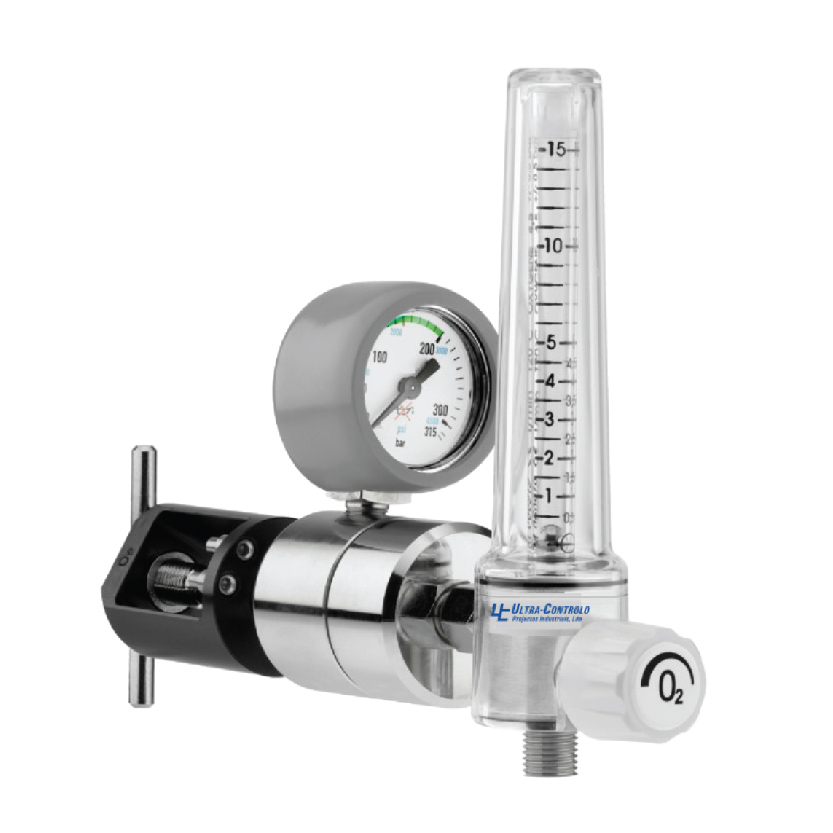
- Regulator with flowmeter
- 200 bar in, 4.5 bar out, 15 Nl/min
- Reducer with built-in area valve
- 10 bar in, 4.5 bar out, 30 Nm³/h
- Reducer, threaded G 1/4
- 10 bar in, 4.5 bar out, 40 Nm³/h
The connections.
Regulator inlets are gas-specific and follow national standards, so match them to the cylinders and outlets already in use.
ISO 7396-1 includes requirements for non-interchangeability between components of different gas and vacuum systems. The cylinder regulators Ultra Controlo supplies have a gas-specific inlet, such as DIN-9 or NF-F for oxygen, and the regulator with flowmeter is also available with a CGA 540 inlet.
Ultra Controlo vacuum regulators connect to the outlet with an AFNOR NF S 90-116, DIN 13260-2 or BS 5682 probe, or a G 1/4 thread, and the second-stage reducers have an emergency gas-specific socket.
- Cylinder regulators, oxygen inlet
- DIN-9 or NF-F
- Regulator with flowmeter, oxygen inlet
- CGA 540, DIN-9 or NF-F
- Cylinder regulators, outlet
- Ø 6 mm hose connector
- Regulator with flowmeter, outlet
- G 1/4 M
- Vacuum regulator, outlet
- G 1/2 M, for the collection jar
Suction regulators.
A suction regulator controls vacuum, not pressure: ISO 10524-2 leaves vacuum out and refers it to ISO 10079-3.
ISO 10079-3:2022 sets basic safety and performance requirements for medical suction equipment powered from a vacuum or positive pressure gas source, including equipment connected to medical gas pipeline systems.
HTM 02-01 (2026) asks for vacuum to be applied through a suction control device, with fluid collected in suction jars, and for the device to include a slam-shut mechanism and a hydrophobic filter to minimise the risk of carry-over into the pipeline. It does not permit wet vacuum systems that draw fluids through a fixed pipeline to a remote suction jar.
- Ranges
- 0 to -250, 0 to -600 or 0 to -1000 mbar
- Maximum flow
- 52, 78 or 80 l/min, by range
- Body
- Chemically nickel-plated aluminium, medical grade silicone membrane
- Option
- Rail 90° with a 1.5 m hose
- Volume
- 150 or 300 cc, polycarbonate
- Position
- Upstream of the vacuum regulator
Materials for oxygen.
For oxygen, ask which materials touch the gas and which oxygen compatibility standard the regulator is made to.
HTM 02-01 (2026) asks for the high-pressure regulators of cylinder manifolds to comply with BS EN ISO 10524-2 and to be supplied with auto-ignition test results.
HTM 02-01 Part B describes BS EN ISO 15001 as the standard for the oxygen compatibility of materials, components and devices that can come into contact with oxygen at pressures above 50 kPa, including pressure regulators.
- Body
- Chemically nickel-plated brass
- Oxygen version
- FKM O-ring and membrane, nylon seal seat
- Springs
- Stainless steel
- Relief
- Overpressure discharge valve built into the regulator
- Gauges
- 0 to 315 bar inlet, 0 to 16 bar outlet, class 2.5
- Standards listed
- EN ISO 10524-1, EN ISO 10524-2 and EN ISO 15001
Regulators and reducers.
Each card opens the product page.
Cylinder regulator, 60 Nm³/h
Dual-gauge cylinder regulator for oxygen and other medical gases, 200 bar inlet.
View productCylinder regulator, 90 Nm³/h
High-capacity cylinder regulator, 200 bar inlet, up to 12 bar outlet.
View productRegulator with flowmeter
Cylinder regulator with an outlet flowmeter up to 15 or 30 l/min.
View productMedical gas pressure regulator
Pressure regulator for medical gases from cylinder or pipeline sources.
View productReducer with built-in area valve
Two regulators in by-pass with an integrated zone shut-off valve, 30 Nm³/h at 4.5 bar.
View productReducer, threaded G 1/4
Second-stage reducer with upstream and operating gauges, 40 Nm³/h at 4.5 bar.
View productVacuum regulator
Three models, up to -250, -600 or -1000 mbar, with AFNOR, DIN or BS probes.
View productVacuum collection jar
150 or 300 cc polycarbonate jar fitted upstream of the vacuum regulator.
View productVacuum second-stage unit
Shut-off unit for vacuum lines, with a ball valve and a contact gauge from -1 to 0 bar.
View productCommon questions about choosing medical gas regulators.
Questions buyers ask about medical gas regulators. More on the medical gas answers page.
What is a two-stage pressure regulator in a medical gas system?
Two-stage reduction lowers the pressure first at the source and again before the terminal units. The typical automatic manifold in HTM 02-01 (2026) has a first-stage and a second-stage regulator on each cylinder bank, and a pressure-reducing station lowers the pressure where gases are distributed above the nominal pipeline pressure at the terminal units.
Which standard covers medical gas pressure regulators?
ISO 10524, in four parts: Part 1 for regulators on cylinders or built into equipment, Part 2 for manifold and line regulators, Part 3 for regulators integrated with cylinder valves, and Part 4 for low-pressure regulators connected to terminal units.
Does ISO 10524 cover vacuum regulators?
No. ISO 10524-2 does not apply to regulators for vacuum pipeline systems and refers them to ISO 10079-3, which covers medical suction equipment powered from a vacuum or positive pressure gas source.
Why are line pressure regulators installed in pairs?
So that maintenance or a component failure does not interrupt the flow. HTM 02-01 (2026) says a pressure-reducing station should be a duplex system and that simplex systems should not be used.
What vacuum ranges do Ultra Controlo vacuum regulators cover?
Three models, from 0 to -250, -600 or -1000 mbar, with a maximum flow of 52, 78 or 80 l/min respectively.
Does Ultra Controlo supply oxygen cylinder regulators?
Yes. Ultra Controlo supplies cylinder regulators for oxygen and other medical gases for a 200 bar inlet pressure, with flows up to 60 or 90 Nm³/h, and a regulator with an outlet flowmeter up to 15 or 30 l/min.
Ready to discuss medical gas regulators?
Tell us about your site. Our engineering team sizes the configuration and sends a quote.