How to choose a medical vacuum plant.
Seven checks to compare medical vacuum plants: capacity, pumps and redundancy, pump technology, vessels and filters, control, exhaust and noise, and standards, with the ULTRAVAC range as the example.
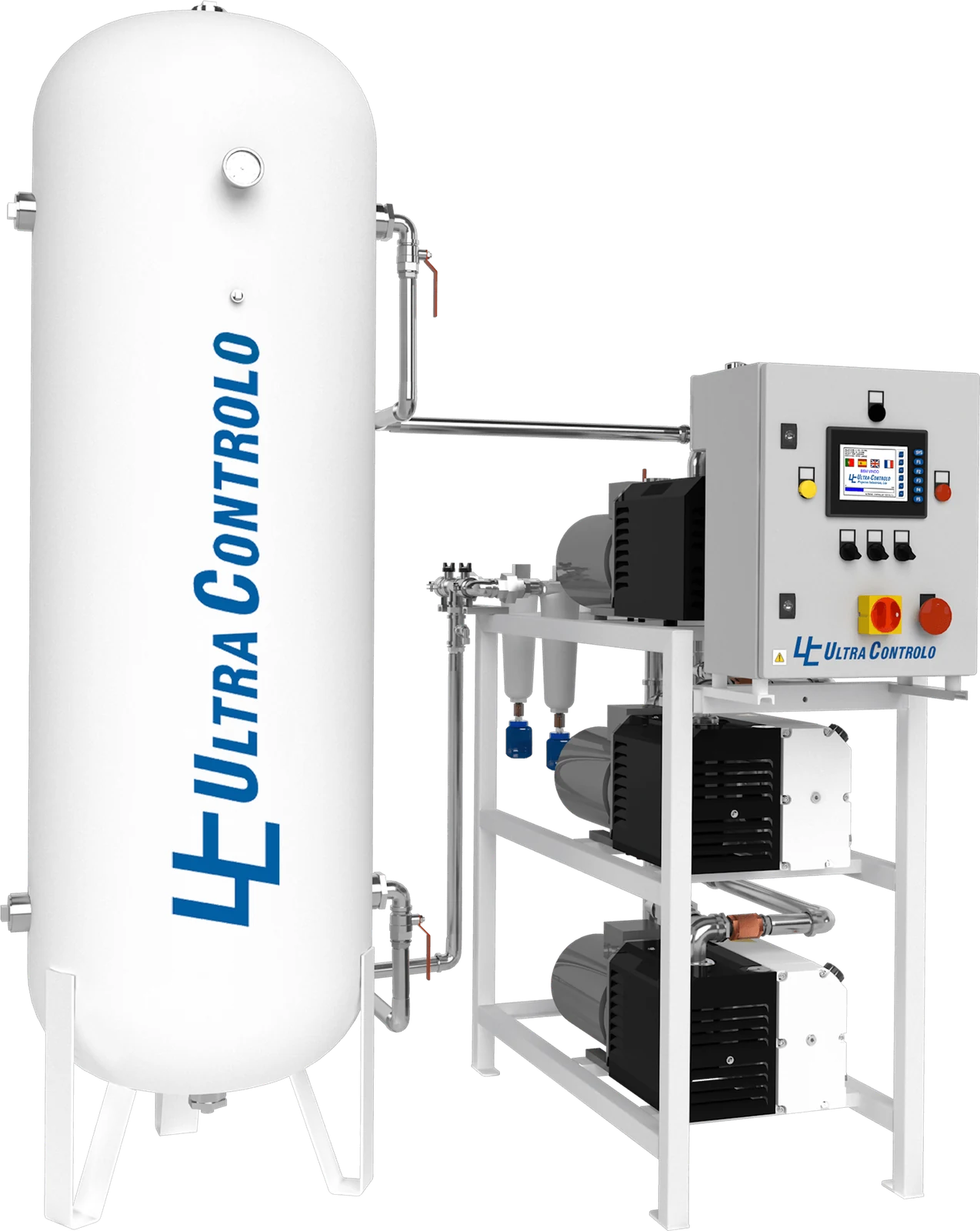
Three plants, one table.
The three plants differ in what they are used for and in pump technology. Figures are as each product page states them.
| Plant | Use | Pumps | Capacity | Noise |
|---|---|---|---|---|
| ULTRAVAC | Hospital medical vacuum network | Oil lubricated rotary vane, Elmo Rietschle, 1 to 6 pumps per plant | 10 to 1,100 m³/h per pump | 60 to 81 dB(A) per pump |
| ULTRAVAC CLP | Medical vacuum for healthcare units | Rotating contactless claws, air cooled, variable speed version; also produced with 2, 3 or more pumps | 60 to 950 m³/h, by model | 78 to 82 dB, by model |
| ULTRAVAC DENTAL | Central suction for dental clinics and colleges, wet aspiration | SCB side channel, Elmo Rietschle, with speed variation | V300 (1 chair) to V18000 (60 chairs at 100%, 100 at 60%) | Not stated on the product page |
Sized to the hospital.
ULTRAVAC pumps range from 10 to 1,100 m³/h each, in 16 pump sizes, and the plant ensures a minimum vacuum level of 450 mmHg at pipeline flow.
HTM 02-01 (2026), the NHS England guidance, says the capacity of the vacuum supply system should be appropriate for the calculated demand, and that pump capacity should be specified as free air aspirated (FAA) in L/min at a vacuum of 475 mmHg (63 kPa) and at 450 mmHg (60 kPa) at the plant pipeline connection.
- Capacity per pump
- 10 to 1,100 m³/h (167 to 18,333 L/min)
- Vacuum level
- −0.75 to −0.85 bar
- Minimum vacuum
- 450 mmHg at pipeline flow
- Nominal inlet vacuum range
- 578 to 728 mmHg (0.77 to 0.97 bar)
What happens when a pump stops.
The ULTRAVAC control panel rotates the pumps automatically by operating hours, and a backup pump maintains the vacuum level.
HTM 02-01 (2026), the NHS England guidance, describes a vacuum supply of three or more pumps, arranged so that during maintenance on any pump and a single fault the remaining pumps and components should be capable of supplying the system design flow.
If the ULTRAVAC changeover relay fails, each pump remains governed by its own vacuum switch.
- ULTRAVAC
- 1 to 6 pumps per plant
- ULTRAVAC CLP
- Also produced with 2, 3 or more pumps
- Pump control
- Manual/Stop/Auto selector per pump
- Pump rotation
- Automatic, by operating hours
Rotary vane, claw or side channel.
ULTRAVAC uses oil lubricated rotary vane pumps from Elmo Rietschle, made in Germany, with solid aluminium vanes and a gas ballast for moisture tolerance; ULTRAVAC CLP uses rotating, contactless claws, with air cooling.
The ULTRAVAC CLP pump requires one oil change every 20,000 hours, and a variable speed version adjusts the pump speed to the vacuum required by the network; the product page says that at variable speed energy costs can drop by around 40%.
ULTRAVAC DENTAL uses SCB side channel pumps, dry running, with no need for freshwater consumption. HTM 02-01 (2026) says water-sealed pumps should not be used in medical vacuum as they represent a biohazard.
- ULTRAVAC
- Oil lubricated rotary vane, Elmo Rietschle, made in Germany
- ULTRAVAC CLP
- Rotating, contactless claws; air cooled; oil change every 20,000 hours
- ULTRAVAC DENTAL
- SCB side channel, Elmo Rietschle, made in Germany; dry running
A reserve, and a filter.
ULTRAVAC vacuum vessels are vertical, carbon steel with white epoxy pre-coating, to EN 286-1, from 200 to 5,000 litres per vessel, in 1 to 5 vessels.
The bacterial filters are duplex, each sized for the full plant flow, with ball valve isolation and a sterilisable drain flask per filter, so cartridges are replaced on an isolated line without interrupting operation.
HTM 02-01 (2026) says vacuum vessels should be installed with a bypass facility and independently isolated while maintaining supply, and that duplex bacteria filter subassemblies should be rated to handle the full plant capacity.
- Vacuum vessels
- 200 to 5,000 litres per vessel, 1 to 5 vessels
- Maximum operating pressure
- 1 bar
- Bacterial filter penetration
- ≤ 0.005%
- Filter pressure drop
- ≤ 30 mbar
Watching the plant.
The ULTRAVAC control panel has a touchscreen HMI showing vacuum level and trends, with a Manual/Stop/Auto selector per pump.
Modbus TCP/IP communication and potential-free contacts for remote alarms are provided, and a QuVac remote monitoring panel (4G/ETH) is an option, as is an HTM 02-01 aligned plant control panel.
HTM 02-01 (2026) says a monitoring system should detect plant faults for each pump, a plant emergency and a pipeline pressure fault.
- Display
- Touchscreen HMI, vacuum level and trends
- Pump selector
- Manual/Stop/Auto per pump
- Communication
- Modbus TCP/IP
- Remote alarms
- Potential-free contacts
- Remote monitoring
- QuVac panel (4G/ETH), optional
The room around the pumps.
ULTRAVAC noise is given as 60 to 81 dB(A) per pump, not for a complete plant, and ULTRAVAC CLP as 78 to 82 dB by model.
HTM 02-01 (2026) says the exhaust termination point should be clear of windows, ventilation intakes and the intake of air compressors and other equipment, and that noise from the exhaust should be subject to a risk assessment, with a silencer where there is potential for noise issues.
- ULTRAVAC noise
- 60 to 81 dB(A) per pump
- ULTRAVAC motor power
- 0.45 to 30 kW per pump, 400 V / 50 Hz / 3 AC
- ULTRAVAC CLP noise
- 78 to 82 dB, by model
- ULTRAVAC CLP power
- 50 Hz: 200 to 240 V Δ, 345 to 415 V Y
Standards, test and service.
ULTRAVAC is designed in accordance with EN ISO 7396-1:2016, HTM 02-01 and NFPA 99, and manufactured and installed under ISO 13485:2016.
It is delivered fully connected and pre-assembled, with pumps, filters, control panel, cables and hoses mounted and factory tested.
Ask any supplier which standard the plant is designed to, which quality system it is made under and what is tested before it ships.
- Pipeline standard
- EN ISO 7396-1:2016
- Quality system
- ISO 13485:2016 and ISO 9001
- Country of origin
- Portugal (EU)
- Service
- UltraCare, which aims to keep the equipment working 24/7
The plants in this guide.
ULTRAVAC
Fully automatic medical vacuum plant with 1 to 6 Elmo Rietschle oil lubricated rotary vane pumps.
View ULTRAVACULTRAVAC CLP
Medical vacuum plant with rotating, contactless claw pumps, air cooled, with a variable speed version.
View ULTRAVAC CLPULTRAVAC DENTAL
Central wet suction for dental clinics and colleges, from one to several hundred chairs.
View ULTRAVAC DENTALQuestions about choosing a medical vacuum plant.
More on the plants in the complete guide to medical vacuum for hospitals.
How many pumps does an ULTRAVAC plant have?
1 to 6 pumps per plant, in 16 pump sizes from 10 to 1,100 m³/h per pump.
Can filter cartridges be replaced during operation?
Yes. Each branch of the duplex bacterial filter is sized for total plant flow, so cartridges are replaced on an isolated line without interrupting operation.
What happens if the changeover relay fails?
Each pump remains governed by its own vacuum switch.
Which pump types do the ULTRAVAC plants use?
ULTRAVAC uses oil lubricated rotary vane pumps, ULTRAVAC CLP uses rotating, contactless claws and ULTRAVAC DENTAL uses SCB side channel pumps. HTM 02-01 (2026) says water-sealed pumps should not be used in medical vacuum as they represent a biohazard.
How often is the oil changed in ULTRAVAC CLP?
The pump requires one oil change every 20,000 hours.
What standards is ULTRAVAC designed to?
ULTRAVAC is designed in accordance with EN ISO 7396-1:2016, HTM 02-01 and NFPA 99, and manufactured and installed under ISO 13485:2016.
Ready to discuss medical vacuum for your hospital?
Tell us about your site. Our engineering team sizes the configuration and sends a quote.