Buying a PSA oxygen plant in Portugal.
Portugal registers its public contracts on the BASE portal, SPMS runs central purchasing for health, and the hospital specification for medical gases is ACSS ET 03/2006. This guide sets out what those public documents say, as read on 19 November 2026, and what to check before you buy a PSA oxygen plant.
Five points before you buy.
Each point comes from a public document opened and read on 19 November 2026: the BASE portal, the SPMS notice on TED and in the Diário da República, ACSS ET 03/2006 and ET 08/2010, and an INFARMED circular. This page is a summary, not legal advice.
| Point | What the document says |
|---|---|
| 1. Where contracts are published | BASE, run by IMPIC, registers public contracts and Diário da República announcements and is searchable by CPV code. |
| 2. The SPMS notice | A dynamic purchasing system for medical gases, notice of 18 June 2026, price only, deadline closed. Not a plant tender. |
| 3. ET 03 on oxygen 93 | Pharmacopoeia limits restated, analyser and shut-off valve upstream of the reservoir, at least 6 air changes per hour. |
| 4. Demand, backup and power | High flow up to 60 L/min, backup in theatres and ICU, and emergency power for oxygen units. |
| 5. Technical air and INFARMED | ET 08/2010 covers technical air only. INFARMED’s 2024 circular is on the medical gases regulation. |
Public contracts are on BASE.
Portugal’s public contracts portal is run by IMPIC and can be searched by object, entity, procedure type and CPV code.
BASE describes itself as centralising the information on public contracts celebrated in mainland Portugal and the autonomous regions, and says its management is the responsibility of IMPIC, I.P., the Institute of Public Markets, Real Estate and Construction. It publishes under Ordinance 57/2018, as amended by Ordinance 284/2019.
The portal publishes the announcements that appear in the Diário da República for procedures to form public contracts. Its search page has separate searches for contracts, Diário da República announcements, entities, contractual modifications, impugnations and preliminary consultations. The contract search has fields for the contract object, the contracting entity, the contracted entity, the procedure type (for example concurso público, ajuste direto or consulta prévia), the contract type, the CPV code, dates and execution place.
- Run by
- IMPIC, I.P.
- Legal basis
- Ordinance 57/2018, amended by Ordinance 284/2019
- Searches
- Contracts, Diário da República announcements, entities, modifications, impugnations, preliminary consultations
- Contract search
- Object, entity, procedure type, contract type, CPV code, dates, place
BASE is a register of public contracts. This guide did not find on it the tender documents of any hospital, so it does not tell you whether a given medical gas tender is open.
The SPMS notice of June 2026.
Portugal’s central purchasing body for health announced a dynamic purchasing system for medical gases on 18 June 2026. It covers gases as a supply.
Serviços Partilhados do Ministério da Saúde, EPE (SPMS) is a public undertaking controlled by the central government, and both notices describe it as a central purchasing body acquiring for other buyers. Notice 2026/287, titled SAD de Gases Medicinais, was published on TED as 418532-2026 and in the Diário da República as announcement 15663/2026 (2nd series, no. 116), both on 18 June 2026.
The object is supplies under CPV 24111500, medical gases, with place of performance Lisbon. The system runs from 16 August 2026 to 30 August 2030 with no renewals, and its estimated value is 48,000,000 EUR excluding VAT, which the Diário da República notice calls the total maximum estimated value for the whole duration. The award criterion is price alone. Submission is electronic, through comprasnasaude.pt, with the documents and the tenders in Portuguese, an electronic catalogue and a qualified electronic signature or seal. The deadline for requests to participate was 16 July 2026 at 18:00, and it has closed.
The two notices differ on the procedure label: TED lists Other multiple stage procedure and the Diário da República lists Concurso limitado por prévia qualificação. The documents on comprasnasaude.pt govern the procedure, and this guide did not read them.
- Buyer
- SPMS, central purchasing body
- Object
- Medical gases as a supply, CPV 24111500
- Period
- 16 August 2026 to 30 August 2030, no renewals
- Estimated value
- 48,000,000 EUR excl. VAT, maximum for the whole system
- Award
- Price only
- Deadline
- 16 July 2026, 18:00, closed
- Notices
- TED 418532-2026 and DR 15663/2026
The notices do not mention oxygen plants, equipment or cylinders, and do not say whether new suppliers can join later. This guide does not say which gases or quantities the system covers.
What does Portugal’s SPMS notice for a medical gases DPS say?
ACSS ET 03 on oxygen 93.
The hospital specification for medical gases and vacuum, revised in June 2024, sets out how an oxygen 93 plant is monitored and housed.
ACSS ET 03/2006 is titled Especificações técnicas para gases medicinais e aspiração em edifícios hospitalares, and the version read is v.2024, dated June 2024. For oxygen 93 it restates the limits of the European Pharmacopoeia: a nominal concentration of 93% ± 3%, carbon monoxide up to 5 ppm, carbon dioxide up to 300 ppm, oil up to 0.1 mg/m³, nitrogen oxides up to 2 ppm, sulphur dioxide up to 1 ppm and water vapour up to 67 ppm.
It places the oxygen analyser and the shut-off valve upstream of the oxygen 93 reservoir. It asks for alarms connected to the building automation and control system, and for a shut-off valve that closes automatically if the analyser detects gas outside the pharmacopoeia specification. It recommends a separate or dedicated distribution network for oxygen 93 in outpatient care and primary care units, where its use is clinically accepted.
For the plant room it asks for ventilation of at least 6 air changes per hour, and for the plant to sit away from the ventilation discharge, car parking and other sources of pollution, so that the air entering the plant is not contaminated.
- Publisher
- ACSS, Portugal
- Version
- v.2024, June 2024
- Oxygen 93 purity
- 93% ± 3%, per the European Pharmacopoeia
- Analyser
- With the shut-off valve, upstream of the reservoir
- Alarms
- Connected to the building automation system
- Plant room
- At least 6 air changes per hour
This guide sets out only some points on oxygen 93. Read the full specification before you tender.
Demand, backup and power.
ET 03 also gives numbers for high-flow oxygen and asks for backup supplies and emergency power.
For oxygen therapy at high flow, ET 03 recommends that all intensive care and emergency observation beds can deliver oxygen up to 60 L/min, and that 20% of inpatient beds can do the same. It asks for permanently connected backup supplies of oxygen, medical air and vacuum in the most critical services, operating theatres and intensive care, which start automatically if the central supply fails.
It recommends emergency electrical power, for example from a generator, so that on-site oxygen generating units are not affected by a failure of the primary supply. For pipework it asks for copper tube to EN 13348, and allows flexible tubing to NP EN 739 where the network cannot be in copper, as in magnetic resonance rooms.
- High flow
- Up to 60 L/min at 100% of ICU and emergency beds
- Inpatient beds
- 20% able to take high flow
- Critical services
- Permanently connected backup in theatres and ICU
- Power
- Emergency supply recommended for oxygen units
- Pipework
- Copper to EN 13348
These are recommendations and requirements of the specification as the answers in the library state them. What a given tender asks for is in its own documents.
Technical air and INFARMED.
A separate specification covers technical compressed air, and an INFARMED circular of 2024 touches on 98% oxygen generators.
ACSS ET 08/2010, in its V.2025 version revised in November 2025, is the specification for technical, non-medical compressed air in hospital buildings. It serves support zones such as workshops, the boiler plant, the laundry and sterilisation, and may not be used for therapeutic purposes. Medical air is excluded and is covered by ET 03/2006. ET 08 sets ISO 8573-1:2010 class [2:4:2] as the minimum quality for centrally produced technical air. If a tender mixes oxygen, medical air and technical air, ask which specification each line follows.
INFARMED’s Circular Informativa 092/CD/100.20.200 of 29 October 2024, on the medical gases regulation, described 98% oxygen generators as being in strong technological development, with certification processes started. This guide does not set out INFARMED’s rules for oxygen made on site, and does not say how oxygen 93 is authorised in Portuguese hospitals.
- ET 08/2010
- Technical compressed air, V.2025, November 2025
- Excluded from ET 08
- Medical air, covered by ET 03/2006
- Minimum air quality
- ISO 8573-1:2010 class [2:4:2]
- INFARMED circular
- 092/CD/100.20.200, 29 October 2024
ACSS ET 08/2010: technical compressed air in hospitals (Portugal)
Four things to put in writing.
They follow from the five points above and apply to every supplier you compare.
Which notice, and which date.
Ask the contracting authority for the notice date, the CPV code and the procedure type. The SPMS notice above covers medical gases as a supply and has closed, so do not read it as a tender for plants.
Which specification.
Ask which version of ACSS ET 03/2006 the tender names, and whether technical air falls under ET 08/2010. Ask who decides whether oxygen 93 is used at the hospital and under which authorisation, because this guide does not cover that.
The monitoring and the room.
Ask for the analyser and the shut-off valve upstream of the reservoir, the alarms to the building automation system, and a plant room with at least 6 air changes per hour, away from sources of pollution.
Demand, backup and power.
Give the manufacturer the high-flow demand, the beds in critical services and the real site conditions. Ask for the backup in theatres and intensive care, the emergency power for the oxygen units, and the training of your technicians in the offer.
How ULTRAOX specifies purity.
Ultra Controlo is a Portuguese company, headquartered in Abrunheira, Sintra, that designs and manufactures medical gas systems for hospitals.
ULTRAOX plants deliver 93% ± 3% oxygen, the same nominal concentration that ACSS ET 03 states for oxygen 93.
This page does not say whether any plant meets ET 03 or a given tender. That is for the contracting authority and the health authorities to confirm.
- PSA oxygen range
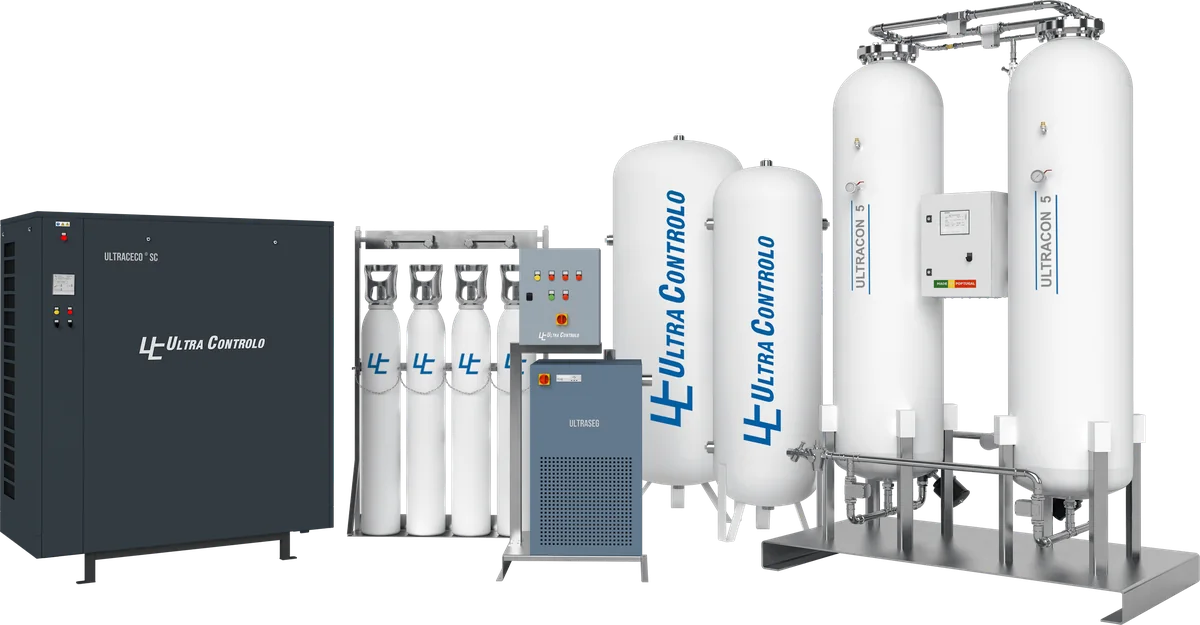
- ULTRAOX SC, ULTRAOX ST and ULTRAOX CO plants, with ULTRACON oxygen generators
- Oxygen grade
- Oxygen 93, 93% ± 3%, per the European Pharmacopoeia
- Control
- ULTRAOX SC: touch screen PLC showing purity, pressure and flow, with alarms and logging
- Medical device
- CE 1639, Class IIb, the whole plant as one medical device
- Built to
- EN ISO 7396-1
- Quality system
- ISO 13485:2016, ISO 9001:2015 and ISO 14001
Where are public hospital tenders published in Portugal?
The BASE portal, managed by IMPIC, centralises information on public contracts in mainland Portugal and the autonomous regions, including the announcements published in the Diário da República. It can be searched by contract object, contracting entity, procedure type, contract type and CPV code. BASE is a register of contracts: it does not by itself tell you whether a particular medical gas tender is open.
What is SPMS notice 2026/287, and is it a tender for oxygen plants?
It is a dynamic purchasing system for medical gases (CPV 24111500), announced by SPMS in TED notice 418532-2026 of 18 June 2026. The notices cover medical gases as a supply and do not mention oxygen plants, equipment or cylinders, so it should not be read as a tender for PSA plants.
Is the SPMS notice still open?
The deadline for requests to participate and for proposals was 16 July 2026 at 18:00, so it has closed. The notices do not say whether new suppliers can join the system later. The system is due to run from 16 August 2026 to 30 August 2030.
Which specification covers medical gases in Portuguese hospitals?
ACSS ET 03/2006, in its 2024 version (revised in June 2024), is the specification for medical gases and vacuum in hospital buildings. Technical, non-medical compressed air has its own specification, ACSS ET 08/2010, in its V.2025 version revised in November 2025.
How does ACSS ET 03 ask for oxygen 93 to be monitored?
It restates the European Pharmacopoeia limits for oxygen 93 and asks for the oxygen analyser and the shut-off valve to sit upstream of the oxygen 93 reservoir. It asks for alarms connected to the building automation and control system, and for a shut-off valve that closes automatically if the analyser detects gas outside the pharmacopoeia specification.
What documents does Ultra Controlo provide for a tender?
ULTRAOX oxygen plants carry CE marking as Class IIb medical devices through notified body 1639 (SGS), with the whole plant certified as a single medical device, and are built to EN ISO 7396-1. For tenders, Ultra Controlo provides its certificates, CE declarations of conformity and technical dossiers.
Who services an ULTRAOX plant after handover?
UltraCare is Ultra Controlo’s technical assistance programme for its medical gas systems, available 24 hours a day, 365 days a year. It covers preventive maintenance and monitoring, corrective service, original spare parts and rental equipment while a unit is serviced. ULTRAOX is designed for a minimum life cycle of 150,000 hours, which Ultra Controlo presents as an investment for at least 20 years.
Ready to discuss oxygen for your hospital?
Tell us about your site. Our engineering team sizes the configuration and sends a quote.