How to size an oxygen plant for a hospital.
To size an oxygen plant for a hospital, estimate the oxygen demand first: WHO (2023) calculates it from the beds per type of ward, the wall outlets per bed or historical consumption. Then match that flow, in Nm³/h, to a plant size.
From beds to a plant size.
Estimate the demand, check what the estimate misses, then match the flow to a plant.
Estimate the demand
Use one of the three methods in WHO’s Foundations of medical oxygen systems (2023), with no more than two usage factors together.
Check the gaps
Count patients who lack oxygen today, allow for future change, and remember that, when converting a plant’s rated output into cylinders filled per day, its working capacity can be 80 to 90% of its rated capacity.
Match the flow
Give Ultra Controlo the oxygen flow, or the cylinders to fill per day, and the site conditions, and its engineers confirm the configuration.
Estimate the demand.
WHO (2023) says plants must be sized and configured on facility needs and estimated oxygen demand.
It lists the three most used methods to calculate the estimated need: the number of beds per type of ward in the health facility, the number of gas wall outlets per bed in each type of ward, and historical consumption, for example additional cylinders consumed per day.
The calculation then applies usage factors: annual inpatient admissions, bed occupancy rate, estimated hypoxaemia rate per type of ward and average flow rates per ward. WHO suggests not using more than two usage factors together, to prevent undersizing, and says that using none of them could lead to oversizing.
Beds per type of ward: average hypoxaemia and flow rates may not represent the real clinical practice in the facility.
Wall outlets per bed: limited to facilities with a pipeline network, and considering 100% of the stations in use at maximum flow can easily oversize the source.
Historical consumption: appropriate for modular facilities and for facilities without piped distribution systems, but historical records can be unrealistic due to several external factors.
Check what the estimate misses.
Open Critical Care warns that current oxygen consumption may grossly underestimate optimal consumption.
Patients who do not have access to oxygen today because of inadequate supply must also be accounted for. Among the common pitfalls Open Critical Care lists not accounting for leaks on the oxygen infrastructure, inaccurately estimating device consumption, and estimating only current consumption without allowing for future increases and decreases in need.
UNDP (2025) includes future expansion plans in its assessment of projected oxygen demand.
Assist International, answering on Open Critical Care about converting a plant’s rated output into cylinders filled per day, says it is reasonable to assume 80 to 90% of the rated capacity as the actual working capacity.
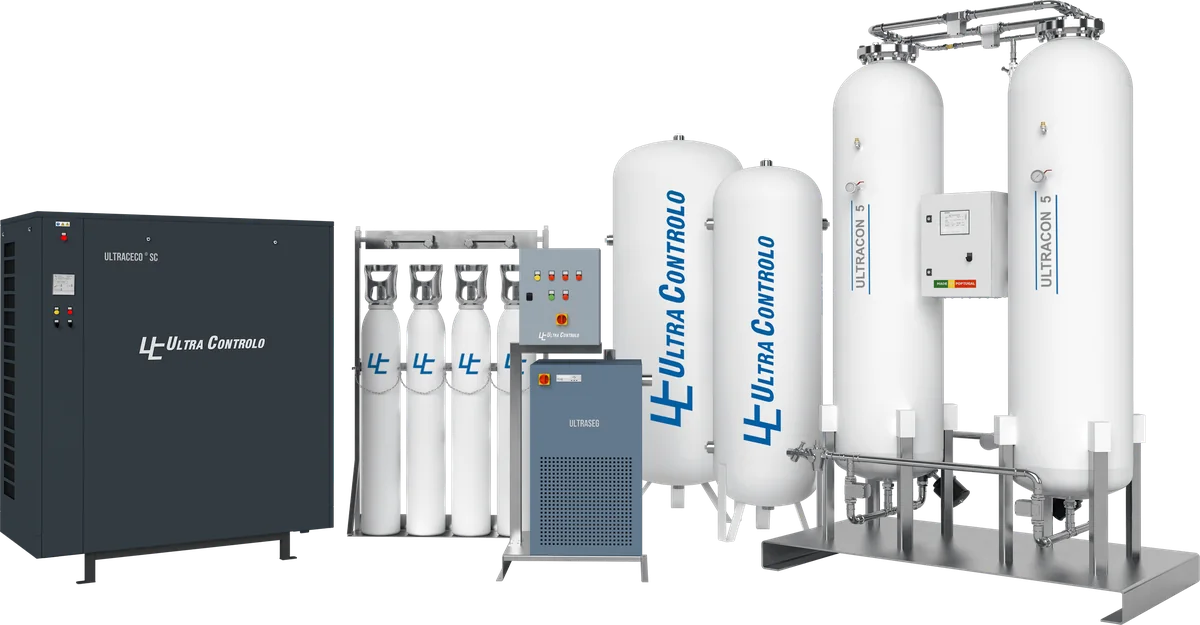
Plants are modular: one or more generators and compressors are combined to match the hospital’s demand, and capacity can be added later without replacing what is already installed.
Match the flow to a size.
Ask for the guaranteed flow in Nm³/h at the stated purity and outlet pressure. If the plant will also fill cylinders, give the cylinder size and how many cylinders a day.
ULTRAOX plant models range from 3.10 Nm³/h of oxygen on ULTRAOX 30 to 165.3 Nm³/h on ULTRAOX 1640, delivered at 5 to 6 bar; each plant has one or two ULTRACON oxygen generators.
The table of all 16 sizes, with the flow, the daily cylinder filling and the compressor by altitude, is on the PSA oxygen generator sizes page.
What information does a supplier need to quote an oxygen plant?
To size a plant, Ultra Controlo needs the oxygen flow required in m³/h or, for cylinder filling, the size and number of cylinders to fill per day.
Heat, humidity, dust, altitude and the power supply all change what a PSA plant needs, so give the manufacturer the real site conditions.
- Altitude
- Metres above sea level
- Temperature
- Highest monthly average
- Humidity
- Highest monthly average
Questions hospitals ask about sizing.
Questions hospitals ask us about on-site oxygen. More on the medical gas answers page.
How do I size an oxygen plant for a hospital?
To size an oxygen plant for a hospital, estimate the oxygen demand first: WHO (2023) lists three methods, based on the beds per type of ward, the wall outlets per bed or historical consumption.
ULTRAOX plant models range from 3.10 Nm³/h of oxygen on ULTRAOX 30 to 165.3 Nm³/h on ULTRAOX 1640, delivered at 5 to 6 bar; each plant has one or two ULTRACON generators.
How many beds does a PSA oxygen plant supply?
It depends on the type of ward and the usage factors applied, because WHO (2023) sizes a plant on estimated oxygen demand, calculated from the beds per type of ward, the wall outlets per bed or historical consumption.
Why not size a plant on current oxygen use?
Open Critical Care says that current oxygen consumption may grossly underestimate optimal consumption, because patients who do not have access to oxygen today because of inadequate supply must also be accounted for.
How much of its rated capacity can a plant be counted on for when filling cylinders?
Assist International, answering on Open Critical Care about converting a plant’s rated output into cylinders filled per day, says it is reasonable to assume 80 to 90% of the rated capacity as the actual working capacity.
What does Ultra Controlo need to size an ULTRAOX plant?
To size a plant, Ultra Controlo needs the oxygen flow required in m³/h or, for cylinder filling, the size and number of cylinders to fill per day.
Can an ULTRAOX plant be expanded later?
Plants are modular: one or more generators and compressors are combined to match the hospital’s demand, and capacity can be added later without replacing what is already installed.
Ready to discuss oxygen for your hospital?
Tell us about your site. Our engineering team sizes the configuration and sends a quote.