PSA vs liquid oxygen vs cylinders.
A PSA plant makes Oxygen 93 on site from air; high-pressure cylinders and liquid oxygen are made off site and delivered by truck. They can be combined: a PSA plant as the main source, with cylinders in reserve.
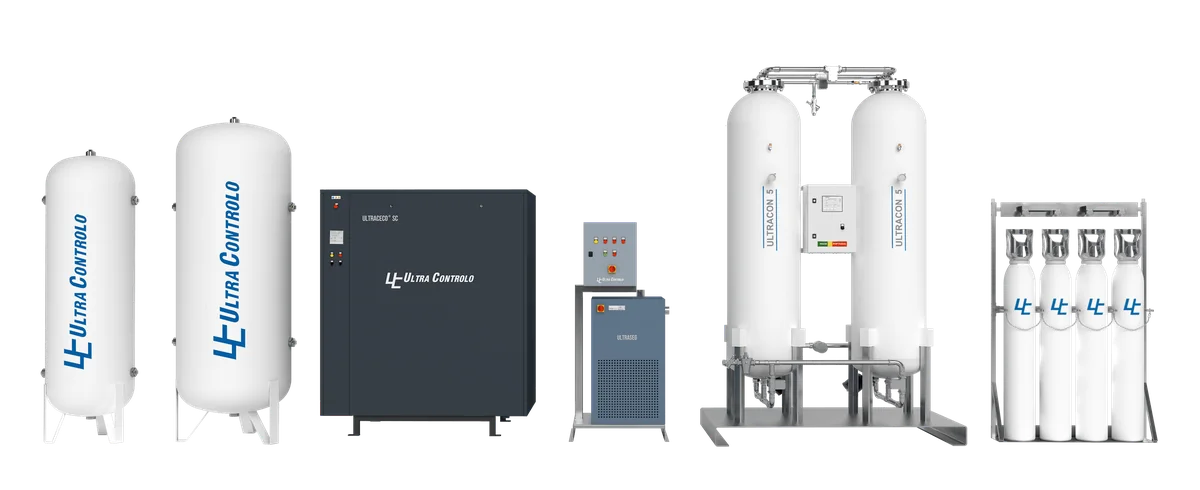
PSA, cylinders or liquid oxygen.
The difference is where the oxygen is made and how it reaches the patient: a PSA plant makes it on site from air, while cylinders and liquid oxygen are made elsewhere and delivered by truck.
| Criterion | On-site PSA (ULTRAOX) | High-pressure cylinders | Liquid oxygen tank |
|---|---|---|---|
| How it is made | On site, from ambient air | Off site, filled and delivered | Off site, by cryogenic distillation |
| Grade | Oxygen 93 (90 to 96%) | Oxygen (99.5% or more), or Oxygen 93 if filled from a PSA plant | Oxygen (99.5% or more) |
| Storage | Low pressure (ULTRAOX delivers at 5 to 6 bar), no hazardous storage | Gas at high pressure | Cryogenic liquid in an insulated tank |
| Deliveries | No oxygen deliveries for daily supply | Regular deliveries and returns | Regular tanker deliveries |
| Electricity on site | Needed: WHO (2020) says oxygen plants require a reliable source of power | Not needed: cylinders require no electricity to be functional (PATH and CHAI, 2021) | Not needed: the tank feeds the pipeline by self-vaporisation (WHO, 2020) |
| The hospital pays for | The plant, its electricity and maintenance | Gas, cylinder rental and transport, including gas left in returned cylinders | Gas, deliveries and evaporation losses |
Which supply fits which site.
The sources do not name one option for every site: a Global Fund briefing note on centralised and decentralised supply (2023) says cost effectiveness depends on local context and conditions, and PATH and CHAI (2021) advise researching local demand and the operating costs of the equipment.
On-site PSA
Where the hospital wants its own supply and has reliable power: WHO (2020) says oxygen plants require a reliable source of power, and the Global Fund (2023) lists the elimination of transport costs as an advantage of a plant at each facility.
High-pressure cylinders
As the reserve for any main source, and wherever oxygen must flow without electricity: PATH and CHAI (2021) note that cylinders require no electricity to be functional, and WHO (2020) calls it best practice to also have cylinders as a backup supply.
Liquid oxygen tank
Where a gas supplier delivers by tanker: the tank needs no power at the hospital, but the liquid vaporises continuously, as much as about 5% a day depending on the tank (WHO, 2023), and its cost usually depends on the distance from the production plant (Losordo, 2014).
PSA as the main source, cylinders in reserve.
WHO interim guidance (2020) calls it best practice to also have cylinders as a backup supply for a PSA plant, and PATH and CHAI (2021) say a backup such as cylinders is required to keep oxygen flowing through a power outage or mechanical failure.
A manifold connects banks of gas cylinders to the pipeline at a constant pressure, and an automatic changeover switches from the primary bank to the reserve bank without interrupting the supply.
The hospital stays on oxygen: an ULTRAOX plant connects to the network as one source among others, and if its production drifts outside specification, the network’s automatic changeover moves the supply to the secondary source, such as a cylinder bank, with no operator action.
An ULTRAFIL filling station takes racks of 5, 10 or 20 cylinders and fills them at a maximum pressure of 150 to 207 bar, depending on the model.
The plant can run from a diesel generator, and the existing oxygen installation can stay in place: ULTRAOX connects to it as a new source.
What each option costs to run.
On-site oxygen costs include the plant and its running, from electricity and maintenance to spare parts and staff, while delivered oxygen costs include recurring payments for gas, cylinder or tank rental and transport, plus losses.
Assist International, answering on Open Critical Care, says liquid oxygen is generally more expensive than PSA because of the cost of equipment, supporting infrastructure and distribution, although after the initial investment in a very large-scale system the cost diminishes over time.
Ultra Controlo sizes and quotes each ULTRAOX plant for the hospital’s oxygen demand and site.
Ultra Controlo states that on-site generation with ULTRAOX can cut oxygen costs by up to 70% over 10 years compared with cylinder or cryogenic supply, because the hospital stops paying for deliveries, cylinder rental and the oxygen left in returned cylinders. Electricity is a major running cost, and pressure drives it: each extra bar of compressor pressure adds about 7% to electricity use. ULTRAOX takes in air above 7.5 bar and delivers oxygen at 5 to 6 bar.
Replacing liquid oxygen tanks in industry.
The ULTRAOX VSA datasheet says the plant can replace existing cryogenic systems with liquid oxygen tanks or work as the main source of supply, at 75% to 95% oxygen and 50 kPa; delivered liquid oxygen is up to 99.9% pure (Nickerson, 2008).
Writing about fish farms, engineer Philip Nickerson (2008) notes that liquid oxygen can automatically back up a generator if power is lost or the unit loses capacity, and considers a combination of the two probably the most economical option.
The equipment behind on-site oxygen.
ULTRAOX SC
Oil-less ULTRACECO compressors.
View ULTRAOX SCULTRAOX ST
ULTRASCREW rotary screw compressors.
View ULTRAOX STULTRAOX CO
A complete plant inside a shipping container, for sites with no technical room.
View ULTRAOXULTRAFIL
Filling station for racks of 5, 10 or 20 cylinders, at a maximum pressure of 150 to 207 bar depending on the model.
View ULTRAFILULTRACECO HP
High-pressure oxygen booster for cylinder filling, suited to run 24 hours a day, 365 days a year.
View ULTRACECO HPULTRACECO HPT
Oil-free, compact high-pressure oxygen compressor.
View ULTRACECO HPTOxygen cylinders
Made in Europe to ISO 9809-2:2010, TPED certified and cleaned inside for medical oxygen.
View Oxygen cylindersULTRALOBO
Low-pressure oxygen boosters that join existing plants. Oil-free, AISI 316 stainless steel.
View ULTRALOBOCommon questions about oxygen supply options.
Questions hospitals ask us about on-site oxygen. More on the medical gas answers page.
PSA, cylinders or liquid oxygen: what is the difference?
The difference is where the oxygen is made and how it reaches the patient: a PSA plant makes it on site from air, while cylinders and liquid oxygen are made elsewhere and delivered by truck.
Single-stage PSA plants such as ULTRAOX produce Oxygen 93, a medical oxygen with its own monographs in the European Pharmacopoeia (Oxygen (93 per cent), 2455) and the US Pharmacopeia (Oxygen 93 Percent).
It contains 90.0% to 96.0% oxygen by volume, the rest mostly argon and nitrogen. Oxygen made by cryogenic distillation, delivered as liquid or in cylinders, follows a different monograph, Oxygen (0417), at 99.5% or more.
Is a PSA plant cheaper than liquid oxygen or cylinders?
Ultra Controlo states that on-site generation with ULTRAOX can cut oxygen costs by up to 70% over 10 years compared with cylinder or cryogenic supply, because the hospital stops paying for deliveries, cylinder rental and the oxygen left in returned cylinders. Electricity is a major running cost, and pressure drives it: each extra bar of compressor pressure adds about 7% to electricity use. ULTRAOX takes in air above 7.5 bar and delivers oxygen at 5 to 6 bar.
Independent guidance gives no single answer: a Global Fund briefing note on centralised and decentralised supply (2023) says cost effectiveness depends on local context and conditions, and Assist International, on Open Critical Care, says liquid oxygen is generally more expensive than PSA because of equipment, supporting infrastructure and distribution.
Does a PSA plant remove all cylinder costs?
No. WHO interim guidance (2020) called it best practice to keep cylinders as a backup supply for a PSA plant, so some cylinder costs remain.
What happens if the oxygen plant stops?
The hospital stays on oxygen: an ULTRAOX plant connects to the network as one source among others, and if its production drifts outside specification, the network’s automatic changeover moves the supply to the secondary source, such as a cylinder bank, with no operator action.
Inside the plant, the Siemens controller switches compressors and generators in cascade to keep pressure stable. Every alarm has a potential-free contact for remote signalling, and an optional control box passes information to the building management system (BMS).
Can a PSA oxygen plant fill oxygen cylinders?
Yes: an ULTRAFIL filling station connects to an ULTRAOX plant and fills medical oxygen cylinders using an ULTRACECO HP or ULTRACECO HPT high-pressure oxygen booster, at a maximum pressure of 150 to 207 bar depending on the model.
The filling rack takes 5, 10 or 20 cylinders, in single or double racks.
Can an industrial site replace its liquid oxygen tank?
ULTRAOX VSA, the Ultra Controlo industrial oxygen plant, is designed for it: its datasheet states that it can replace existing cryogenic systems with liquid oxygen tanks or work as the main source of supply, delivering 75% to 95% oxygen at 50 kPa.
Writing about fish farms, engineer Philip Nickerson (2008) notes that liquid oxygen can automatically back up a generator if power is lost or the unit loses capacity, and considers a combination of the two probably the most economical option.
Ready to discuss oxygen for your hospital?
Tell us about your site. Our engineering team sizes the configuration and sends a quote.