How to choose an industrial oxygen generator.
To choose an industrial oxygen generator, compare suppliers on eight points: concentration, delivery pressure, flow, liquid oxygen, reference conditions, electricity, installation and service.
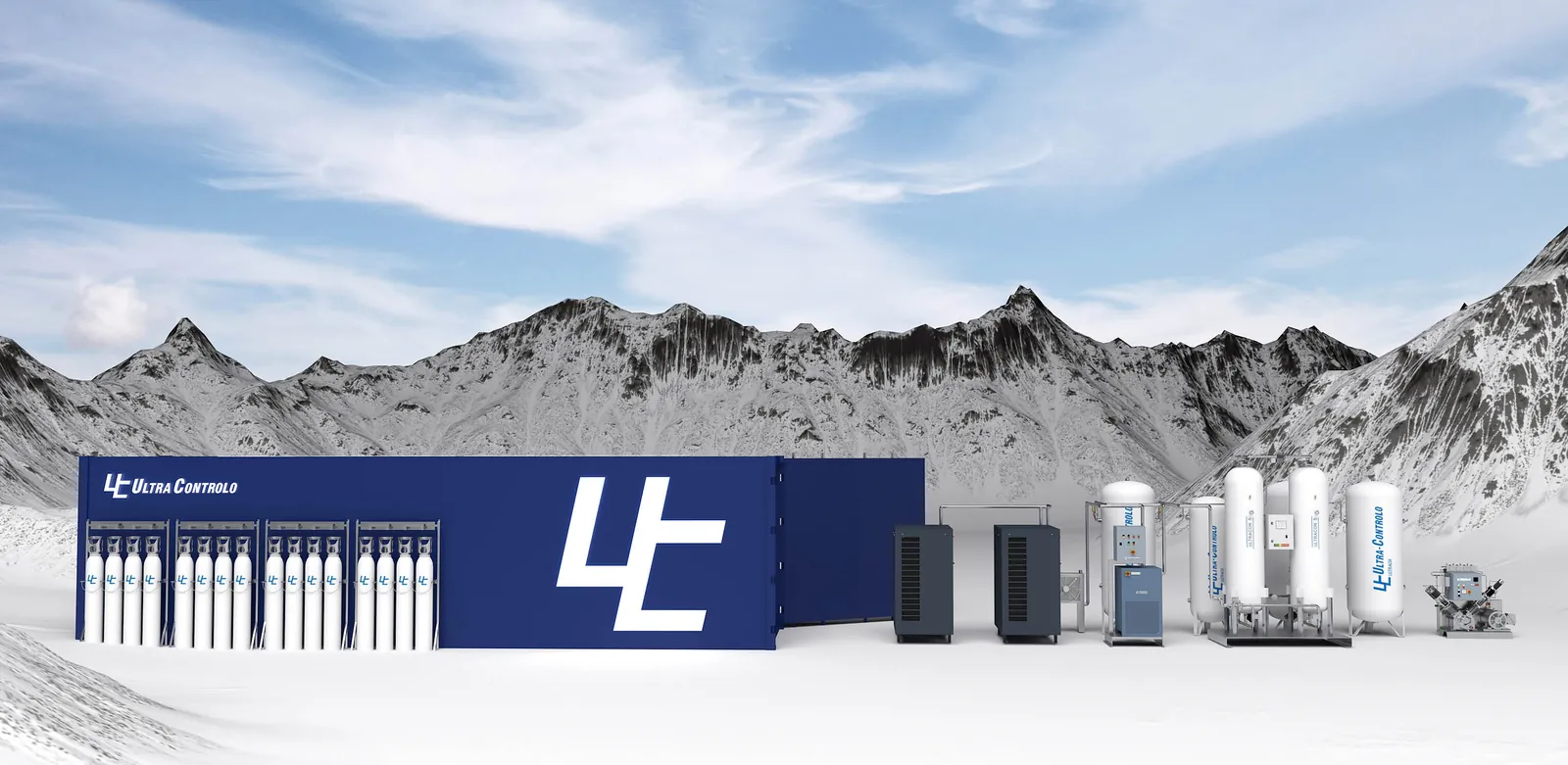
Eight questions before you buy.
Ask every industrial oxygen generator supplier the same eight questions, in writing, and compare the answers side by side. The ULTRAOX VSA figures on this page are those of its datasheet.
| Check | What to ask the supplier |
|---|---|
| 1. Oxygen concentration | At which concentration and pressure is the oxygen quoted, and how much can it vary? |
| 2. Pressure and booster | At which pressure does the oxygen arrive, and what raises it? |
| 3. Flow and peaks | Which flow is quoted at your concentration, and does it cover your peak? |
| 4. Liquid oxygen | Does the plant replace liquid oxygen, or sit beside it as a backup? |
| 5. Reference conditions | Which temperature, pressure and humidity do the quoted figures assume? |
| 6. Electricity | How many kW at the pressure you need, and on which supply? |
| 7. Installation and site | What arrives on site, and what must the site provide? |
| 8. Service | How often does it need service, and who can do it where you are? |
The oxygen concentration.
Ask for the concentration together with the pressure it is quoted at, and for the tolerance.
ULTRAOX VSA delivers oxygen at a concentration between 75% and 95% at 50 kPa. Its datasheet gives flows at 90% and at 93%, and states that purity data can vary up to 2%.
What concentration a process needs depends on the process. The US Department of Energy (2005) describes oxygen-enriched combustion systems that range from blending oxygen into the incoming combustion air to using almost 100% oxygen in the main combustion header.
The 75% to 95% of ULTRAOX VSA is below the over 99% oxygen that the EU iron and steel reference document (2013) describes for the basic oxygen converter.
- Concentration
- Between 75% and 95% at 50 kPa
- Flow data
- Given at 90% and at 93%
- Tolerance
- Purity data can vary up to 2%
The delivery pressure.
Ask at which pressure the oxygen leaves the plant, and what it takes to raise it.
ULTRAOX VSA delivers oxygen at 50 kPa. Higher pressures can be achieved with an additional oxygen booster as part of the supply, on demand.
Nickerson (2008, Global Aquaculture Advocate) writes that VSA generation happens at 10 psi or lower, while PSA involves compressing air to 100 to 120 psi. PATH and CHAI (2021) say VSA plants produce oxygen at a much lower pressure than PSA plants and often require an additional high-pressure oxygen compressor; their brief was written for medical oxygen plants.
- Delivery pressure
- 50 kPa
- Higher pressures
- With an additional oxygen booster as part of the supply, on demand
The flow you need.
Ask for the flow at the concentration you need, and size for the peak as well as the average.
ULTRAOX VSA comes in seven models, ULTRAOX VSA 180 to 2400, from 22 to 288 m³/h at 90% and from 18 to 240 m³/h at 93%. Other capacities are available on request.
Losordo (2014, Global Aquaculture Advocate) writes that if fish are fed over a shorter period of time, peak oxygen demand should be estimated. Nickerson (2008) writes that the oxygen used in late summer can be more than twice as high as that used during the winter.
- Models
- ULTRAOX VSA 180 to 2400
- Flow at 90%
- 22 to 288 m³/h
- Flow at 93%
- 18 to 240 m³/h
- Other capacities
- Available on request
Liquid oxygen: replace it or keep it.
Decide whether the generator replaces liquid oxygen or runs beside it.
ULTRAOX VSA can replace existing cryogenic systems with liquid oxygen tanks or work as the main source of supply.
A 2001 paper by the US Department of Energy and Energetics names three primary ways to supply oxygen to glass furnaces; the choice depends on consumption, electricity costs and the distance to existing oxygen plants.
Nickerson (2008) notes that a generator sized for maximum consumption could cost much more than buying liquid oxygen, and that a combination of the two is probably the most economical option. The DOE (2005) suggests including the cost of the oxygen, or of the vacuum pressure swing adsorption unit, in the payback calculation.
- Role
- Can replace existing cryogenic systems with liquid oxygen tanks, or work as the main source of supply
The reference conditions.
Read the footnotes: they say what the figures are based on.
The ULTRAOX VSA datasheet states that its performance data are based on a standard cubic metre at 15 °C, 1 atmosphere and 40% relative humidity, and that energy consumption data have a tolerance of ±5%.
The unit changes the gas volume. WHO (2023), writing about medical oxygen plants, says Nm³/h has a reference condition of 0 °C at an absolute pressure of 101.3 kPa, while a flow expressed in Sm³/h is based on standard reference conditions of 20 °C and 101.3 kPa. Ask every supplier for the reference conditions behind each figure before comparing quotes.
- Reference
- Standard cubic metre at 15 °C, 1 atmosphere, 40% relative humidity
- Energy data
- ±5%
- Purity data
- Can vary up to 2%
The electricity it needs.
Ask for the power at the pressure you need, and for the supply it runs on.
The ULTRAOX VSA datasheet gives the energy consumption of each model at 90% oxygen, in kW: from 9 to 120 kW at 50 kPa and from 12 to 150 kW at 800 kPa across the seven models. The power supply is three-phase 50 Hz, with other supplies under request.
PATH and CHAI (2021) say energy consumption increases for higher service pressures. The Global Fund briefing note (2025) says the peak operating power of a VSA plant is the same as a PSA plant, so VSA needs the same size of generator and switchgear; both documents were written for medical oxygen plants.
- At 50 kPa
- 9 to 120 kW, seven models
- At 800 kPa
- 12 to 150 kW, seven models
- Power supply
- Three-phase 50 Hz, other under request
- Tolerance
- ±5%
The installation and the site.
Ask what arrives on site, how it connects, and what the site must provide.
ULTRAOX VSA is a skid or container system for easy connection.
PATH and CHAI (2021) say PSA and VSA plants all require electricity and sufficient ambient air flow, and that the equipment generates substantial amounts of heat and requires adequate air conditioning for cooling. WHO (2023) says VSA operation is less affected by altitude, and PATH and CHAI say VSA plants can operate at higher altitudes without a reduction in performance; both documents were written for medical oxygen plants.
- Installation
- Skid or container system for easy connection
- Production system
- Totally oil-free
- Dew point
- Below -50 °C at atmospheric pressure
Long-term service.
Ask how often the plant needs service, and who can provide it where you are.
The ULTRAOX VSA datasheet lists among its benefits few parts to be assisted with large service intervals, and a life cycle calculated for 150,000 hours.
The Global Fund briefing note (2025) lists highly specialised maintenance tools among the drawbacks of VSA, and says that in countries where such plants are not common, spare parts supply chains and maintenance support may not be optimal. WHO (2023) says VSA sieve beds have a longer projected lifespan and require less maintenance than those for PSA. Both documents were written for medical oxygen plants.
- Service
- Few parts to be assisted with large service intervals
- Life cycle
- Calculated for 150,000 hours
Questions about choosing an industrial oxygen generator.
More on the medical gas answers page.
What oxygen concentration does an industrial oxygen generator deliver?
ULTRAOX VSA delivers oxygen at a concentration between 75% and 95% at 50 kPa. Higher pressures can be achieved with an additional oxygen booster as part of the supply, on demand.
How do I size an industrial oxygen generator?
Ask each supplier for the flow at the concentration you need, in m³/h with the reference conditions stated, and for the peak as well as the average. Losordo (2014) writes that if fish are fed over a shorter period of time, peak oxygen demand should be estimated, and Nickerson (2008) that late-summer use can be more than twice winter use.
Can an industrial oxygen generator replace liquid oxygen?
Yes. ULTRAOX VSA can replace existing liquid oxygen supplies (cryogenic tanks), or work as the main source of supply. Nickerson (2008) notes that a combination of generator and liquid oxygen is probably the most economical option.
Is ULTRAOX VSA a medical oxygen plant?
No. ULTRAOX VSA is an industrial line. For medical oxygen, see ULTRAOX ST and ULTRAOX SC.
Ready to discuss oxygen for your plant?
Tell us about your site. Our engineering team sizes the configuration and sends a quote.