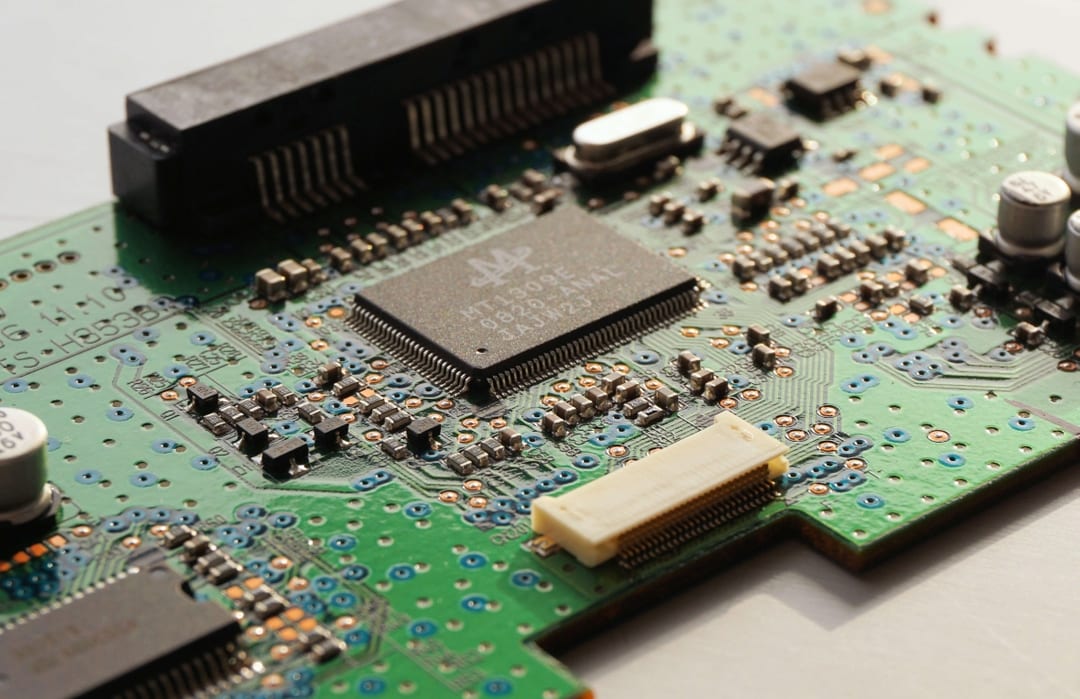
Semiconductors and electronics. Process air, oil-free air and vacuum.
The US Department of Energy places electronics at the process air quality level and says lubricant-free rotary screw compressors are used in applications that require clean air, such as food processing, pharmaceuticals and electronics. Ultra Controlo supplies ULTRADRY adsorption dryers and ULTRAK carbon towers, which its brochure lists for electronics, and Gardner Denver oil-free compressors and Elmo Rietschle vacuum pumps, which their makers list for electronics.
Lowest dew point of ULTRADRY adsorption dryers, per catalogue
02
<0.003mg/m³
Oil vapour after an ULTRAK carbon tower, per catalogue
03
<0.01mg/m³
Oil and oil vapour in Class 0 air, as Gardner Denver defines it
Where air and vacuum go
Five places electronics plants need clean air or vacuum.
The US Department of Energy and the partner makers describe these uses.
Process air
Air at the process level
The DOE places electronics at the process air quality level, with food and pharmaceutical process air.
Oil-free
Lubricant-free compression
Lubricant-free rotary screw compressors are used in applications that require clean air, such as electronics, according to the DOE sourcebook.
Drying
Very dry air
Where a pressure dew point below 35 °F is required, the DOE says a refrigerant dryer cannot be used; twin-tower desiccant dryers are typically rated at −40 °F.
Process vacuum
Screw and claw vacuum
Elmo Rietschle lists electronics and semiconductors among the applications of its screw and claw vacuum pumps.
Repair
De-soldering
Thomas lists de-soldering machines, with precise and controlled vacuum for electronic manufacturing and repair, among the uses of its linear pumps.
Sources: US DOE and Compressed Air Challenge, Improving Compressed Air System Performance: A Sourcebook for Industry, third edition (2016), Fact Sheets 1 and 7 and Appendix D; Elmo Rietschle screw and claw vacuum pump pages; Thomas linear pumps page.
Oil in the air
Oil-free compressor or treated air.
Electronics is one of the uses where the oil content of the air matters. The sources describe two routes to the same air.
Oil-free compression
Class 0
Gardner Denver says industries like pharmaceuticals, food and beverage and electronics manufacturing typically require oil-free air to meet strict contamination control protocols, and calls Class 0 the most stringent air class defined by ISO 8573-1.
Source: Gardner Denver, compressors and EnviroAire T/TVS pages (EMEIA).
Treated air
Separation and filtration
Lubricant-free air can also be produced with lubricant-injected compressors that have additional separation and filtration equipment, which causes some reduction in efficiency, particularly if systems are not properly maintained.
Source: DOE sourcebook (2016), Fact Sheet 1.
The standard
ISO 8573-1:2010
ISO 8573-1:2010 specifies purity classes of compressed air for particles, water and oil, independent of where in the system the air is specified or measured.
Source: ISO 8573-1:2010 abstract (iso.org).
The ISO classes describe the air, not the compressor. Sources: Gardner Denver; DOE sourcebook (2016); ISO.
Air quality levels
Electronics sits at the process air level.
The DOE sourcebook (2016) sorts compressed air into four quality levels. Quality is set by the dryness and contaminant level that the end uses require, and the higher the quality, the more the air costs to produce.
Source: US DOE and Compressed Air Challenge sourcebook (2016), Fact Sheet 1.
Quality level
Applications listed
Plant air
Air tools, general plant air
Instrument air
Laboratories, paint spraying, powder coating, climate control
Process air
Food and pharmaceutical process air, electronics
Breathing air
Hospital air systems, diving tank refill stations, respirators for cleaning and/or grit blasting
What we supply
For process air and vacuum.
Equipment that the Ultra Controlo brochure and its partner makers tie to electronics.
Sources: Ultra Controlo Industrial 2026 catalogue, pp. 11, 12, 17 and 19; Ultra Controlo industrial brochure; Gardner Denver oil-free compressors page (EMEIA); Elmo Rietschle screw and claw pages.
One supplier. Made and serviced in Portugal.
Ultra Controlo is a Portuguese manufacturer of compressed air, vacuum and technical gas systems, with 40 years of experience. We design, assemble and test our own compressors, dryers and carbon towers in Portugal, and supply and service five partner brands.
Our own lines
ULTRASCREW compressors, ULTRASEC and ULTRADRY dryers and ULTRAK activated carbon towers.
Preventive and corrective maintenance, original spare parts and emergency support, by our own team.
Source: Ultra Controlo Industrial 2026 catalogue, pp. 3, 10, 16, 17 and 22.
Questions
Semiconductors and electronics: questions and answers.
What compressed air quality do electronics plants need?
The US DOE sourcebook (2016) places electronics at the process air quality level, with food and pharmaceutical process air, and says quality is determined by the dryness and contaminant level that the end uses require.
Do electronics plants need oil-free compressors?
Gardner Denver says electronics manufacturing typically requires oil-free air to meet strict contamination control protocols; the DOE sourcebook (2016) adds that lubricant-free air can also come from lubricant-injected compressors with additional separation and filtration.
What is Class 0 compressed air?
ISO 8573-1:2010 specifies purity classes for particles, water and oil. Gardner Denver calls Class 0 the most stringent class of the standard, defines it as oil and oil vapour below 0.01 mg/m³, and says its EnviroAire T/TVS compressors are certified Class 0 by TÜV.
Can a refrigeration dryer supply very dry air?
The DOE sourcebook (2016) says that where a pressure dew point below 35 °F is required, a refrigerant-type dryer cannot be used; twin-tower desiccant dryers are typically rated at a pressure dew point of −40 °F.
Which vacuum pumps are listed for semiconductors?
Elmo Rietschle lists electronics and semiconductors among the applications of its screw and claw vacuum pumps. Ultra Controlo distributes and services Elmo Rietschle, one of its five partner brands.