Industry Solutions

Industry · Laser cutting

Laser cutting. Cutting gas, machine air and its quality.

A laser cutter blows a gas through the kerf: oxygen at up to 6 bar for flame cutting, nitrogen or argon at 2 to 20 bar for fusion cutting, and on thin sheet compressed air, according to TRUMPF. The machine builder also sets the compressed air quality, as an ISO 8573-1 class. Ultra Controlo supplies the equipment types one builder's manual recommends for that air: a refrigerated dryer, activated carbon and an oil-free screw compressor from partner brand Gardner Denver.

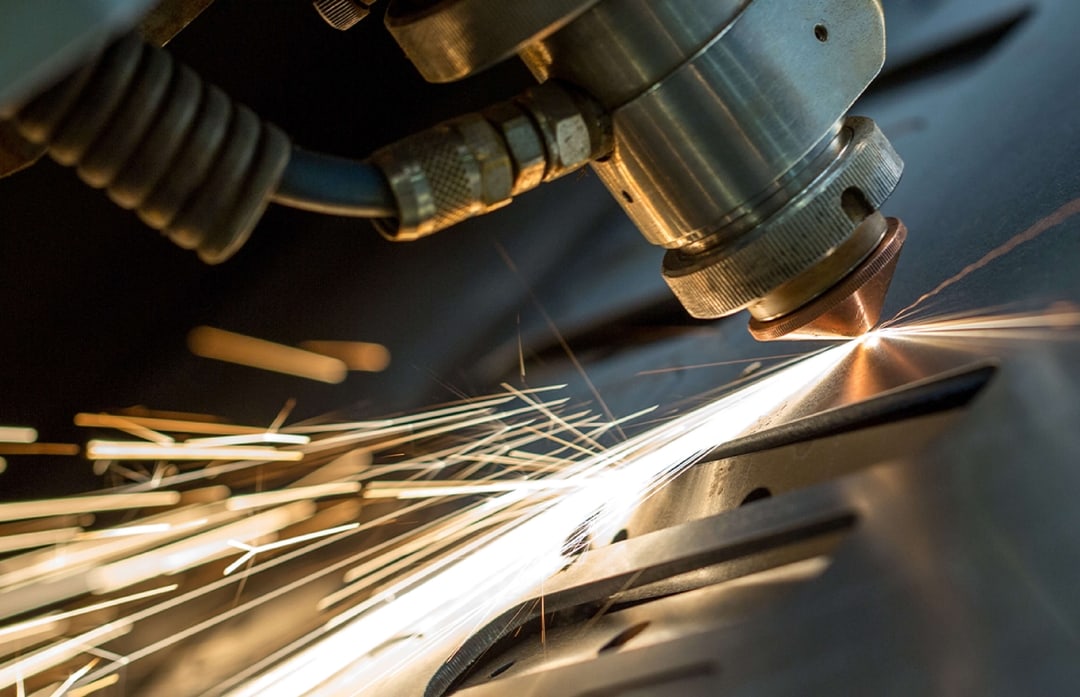
Laser cutting head cutting sheet metal, with sparks
01
2–20bar
Nitrogen or argon in fusion cutting, per TRUMPF
02
6bar
Oxygen in flame cutting, up to, per TRUMPF
03
3mm
Sheet thickness for compressed air cutting, up to, per TRUMPF
04
+3°C
Pressure dew point of the air for one TRUMPF machine
Where the gas and air go

Six jobs for gas and air on a laser cutter.

TRUMPF's laser cutting process pages and catalogue, and a pre-installation checklist from the laser machine builder Mazak Optonics, describe these uses.

Flame cutting

Oxygen into the kerf

Oxygen is the cutting gas, blown in at up to 6 bar; its reaction with the metal releases up to five times the laser energy and assists the beam.

Fusion cutting

Nitrogen or argon

Inert gas at 2 to 20 bar blows the melt out of the kerf and shields the cut edge from the air, so edges come out oxide free.

Compressed air cutting

Air as the cutting gas

On thin sheet, compressed air can be used besides oxygen and nitrogen; TRUMPF says it raises surface roughness, lowers cut quality and works up to 3 mm.

Optics

Cleaning the protective window

Mazak Optonics machines routinely use compressed air to clean the protective window; the builder says poor air quality can contaminate the laser optics.

Machine functions

Pneumatics and torch maintenance

Compressed air is required for essential machine functions, including torch maintenance and pneumatic processes, per Mazak Optonics.

Extraction

The dust collector

The dust collector is connected to compressed air too; Mazak Optonics specifies ISO 8573-1:2001 Class 4.4.4 for it.

Sources: TRUMPF, laser cutting process pages (flame cutting, fusion cutting) and TruServices product enhancements catalogue (compressed air cutting); Mazak Optonics, Pre-Installation Checklist, 6 December 2021.

Air quality at the machine

What two builders ask of the air.

The machine builder sets the air quality. These are two published examples, both as ISO 8573-1:2001 classes, read in the order particles, humidity, oil.

TRUMPF TruLaser 2030 fiber

Classes 7, 4 and 4

Dust-free to class 7 (particles up to 40 µm, 10 mg/m³), condensate-free to class 4 (cooled to a +3 °C pressure dew point, with a cold dryer) and oil-free to class 4 (5 mg/m³ maximum), from an oil-free screw compressor with an active carbon filter.

Source: TRUMPF, TruLaser 2030 fiber pre-installation manual, Tab. 2-21.
Mazak Optonics

Class 2.2.1 for the laser

Mazak Optonics specifies ISO 8573-1:2001 Class 2.2.1 for the laser and Class 4.4.4 for the dust collector, and says a pre-air filter is vital to meet these air quality standards.

Source: Mazak Optonics, Pre-Installation Checklist (2021).

Piping

50 m at most

TRUMPF places the compressor no more than 50 m from the machine and limits the ring main to 50 m, because condensation water can form over longer distances.

Source: TRUMPF, TruLaser 2030 fiber pre-installation manual, Tabs. 2-20 and 2-21.

The order particles, humidity, oil is the order of the TRUMPF table and the Mazak checklist. The manual for the specific machine sets the requirement.

Cutting gas supply

One machine's gas and air figures.

The pre-installation manual of the TRUMPF TruLaser 2030 fiber gives these purities and pressures. Other machines and builders differ.

Source: TRUMPF, TruLaser 2030 fiber pre-installation manual (B1034en, Version 3), section 3.1 and Tabs. 2-7, 2-19 and 2-21. Flows are volumes under standard conditions at 100% on-time.
GasPurity or classAt the nozzle (example)At the machine connection
Oxygen, standard pressure3.5 (99.95% by vol.)6 bar, 1.7 mm nozzle, 10 m³/hat least 8 bar
Oxygen, high pressure3.5 (99.95% by vol.)12 bar, 1.7 mm nozzle, 20 m³/hat least 15 bar
Nitrogen, high pressure5.0 (99.999% by vol.) recommended; 4.0 (99.99%) in exceptional cases20 bar, 2.7 mm nozzle, 90 m³/hat least 27 bar
Compressed air (option)ISO 8573-1:2001 classes 7, 4, 4a 2.7 mm nozzle needs at least 7.5 bar in the network7–12 bar network; about 40 m³/h with compressed air cutting

One supplier. Made and serviced in Portugal.

Ultra Controlo is a Portuguese manufacturer of compressed air, vacuum and technical gas systems, with 40 years of experience. We design, assemble and test our own compressors, dryers and carbon towers in Portugal, and supply and service five partner brands.

Our own lines

ULTRASCREW compressors, ULTRASEC and ULTRADRY dryers and ULTRAK activated carbon towers.

Five partner brands

Gardner Denver, Elmo Rietschle, Thomas, Speck Pumpen (Circutec) and Speck Triplex.

UltraCare, 24/7

Preventive and corrective maintenance, original spare parts and emergency support, by our own team.

Source: Ultra Controlo Industrial 2026 catalogue, pp. 3, 10, 16, 17 and 22.

Questions

Laser cutting: questions and answers.

What gases does laser cutting use?

TRUMPF describes oxygen for flame cutting, blown into the kerf at up to 6 bar, nitrogen or argon for fusion cutting at 2 to 20 bar, and nitrogen, argon or helium for sublimation cutting. Some machines can also cut with compressed air.

Can a laser cut with compressed air?

Yes, on thin material. TRUMPF says compressed air can be used as a cutting gas in addition to oxygen and nitrogen, that it increases surface roughness and decreases cut quality, and that it works up to a sheet thickness of 3 mm, depending on laser output and material.

What compressed air quality does a laser cutter need?

The machine builder sets it. TRUMPF's TruLaser 2030 fiber manual asks for ISO 8573-1:2001 classes 7, 4 and 4, with a +3 °C pressure dew point and at most 5 mg/m³ of oil; Mazak Optonics specifies Class 2.2.1 for its lasers.

What nitrogen purity does laser cutting need?

For optimum cutting results and process stability, TRUMPF recommends nitrogen of purity 5.0 (99.999% by volume) for its TruLaser 2030 fiber, and says purity 4.0 (99.99%) can be used in exceptional cases but may impair cut quality.

Does Ultra Controlo supply equipment for laser cutting air?

The Ultra Controlo catalogue lists ULTRASEC refrigerated dryers with a stable +3 °C dew point, ULTRAK activated carbon towers and, from partner brand Gardner Denver, oil-free screw compressors: the equipment types the TRUMPF manual recommends for its compressed air.

Related

Related industries.

Tell us about your cutter.

The machine, the cutting gas, the air class in its manual and the hours per day. We reply with the equipment that fits.