How to choose an anaesthetic gas scavenging system.
To choose an anaesthetic gas scavenging system (AGSS), compare suppliers on eight points: the rooms it serves, the flow settings, the pump layout, the pumps and their capacity, the control and alarms, the separation from vacuum, the standards and certificates, and the testing and service.
Eight questions before you buy.
Ask every AGSS manufacturer the same eight questions, in writing, and compare the answers side by side.
| Check | What to ask the manufacturer |
|---|---|
| 1. Rooms served | Which rooms will have terminal units, and what is the plant sized for? |
| 2. Flow settings | Which receiving systems are in use, and can the flow be set for high-flow and low-flow systems? |
| 3. Pump layout | Simplex, duplex or triplex, and what happens when a pump stops? |
| 4. Pumps and capacity | Which pump technology, which capacity per pump and which suction level? |
| 5. Control and alarms | How does the plant show a fault, and can it report to the building management system? |
| 6. Separation from vacuum | Is the system separate from the medical vacuum, and where does it discharge? |
| 7. Standards and papers | Which standard, which CE class and which quality system certificates? |
| 8. Testing and service | Who tests and recommissions it, and how often does it need service? |
The rooms it serves.
List the rooms that will have an AGSS terminal unit, then ask what the plant is sized for.
An AGSS captures waste anaesthetic gases from the patient’s breathing circuit and removes them from the operating room, protecting staff from long-term exposure. The anaesthetic breathing circuit connects via a receiver unit to the terminal unit, which is generally installed close to the point of use.
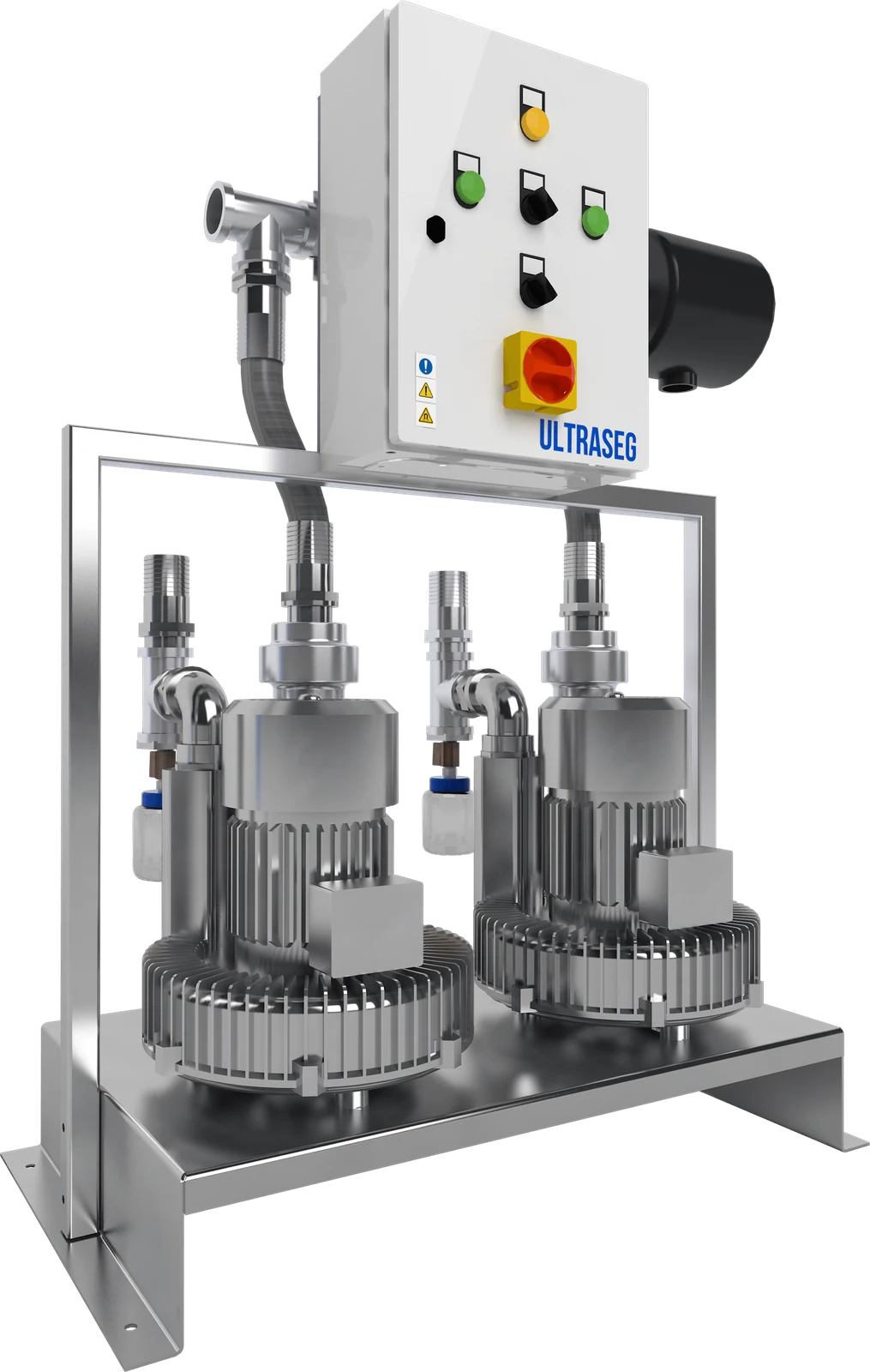
ULTRASEG is an active system based on suction of anaesthetic gas mixtures from operating rooms and others fitted with nitrous oxide terminal units. Each pump delivers 50 to 315 m³/h at 50 Hz, depending on the model, and other capacities are available on request.
The flow settings.
Ask which anaesthetic gas scavenging receiving systems are in use, and how the flow at each terminal unit is set.
Ask how the flow is set at each terminal unit, who sets it on site, and whether the plant can serve both high-flow and low-flow systems.
ULTRASEG is designed to work with AGSS receiver units. Its terminal units have an adjustable orifice that allows the flow to be set for high-flow and low-flow systems.
The pump layout.
Ask whether the plant is simplex, duplex or triplex, and what keeps it running when a pump stops.
Ask the supplier to show on the drawing which pump runs, which one waits, and how the changeover is controlled.
Standard layouts are SIMPLEX, DUPLEX and TRIPLEX, with a Manual/Stop/Auto selector and a run and fault indicator light per pump. In the duplex version one pump runs while the other stands by.
The pumps and capacity.
Ask which pump technology is used, the capacity per pump at the stated suction level, and whether variable speed is offered.
Compare capacity at the suction level the system works at, not only the nominal flow. An AGSS runs at a much lower suction level than clinical vacuum.
ULTRASEG uses fully dry running, air cooled side channel vacuum blowers using Elmo Rietschle technology, at −0.2 bar, with motors of 0.2 to 2.2 kW per pump. Variable speed by frequency converter is an option. There are 12 models, from the H50 and E50 (50 m³/h) to the E300 (315 m³/h at 50 Hz).
Control, indicators and alarms.
Ask what the control panel shows, which alarms it gives, and how it connects to a building management system.
Ask for the list of alarms, where each one is shown, and whether the contacts are potential-free.
The control panel has a digital vacuum controller and level display, a remote interface for OT terminal units and Modbus TCP/IP. Alarms are visual and audible, with low pipeline vacuum alarms, potential-free contacts and an alarm log capacity of 2 to 8 GB. Supplementary information for Building Management Systems (BMS) or remote information is offered as an option, as is a QuVac remote monitoring panel (4G/ETH).
Separate from the vacuum.
Ask whether the system is separate from the medical vacuum, and where it discharges.
Medical vacuum provides clinical suction at a stronger vacuum, while an AGSS removes anaesthetic gases at a much lower suction level, and its disposal system has its own standard, EN ISO 7396-2. Clinical vacuum runs at −0.75 to −0.85 bar. Anaesthetic gas scavenging runs at −0.2 bar.
ULTRASEG works at −0.2 bar under EN ISO 7396-2, and ULTRAVAC at −0.75 to −0.85 bar.
Standards and papers.
Ask which standard the plant is built to, its CE class and the quality system certificates.
Ask for the certificate number, the notified body and the declaration of conformity, and check that they name the product you are buying.
ULTRASEG is manufactured in accordance with EN ISO 7396-2 and built in accordance with HTM 02-01, the NHS England guidance. It is Medical CE marked (CE 1639) under Directive 93/42/EEC as a Class IIa medical device, and produced under ISO 13485:2016 and ISO 9001:2015.
Testing, recommissioning and service.
Ask who tests the plant, how it is recommissioned, how often it needs service, and who trains your technicians.
Ask what the supplier delivers: factory tests, commissioning on site, staff training and the service interval of the pumps.
ULTRASEG arrives pre-assembled, set up and tested in the factory. On medium and large plants, factory technicians supervise commissioning and staff training. Up to 20,000 operating hours between services; preventive care is typically an annual inspection, with occasional replacement of the suction-side filter element.
Questions buyers ask before choosing an AGSS.
Questions hospitals ask us about anaesthetic gas scavenging. More on the medical gas answers page.
What should I compare when buying an anaesthetic gas scavenging system?
To choose an anaesthetic gas scavenging system (AGSS), compare suppliers on eight points: the rooms it serves, the flow settings, the pump layout, the pumps and their capacity, the control and alarms, the separation from vacuum, the standards and certificates, and the testing and service.
Is AGSS the same as medical vacuum?
No. Medical vacuum provides clinical suction at a stronger vacuum, while an AGSS removes anaesthetic gases at a much lower suction level, under its own standard, EN ISO 7396-2. ULTRAVAC works at −0.75 to −0.85 bar and ULTRASEG at −0.2 bar.
Is ULTRASEG compatible with our receiver units?
ULTRASEG is designed to work with AGSS receiver units. Its terminal units have an adjustable orifice that allows the flow to be set for high-flow and low-flow systems.
How often does ULTRASEG need service?
Up to 20,000 operating hours between services. Preventive care is typically an annual inspection, with occasional replacement of the suction-side filter element.
Which layouts are available?
SIMPLEX, DUPLEX and TRIPLEX, with a Manual/Stop/Auto selector per pump. In the duplex version one pump runs while the other stands by.
Is Ultra Controlo a manufacturer or a distributor of anaesthetic gas scavenging systems?
Ultra Controlo is the manufacturer. It designs ULTRASEG and assembles and tests it in its own factories in Portugal.
Ready to discuss anaesthetic gas scavenging for your hospital?
Tell us about your site. Our engineering team sizes the configuration and sends a quote.