The complete guide CE 1639 · MDR Class IIb

Medical air plants for hospitals: the complete guide.

How oil-free medical air plants supply pharmacopoeia-grade breathable air to hospital pipelines under EN ISO 7396-1, why hospitals build redundant duplex systems, and how to specify the right plant for your facility. Engineered in Lisbon since 1981, deployed in 80+ countries.

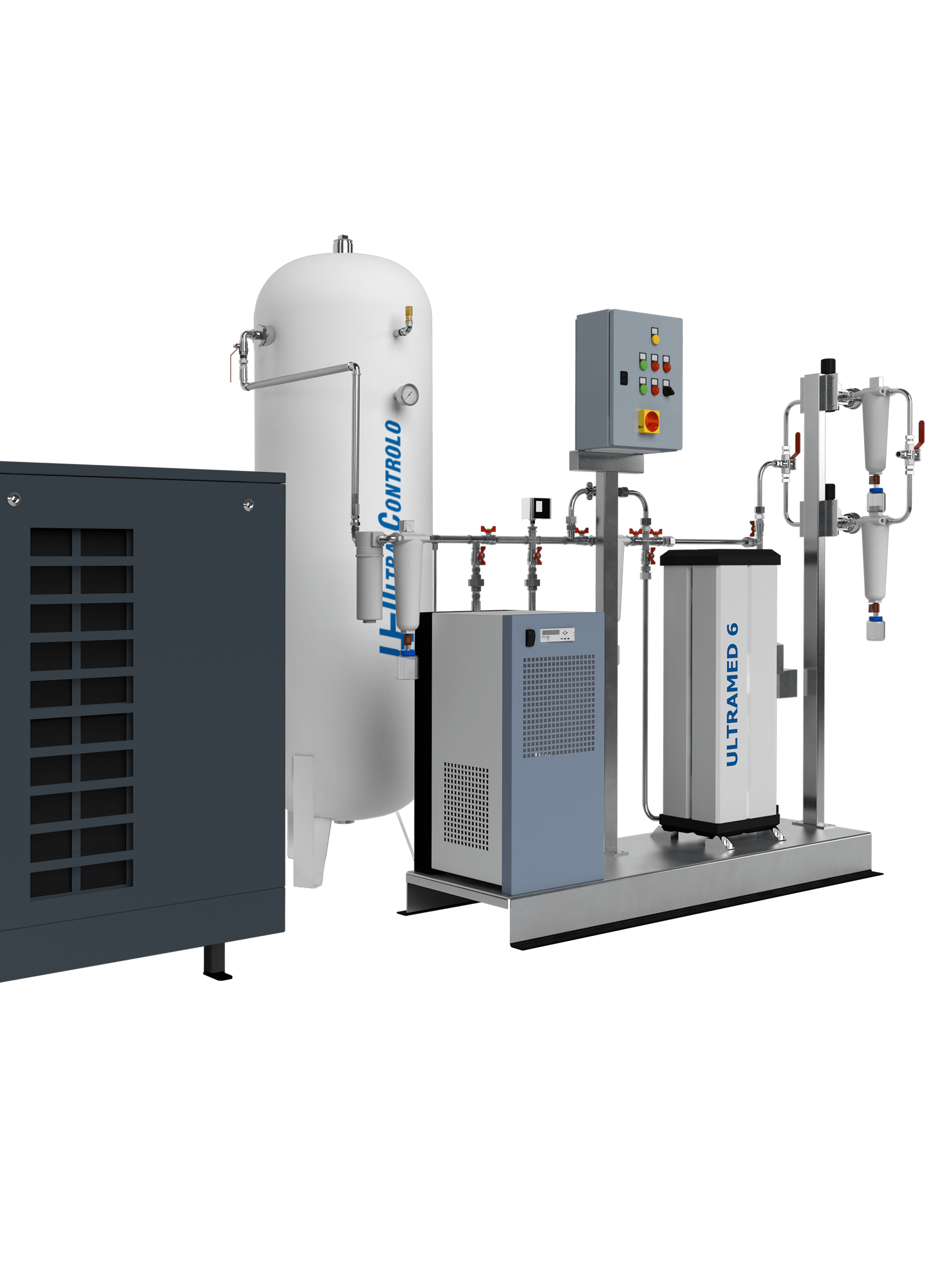
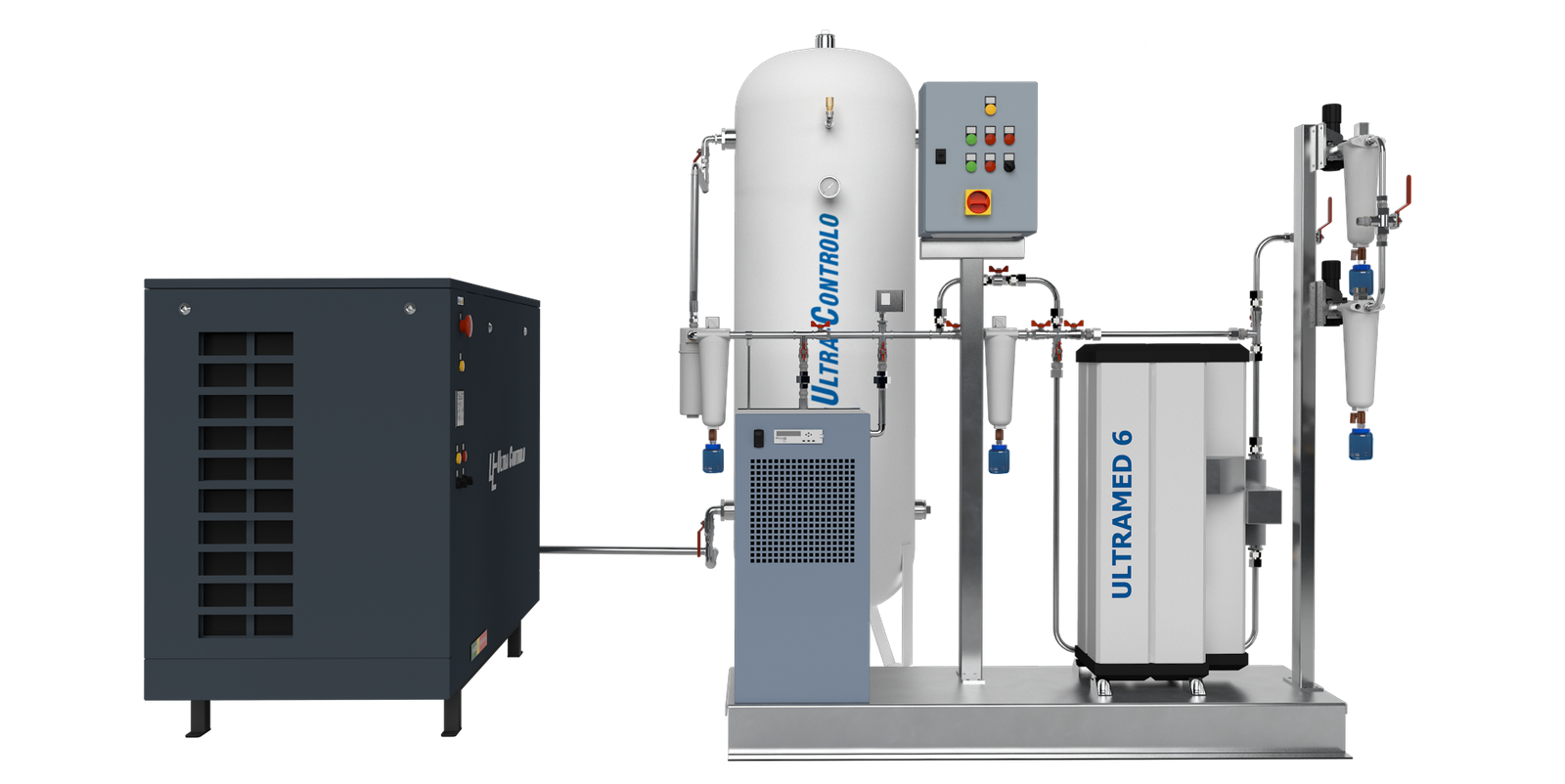
ULTRAAR oil-free medical air plant by Ultra Controlo
Pipeline standard
EN ISO7396-1
Hospital medical gas pipelines
Pipeline pressure
4bar
Standard medical air outlet pressure
Dewpoint
−40°C
Pressure dewpoint after treatment chain
Compressor type
100%
Oil-free for medical applications
Countries deployed
80+
Hospitals, ministries of health, NGOs
What is a medical air plant

Breathable air, produced and treated at your facility.

Medical air is one of the most consumed gases in any modern hospital. Unlike industrial compressed air, medical air is inhaled directly by patients in intensive care, surgery, anaesthesia, and neonatal departments. It must therefore be produced under medical-device controls, treated to pharmacopoeia-grade purity, and delivered at consistent 4 bar pipeline pressure 24 hours a day.

Medical air explained

From ambient air to ventilator-ready output.

A complete medical air plant compresses ambient air using oil-free scroll or screw compressors, then passes it through a multi-stage treatment chain that removes water, particulates, residual oils, hydrocarbons, and microbes before delivering it to the hospital pipeline.

A medical air plant is a complete medical-device system that produces breathable, pharmacopoeia-grade compressed air on site. It includes oil-free compressors, dryers, multi-stage filtration, regulators, monitoring instruments, and an EN ISO 7396-1 compliant control panel.

Why oil-free is non-negotiable

Lubricated industrial compressors leak microscopic oil aerosols into the compressed air. In industrial use this is harmless. In a hospital, oil aerosols inhaled through ventilators can cause severe respiratory complications. Oil-free compression is therefore mandatory for medical air production under EN ISO 7396-1 and the European Pharmacopoeia.

ULTRAAR plants use only oil-free scroll and screw compressors. The complete plant is certified as a Class IIb medical device under MDR (EU) 2017/745.

Treatment chain · ambient to ventilator
6 stages
01
Oil-free compressionScroll or screw, ULTRASCREW or ULTRACECO SC
02
Pre-filtrationCoalescing filter removes particulates
03
Refrigerant or desiccant dryingULTRADRY, dewpoint to −40°C
04
Multi-stage filtrationULTRAMED · coalescing + activated carbon
05
Sterile final filtrationULTRATECH 0.01 micron sterile grade
06
Pipeline regulation & monitoring4 bar outlet, EN ISO 7396-1 compliant
How a medical air plant works

Four functional stages, one continuous pipeline supply.

Medical air plants are complex systems. Four functional stages must work together continuously to deliver pharmacopoeia-grade air at the bedside.

EN ISO 7396-1 compliant
01

Oil-free compression of ambient air

Filtered ambient air is compressed by oil-free scroll or screw compressors. The compression chamber never contacts lubricant, so the compressed air remains free of hydrocarbon contamination from the very first stage. ULTRASCREW VSD compressors deliver capacity matched to actual hospital demand.

Oil-free guaranteed
02

Drying and treatment chain

Compressed air carries water vapour that must be removed before pipeline distribution. ULTRADRY refrigerant or desiccant dryers reduce the pressure dewpoint to −40°C, preventing condensation and microbial growth. Multi-stage coalescing and carbon filters remove particulates, residual oil, and odours.

−40°C dewpoint
03

Buffer and pipeline regulation

Treated air is stored in a receiver tank that buffers consumption peaks and ensures stable supply. A pressure regulator delivers air to the hospital pipeline at the standard 4 bar medical air pressure. Duplex systems include two parallel production lines for redundancy under EN ISO 7396-1.

4 bar pipeline standard
04

Continuous monitoring & auto-failover

Onboard sensors continuously track pipeline pressure, dewpoint, residual oil content, and CO/CO₂ levels. Any out-of-spec drift triggers alarms, automatic failover to a backup source (cylinders or second production line), and notification to biomedical engineering staff and Ultra Controlo's UltraCare service centre.

24/7 remote diagnostics
Why on-site air

Four reasons hospitals build their own medical air supply.

Unlike oxygen, medical air cannot be practically supplied from cylinders at hospital scale. On-site production is the only viable model and the right partner makes the difference between a system that runs reliably for two decades and one that fails repeatedly.

Reason 01

Demand exceeds cylinder economics

A medium hospital with 100 beds, 6 ICU positions, and 4 operating theatres can consume 50 to 100 Nm³/hour of medical air. Supplying this from cylinders requires hundreds of bottle changes per week. On-site plants eliminate the logistics burden entirely with electricity and ambient air as the only inputs.

50–100 Nm³/h
typical mid-size hospital demand
Reason 02

Continuity matters most for ventilator patients

Loss of medical air supply for patients on mechanical ventilation is a Class A clinical event. EN ISO 7396-1 mandates redundant supply with auto-failover. Duplex configurations with two parallel production lines satisfy regulatory requirements and clinical risk frameworks. ULTRAAR ME and DS configurations are designed for full duplex redundancy.

24/7/365
duplex redundancy with auto-failover
Reason 03

Lowest cost per Nm³ over the lifecycle

An on-site oil-free medical air plant has an operational lifespan of 15 to 20 years. Capital is recovered within 18 to 36 months. Running cost is essentially the cost of electricity to drive the compressor. Over a 10-year horizon, on-site air is the lowest cost per Nm³ option for any hospital above 20 Nm³/hour demand.

15–20 yr
operational lifespan with UltraCare maintenance
Reason 04

Compliance built in by design

ULTRAAR plants are complete medical devices, not assembled from generic industrial components. Every plant is certified CE 1639 under MDR (EU) 2017/745, manufactured under ISO 13485:2016 quality system, and delivered with full EN ISO 7396-1 documentation and commissioning support.

CE 1639
MDR Class IIb · ISO 13485
Supply options compared

On-site air, cylinders, and shared compression, compared.

Three approaches exist for hospital medical air supply. Only one scales to modern hospital demand at sustainable cost.

Method 1
Cylinders
Bottled medical air, delivered
Method 2
Shared industrial compressor
Repurposed industrial unit + treatment
Capacity vs hospital demand
Insufficient at scale
Often undersized
Oil-free certified
Yes (factory filled)
Often not (industrial)
EN ISO 7396-1 compliance
Partial (cylinders only)
No
Cost per Nm³
Highest by 5–10×
Medium
Continuity risk
High · logistics dependent
Medium · single point of failure
Manufacturer accountability
Gas supplier
Distributed (no single owner)
Best for
Backup & small clinics
Not recommended for medical use
Important: Repurposing industrial compressors for medical air is non-compliant with EN ISO 7396-1 and MDR. ULTRAAR is sold as a complete medical device with single CE certification covering compressors, dryers, filters, and pipeline interface.
ULTRAAR oil-free medical air plant configuration
ULTRAAR® Complete medical device
The reference medical air plant

ULTRAAR. The complete medical air solution.

ULTRAAR is a complete medical air plant certified as a Class IIb medical device under MDR (EU) 2017/745. Engineered and manufactured in Lisbon since 1981. Available in compact, scroll, screw, and modular extended-capacity configurations to match any hospital demand profile.

Pipeline pressure
4 bar standard
Adjustable from 4 to 10 bar
Certification
CE 1639
MDR Class IIb · ISO 13485:2016
Compression
100% oil-free
Scroll or ULTRASCREW VSD screw
Dewpoint
−40°C PDP
After ULTRADRY treatment chain
Containerised medical air plant deployed in cold-climate environment
Containerised Any environment
Built for any environment

From Saharan deserts to Arctic snowfields.

ULTRAAR plants are deployed in extreme operating conditions worldwide: high-altitude clinics, desert hospitals, tropical humidity, and below-freezing latitudes. Containerised configurations arrive pre-assembled, factory-tested, and ready to commission in 24 to 72 hours.

Operating range
−20°C to +50°C
Deploy time
24 to 72 hours
Infrastructure
Self-contained
Form factor
20 ft / 40 ft container
Inside the system

Engineered to medical-device standards. Built to last.

Every ULTRAOX is assembled in our Lisbon facility under ISO 13485:2016 quality control. Oil-free compressors, premium zeolite molecular sieves, redundant gas analysers, and continuous monitoring systems all integrated into a single CE 1639 certified medical device.

  • Oil-free compression Mandatory for medical oxygen. No hydrocarbon contamination at any stage of production.
  • Premium zeolite molecular sieves Long-life adsorbent material engineered for continuous duty cycles and high purity output.
  • Redundant gas analysers Continuous monitoring of O₂ purity, residual moisture, CO and CO₂. Auto-failover on out-of-spec.
  • Remote diagnostics ready Optional remote telemetry for predictive maintenance and 24/7 oversight by Ultra Controlo engineers.
ULTRAOX PSA medical oxygen generator close-up detail
Real-world deployments

ULTRAOX in service. Hospitals on five continents.

Real PSA oxygen plants delivered, commissioned, and supported by Ultra Controlo. Ministries of health, UN agencies, the Global Fund, and NGO partners across Africa, the Middle East, and Latin America.

CV
2024
Cabo Verde · Praia

Hospital Agostinho Neto regional referral hospital

A ULTRAOX ST PSA generator with redundant compression and dual-tower production serves a 220-bed regional referral hospital across the Sotavento islands. Twin-tower configuration ensures continuous supply during maintenance windows.

Beds
220
Configuration
ULTRAOX ST
Ministry of Health partnership
ML
2026
Mali · Bamako + Kayes

Two ULTRAOX duplex plants commissioned by the Minister of Health

A ULTRAOX duplex PSA system at Hôpital Dermatologie de Bamako and a Ministerial inauguration of an ULTRAOX in Kayes by Colonel Major Dr Assa Badiallo Touré. National oxygen production capacity strengthened across two regions.

Plants
2 duplex
Inauguration
Ministerial
Ministry of Health Mali
YE
2025
Yemen · Zabeed

Zabeed General Hospital ULTRAOX 180D ST

A high-capacity ULTRAOX 180D ST with 2×ULTRASCREW 37 VSD PM oil-free compressors and 2×ULTRACON 10 PSA modules. Designed for high-demand regional hospital operations under challenging supply conditions.

Capacity
180 Nm³/h
Compressors
2×37 kW VSD
Humanitarian deployment
AO
2026
Angola · Benguela

UNDP and Global Fund national programme

Inauguration of ULTRAOX at Hospital de Benguela under a national UNDP and Global Fund programme covering up to 8 hospitals nationwide. Complete supply, installation, training, and lifecycle support across regional facilities.

Hospitals
Up to 8
Donor
UNDP + GF
UNDP · Global Fund
PE
Active
Peru · High-altitude Andes

Andean clinic high-altitude PSA installation

An ULTRAOX system operating at high altitude in the Peruvian Andes, supplying critical care services to remote mountain populations. Demonstrates ULTRAOX viability across extreme operating environments and altitudes.

Environment
Andean
Altitude
High
Latin America deployment
BD
2024
Bangladesh

ULTRAAR ME 2.60/1000 medical air plant

Companion ULTRAAR ME 2.60/1000 UD DS 4G PO medical air plant with 2×ULTRASCREW 7 FSD compressors, 1000L receiver, and full ULTRADRY treatment chain. Demonstrates Ultra Controlo's complete medical gas pipeline capability.

Capacity
2×52 Nm³/h
Pressure
10 bar max
Hospital procurement
Sizing & specification

How to size a PSA oxygen system for your hospital.

Choosing the right PSA system requires understanding your facility's actual and projected oxygen demand. Five factors determine the appropriate system size.

Ultra Controlo's engineering team provides free pre-project site assessments and system sizing consultations as part of every project enquiry.

Request free sizing assessment
01

Peak flow rate, not average

Medical oxygen systems must be sized for peak demand, not average demand. Peak typically occurs in the ICU, operating theatres, and emergency departments simultaneously. A system sized only for average consumption will be insufficient during high-demand events.

02

Active beds and clinical specialisms

General ward beds typically consume less oxygen per hour than ICU or surgical beds. A hospital with 10 ICU beds may consume more oxygen than one with 50 general ward beds. Specialty mix affects total demand significantly.

03

Pipeline pressure requirements

Hospital pipeline systems typically operate at 4 bar. The PSA system must maintain this pressure at peak flow continuously. ULTRAOX outlet pressure spans 4 to 10 bar across all configurations to suit varied pipeline standards.

04

Backup and redundancy requirements

Regulatory requirements and clinical risk assessments often mandate a backup oxygen source: either a cylinder manifold or a second PSA production line, to cover maintenance periods and system faults. Duplex configurations provide built-in redundancy.

05

Growth projections

A system sized only for current demand may be insufficient within 3 to 5 years. Modular systems, where additional production capacity can be added as demand grows, are preferable for facilities undergoing expansion. ULTRAOX modular design supports incremental capacity growth.

Standards & certification

The compliance stack required for hospital oxygen.

A hospital PSA oxygen generator must satisfy multiple international standards. ULTRAOX holds the complete medical-device compliance stack.

CE 1639

MDR (EU) 2017/745 Class IIb

Medical device certification under the European Medical Device Regulation. Required for hospital oxygen generators sold or operated in the EU and aligned markets.

ISO 13485:2016

Manufacturer quality system

Quality management system certification for medical device manufacturers. Governs design, production, and post-market surveillance processes throughout the device lifecycle.

EN ISO 7396-1

Medical gas pipeline systems

European standard for medical gas pipeline systems. Specifies design, installation, function, performance, documentation, testing, and commissioning of compressed medical gas pipelines.

Oxygen 93

EU + US Pharmacopoeia

Pharmacopoeia grade designation for medical oxygen produced by PSA. Both European Pharmacopoeia and US Pharmacopeia specify minimum 93% purity (±3%) for clinical use.

Frequently asked questions

Common questions about PSA oxygen for hospitals.

Answers from our engineering team to the questions hospital procurement, biomedical engineers, and ministries of health most often ask.

What is a PSA medical oxygen generator?

A PSA (Pressure Swing Adsorption) medical oxygen generator is a medical device that produces oxygen continuously from ambient air at the point of care. It separates oxygen from nitrogen using zeolite molecular sieves under alternating pressure cycles, delivering up to 95% pure oxygen directly to the hospital pipeline.

ULTRAOX was the first PSA oxygen plant certified as a medical device under the European Directive.

Can PSA oxygen be used for all clinical applications, including intensive care and surgery?

Yes. PSA-generated oxygen meeting pharmacopoeia purity standards (Oxygen 93, minimum 93% O₂) is clinically equivalent to cylinder or liquid oxygen and is appropriate for all hospital applications, including:

Mechanical ventilation, anaesthesia, neonatal care, hyperbaric oxygen therapy, surgical theatres, ICU bedside delivery, and emergency resuscitation.

How long does it take to install a PSA oxygen system?

Installation timelines vary by facility:

Indoor installation (ULTRAOX SC or ST) in a prepared technical room can be commissioned within 2 to 4 weeks of equipment arrival.

Containerised installation (ULTRAOX CO) can be operational in 24 to 72 hours, as systems arrive pre-assembled and require only utility connections.

What are the electricity requirements for a PSA oxygen generator?

Power consumption depends on production capacity. As a general reference, a system producing 20 Nm³/hour of oxygen typically consumes approximately 7 to 10 kW.

Ultra Controlo provides precise power specifications during the site assessment phase and offers UltraGreen renewable-energy compatibility for solar-powered or hybrid installations.

What maintenance does a PSA system require?

A well-designed PSA system requires periodic preventive maintenance every 6 to 12 months. This covers filter replacement, zeolite sieve inspection, compressor servicing, and calibration of the monitoring system.

Ultra Controlo's UltraCare programme provides scheduled preventive maintenance, corrective maintenance on demand, 24/7 international technical support, and a genuine spare parts service.

Is PSA oxygen generation approved by the WHO?

Yes. The World Health Organisation recommends on-site PSA oxygen generation as an appropriate method for producing medical oxygen in healthcare facilities, particularly in low- and middle-income countries.

WHO technical specifications for PSA oxygen generators are publicly available and consistent with the design parameters of certified systems like ULTRAOX.

What certifications should a hospital PSA oxygen generator have?

A hospital PSA oxygen generator must hold:

CE marking under MDR (EU) 2017/745 as a Class IIb medical device. ISO 13485:2016 quality system certification for the manufacturer. Oxygen output compliant with EN ISO 7396-1 pipeline standards. Pharmacopoeia (Oxygen 93) purity grade.

ULTRAOX is certified CE 1639 under MDR Class IIb.

How does PSA compare to liquid oxygen (LOX) for hospitals?

PSA generation produces oxygen on-site continuously from ambient air, eliminating delivery dependencies. LOX requires regular tanker deliveries from specialist suppliers and cold storage infrastructure.

PSA is typically more cost-effective above 10 to 15 Nm³/hour continuous demand and provides supply chain independence. LOX may suit very large urban hospitals with reliable supplier access and high daily oxygen consumption.

Can the system operate in hot climates or remote locations?

Yes. The containerised ULTRAOX CO system is specifically designed for deployment in extreme environments, including:

Deserts, tropical climates, high-altitude locations, coastal humidity, and sites with no existing technical infrastructure. ULTRAOX systems are operating in environments ranging from the Sahara to coastal Cabo Verde to high-altitude Andean clinics.

What is the typical payback period for a PSA oxygen generator?

The capital investment in a PSA system is typically recovered within 12 to 36 months, depending on the facility's oxygen consumption and the local cost of cylinder supply.

Over a 10-year operational lifespan, savings often exceed 70 percent of the equivalent cylinder supply cost.

What oxygen purity does ULTRAOX produce?

ULTRAOX consistently delivers oxygen at up to 95% purity, exceeding the minimum 93% purity required by both European Pharmacopoeia and United States Pharmacopeia for medical oxygen produced by PSA methods (Oxygen 93 grade).

Where is ULTRAOX manufactured and deployed?

ULTRAOX is engineered and manufactured in Lisbon, Portugal by Ultra Controlo since 1981.

The systems are deployed in hospitals, ministries of health, UN agencies, and NGO programmes across more than 80 countries, including Cabo Verde, Mali, Angola, Yemen, Peru, Bangladesh, and many others across Africa, the Middle East, Latin America, and Southeast Asia.

Request a project assessment

Ready to discuss oxygen for your hospital?

Ultra Controlo provides free project assessments, system sizing consultations, and technical support throughout the procurement and installation process. Our engineering team in Lisbon is available to discuss your facility, your timeline, and your compliance requirements.

CE 1639
MDR Class IIb
ISO 13485:2016
80+ countries
Since 1981