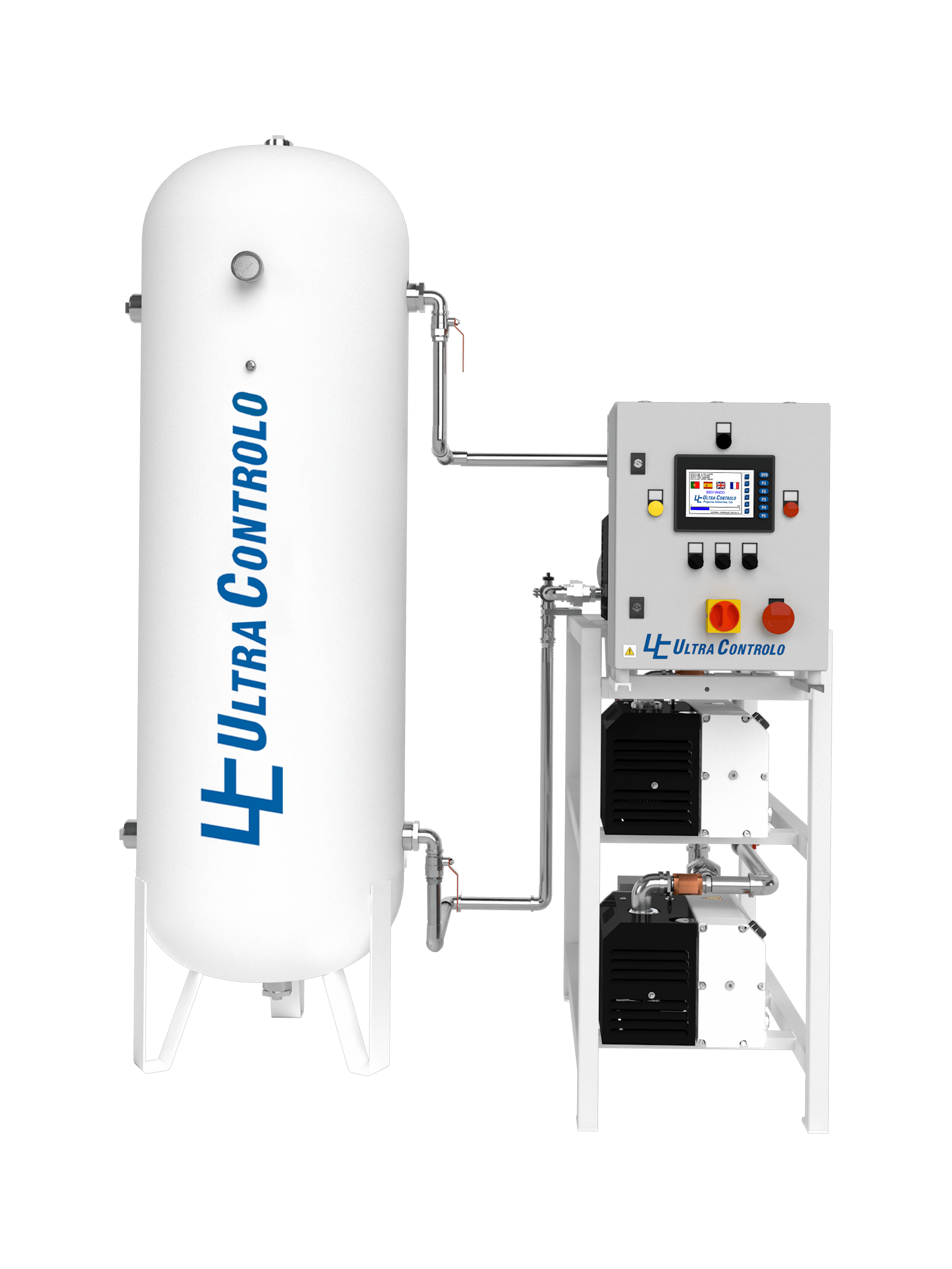
How oil-free medical vacuum plants and AGSS systems serve hospital pipelines under EN ISO 7396-1, why every operating theatre needs both, and how to specify the right plant for your facility. Engineered in Lisbon since 1981, deployed in 80+ countries.
Medical vacuum is the fourth core medical gas pipeline service in any modern hospital, alongside oxygen, medical air, and AGSS. It powers surgical suction, bedside aspiration, fluid drainage, and clinical waste handling 24 hours a day. Without reliable medical vacuum, no operating theatre, ICU bed, or emergency department can function.
A complete medical vacuum plant uses oil-free or oil-sealed vacuum pumps to maintain continuous negative pressure throughout the hospital pipeline. Aspirated fluids are collected in jars at the point of use; the gas component flows through bacterial filters before being exhausted safely outside the building.
Hospitals use vacuum for distinctly different clinical purposes. The pipeline must be sized to handle peak simultaneous demand across all four:
Medical vacuum plants are integrated systems. Four functional stages must work together continuously to maintain pipeline vacuum and handle aspirated material safely.
Oil-free or oil-sealed vacuum pumps create and maintain negative pressure in the pipeline. ULTRAVAC plants use proven rotary vane, claw, or screw vacuum pump technologies sized to actual hospital demand. Pumps cycle on demand based on pipeline pressure feedback.
Oil-free optionsA vacuum reservoir buffers consumption peaks and maintains stable pipeline pressure during rapid demand changes. Reservoir sizing is critical: too small causes pressure swings, too large wastes energy. ULTRAVAC reservoirs are sized specifically for each facility's profile.
500–700 mmHg pipelineVacuum pump exhaust contains aerosolised body fluids and gases that must be filtered before venting. ULTRAVAC plants include bacterial filtration on the exhaust line plus a safe vent path outside the building. AGSS exhaust is always vented separately.
Bacterial · external ventOnboard sensors continuously track pipeline vacuum level, pump status, and reservoir pressure. EN ISO 7396-1 mandates auto-failover to a backup pump on any out-of-spec parameter. Remote telemetry sends alarms to biomedical engineering staff and Ultra Controlo's UltraCare service centre.
24/7 remote diagnosticsUnlike oxygen and medical air, no real alternative exists for medical vacuum. Every hospital with surgical theatres, ICU beds, or inpatient wards must operate a dedicated vacuum plant. The question is not whether to install one, but how to specify it for reliability and lifecycle cost.
Every operating theatre, ICU bed, emergency room bay, and recovery position requires reliable vacuum. A medium hospital can have 50 to 200 active vacuum outlets, with peak simultaneous demand during morning surgical and admission rounds.
Surgical procedures cannot proceed without working suction. EN ISO 7396-1 mandates N+1 redundancy for hospital vacuum plants. Most installations use duplex or triplex pump configurations with auto-failover, allowing maintenance without service interruption.
Vacuum exhaust contains aerosolised body fluids and respiratory gases, which is a clinical and infection-control hazard if not managed correctly. Bacterial filtration on the exhaust line and external venting outside the building are mandatory under modern hospital design standards.
ULTRAVAC plants are complete medical devices, not assembled from generic industrial components. Every plant is certified CE 1639 under MDR (EU) 2017/745, manufactured under ISO 13485:2016 quality system, and delivered with full EN ISO 7396-1 documentation and commissioning support.
Three approaches exist for hospital vacuum supply. Only one delivers compliant, continuous service at the scale modern hospitals require.
500–700 mmHg
ULTRAVAC is a complete medical vacuum plant certified as a Class IIb medical device under MDR (EU) 2017/745. Engineered and manufactured in Lisbon since 1981. Available in standard, claw, low-noise, and dental configurations to match any hospital application.
Every operating theatre using inhaled anaesthetic agents (sevoflurane, isoflurane, desflurane, nitrous oxide) needs a dedicated Anaesthetic Gas Scavenging System (AGSS). AGSS captures waste anaesthetic gases from the breathing circuit and exhausts them safely outside the building, protecting surgical staff from chronic occupational exposure.
ULTRASEG is Ultra Controlo's dedicated AGSS solution. It runs as a separate pipeline from medical vacuum and is governed by EN ISO 7396-2, the standard specifically covering anaesthetic gas scavenging systems.
Every ULTRAVAC plant is assembled in our Lisbon facility under ISO 13485:2016 quality control. Vacuum pumps, reservoirs, bacterial filtration, monitoring instrumentation, and EN ISO 7396-1 control panels all integrated into a single CE 1639 certified medical device.
Real medical vacuum plants delivered, commissioned, and supported by Ultra Controlo. Ministries of health, UN agencies, and NGO partners across Africa, the Middle East, Latin America, and Southeast Asia.
A complete medical gas pipeline system serving this 220-bed regional referral hospital, including ULTRAVAC central vacuum plant alongside ULTRAOX oxygen and ULTRAAR medical air. Full pipeline distribution to all critical care areas.
Two complete medical gas pipelines including ULTRAVAC vacuum plants at Hôpital Dermatologie de Bamako and a Ministerial inauguration in Kayes. Vacuum coverage for surgical theatres, ICU, and inpatient wards.
Complete medical vacuum plant integrated with the wider medical gas pipeline including ULTRAOX 180D ST oxygen generation. Designed for high-demand regional hospital operations under challenging conditions.
Complete medical gas systems including ULTRAVAC vacuum plants at Hospital de Benguela under a national UNDP and Global Fund programme covering up to 8 hospitals nationwide. Complete supply, installation, training, and lifecycle support.
A complete medical gas system including vacuum services operating at high altitude in the Peruvian Andes, supplying critical care and surgical capability to remote mountain populations. Demonstrates ULTRAVAC viability across extreme environments.
A flagship hospital project including ULTRAAR medical air duplex (2×52 Nm³/h) and full ULTRAVAC vacuum plant commissioned together. Demonstrates Ultra Controlo's capability as single source for full medical gas pipeline systems.
Choosing the right plant requires understanding your facility's actual and projected vacuum demand. Five factors drive the right specification.
Ultra Controlo's engineering team provides free pre-project site assessments and system sizing consultations as part of every project enquiry.
Request free sizing assessmentSum of all bedside outlets is misleading. Peak simultaneous use matters. Diversity factors of 25 to 40 percent for general wards, 50 to 70 percent for ICU, and 80 to 95 percent for operating theatres are typical.
A facility with 4 active operating theatres can generate more vacuum demand than a 100-bed general ward hospital. Surgical and ICU mix dominates total m³/hour calculations.
EN ISO 7396-3 requires minimum 400 mmHg at every terminal. Hospital pipelines typically maintain 500 to 700 mmHg at the plant to ensure adequate vacuum at the most distant outlets even at peak load.
EN ISO 7396-1 mandates a backup pump source. Duplex configurations with two independent vacuum pumps are standard, allowing one pump to undergo maintenance while the other maintains pipeline service uninterrupted.
If your facility uses inhaled anaesthetic agents in any operating theatre, ULTRASEG (AGSS) must be specified as a separate parallel plant. AGSS exhaust never combines with general medical vacuum exhaust under EN ISO 7396-2.
A hospital medical vacuum plant must satisfy multiple international standards. ULTRAVAC and ULTRASEG hold the complete medical-device compliance stack.
Medical device certification under the European Medical Device Regulation. Required for hospital medical vacuum and AGSS plants in the EU and aligned markets.
Quality management system certification for medical device manufacturers. Governs design, production, and post-market surveillance throughout the device lifecycle.
European standard for medical gas pipeline systems, including vacuum. Specifies design, installation, performance, documentation, testing, and commissioning of compressed and vacuum medical gas pipelines.
Dedicated standard for AGSS (Anaesthetic Gas Scavenging Systems) in healthcare facilities. Required wherever inhaled anaesthetic agents are used. ULTRASEG is fully compliant.
Answers from our engineering team to the questions hospital procurement, biomedical engineers, and ministries of health most often ask.
A medical vacuum plant is a complete medical-device system that generates and maintains negative pressure throughout a hospital's vacuum pipeline. It is used for surgical and bedside suction, fluid removal, drainage, and clinical aspiration.
ULTRAVAC by Ultra Controlo is a complete medical vacuum plant certified as a Class IIb medical device.
Medical vacuum is used in surgical suction during operations, bedside aspiration in ICU and general wards, fluid drainage from wounds and chest tubes, dental procedures, gastric suction, and laboratory specimen handling.
It is one of the four core medical gas pipeline services alongside oxygen, medical air, and AGSS.
Medical vacuum (ULTRAVAC) provides general clinical suction across the hospital.
AGSS (Anaesthetic Gas Scavenging System, ULTRASEG) is a separate dedicated system that captures waste anaesthetic gases from operating theatre breathing circuits and exhausts them safely outside the building. Both are required by EN ISO 7396-1 in any hospital with surgical theatres.
EN ISO 7396-3 specifies a minimum vacuum level of 400 mmHg (53 kPa) at every terminal unit.
Hospital vacuum plants typically maintain pipeline vacuum between 500 and 700 mmHg to ensure adequate vacuum at the most distant outlets even at peak simultaneous use.
Modern medical vacuum plants use oil-free or oil-sealed rotary vane pumps, claw pumps, or screw pumps. Oil-free designs are preferred for low-maintenance operation.
ULTRAVAC plants use proven oil-sealed and oil-free vacuum pump technologies sized to hospital demand profiles, with full filtration of exhaust gases.
Medical vacuum plants must comply with EN ISO 7396-1 (medical gas pipeline systems), EN ISO 7396-2 (anaesthetic gas scavenging), MDR (EU) 2017/745 as Class IIb medical devices, and ISO 13485:2016 for manufacturer quality systems.
ULTRAVAC and ULTRASEG hold CE 1639 certification.
Yes. EN ISO 7396-1 requires N+1 redundancy for medical vacuum plants serving hospital surgical and intensive care areas.
Most installations use duplex configurations with two independent vacuum pumps, allowing one pump to undergo maintenance while the other maintains pipeline vacuum.
Vacuum pump exhaust contains aerosolised body fluids and gases that must be filtered and vented safely. Modern medical vacuum plants include bacterial filtration of exhaust gases and external venting outside the building.
AGSS exhaust is vented separately and should never combine with general vacuum exhaust.
Hospital vacuum demand depends on bed count and surgical activity:
Small clinics: 30 to 60 m³/hour. Mid-size general hospitals: 100 to 250 m³/hour. Large referral hospitals with multiple ICUs and theatres: 400+ m³/hour.
ULTRAVAC plants span the full range with single, duplex, and triplex configurations.
A well-maintained medical vacuum plant has an operational lifespan of 12 to 18 years. Vacuum pumps require periodic preventive maintenance every 4000 to 8000 hours, depending on duty cycle and pump technology.
Ultra Controlo's UltraCare programme provides full lifecycle support, including spare parts and remote diagnostics.
ULTRAVAC DENTAL is a dedicated dental vacuum system designed for dental practices and dental wings of general hospitals. It includes amalgam separation, wet/dry operation modes, and noise levels suitable for clinical environments.
Available in single chair to multi-chair configurations.
ULTRAVAC is engineered and manufactured in Lisbon, Portugal by Ultra Controlo since 1981.
The systems are deployed in hospitals, ministries of health, UN agencies, and NGO programmes across more than 80 countries. UltraCare provides 24/7 international technical support, spare parts, and preventive maintenance.
Ultra Controlo provides free project assessments, system sizing consultations, and technical support throughout the procurement and installation process. Our engineering team in Lisbon is available to discuss your facility, your timeline, and your compliance requirements, including AGSS planning.