The US Department of Energy lists agitating liquids, clamping, conveying, automated equipment, controls and actuators, loom jet weaving, spinning and texturising as compressed air uses in textiles, and the 2023 EU reference document for the textiles industry calls weaving a major consumer of compressed air, particularly with air-jet looms. Ultra Controlo builds compressors and dryers for any industry, and distributes Speck Triplex pumps, which the maker lists for textile cleaning.
Share of a compressor's electricity that becomes compressed air, per EU BREF
02
50–60%
Typical heat recovery efficiency of large water-cooled compressors, per EU BREF
03
1bar
Pressure cut in an example mill after splitting off the weaving air, per EU BREF
04
200,000turns/min
Speed of the fibre strand in vortex spinning, up to, per EU BREF
Where the air goes
Six jobs for air in a textile mill.
The US Department of Energy lists the compressed air uses in textiles, and the 2023 EU textiles BREF describes several of them.
Weaving
Air-jet weaving
Weft insertion by air; the BREF calls weaving a major consumer of compressed air, particularly when the looms are air-jet.
Spinning
Spinning and texturising
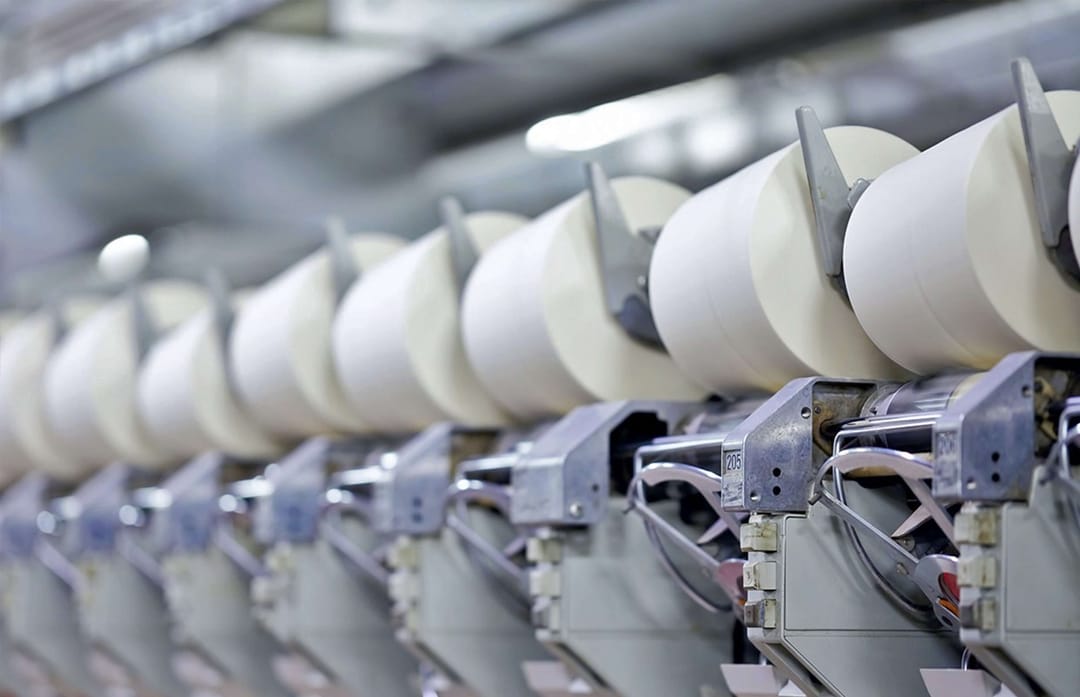
In vortex spinning, an air-jet nozzle twists the yarn, and the fibre strand can turn at up to 200,000 turns per minute, according to the BREF.
Wet processing
Agitating and ejecting liquor
Agitating liquids, listed by the DOE, and blowing liquid out of the fabric with compressed air between washing and rinsing steps, described by the BREF.
Dyeing
Air-jet dyeing
Machines where an air jet instead of a water jet keeps the fabric in circulation, with liquor ratios from 1:2 to 1:5, per the BREF.
Printing
Jet printing
A controlled air stream switches the dye jets on and off as the fabric moves, in the jet printing that the BREF describes.
Machines
Clamping, conveying and automation
Clamping, conveying, automated equipment, and controls and actuators, listed by the DOE for textiles and apparel.
Sources: US DOE and Compressed Air Challenge, Improving Compressed Air System Performance: A Sourcebook for Industry, third edition (2016), Table 1.1; European Commission JRC, Best Available Techniques (BAT) Reference Document for the Textiles Industry, EUR 31392 EN (2023), Sections 2.8.2.4, 4.1.3.4, 4.3.2.2, 4.3.2.3 and 8.3.3.1.5.
Weaving air
Pressure only where the looms need it.
The 2023 EU textiles BREF describes these measures for the compressed air system of a weaving mill.
Air-jet looms
No excess air
Optimise the air distribution for air-jet weaving by avoiding the use of excess air, with automatic pressure control valves and software that optimise the pressure distribution during weft insertion.
Source: EU textiles BREF (2023), Section 4.3.2.3.
Two pressure levels
1 bar lower elsewhere
In an example plant, only the weaving section needed the maximum pressure: a separate pipe was installed for it, the rest of the system was reduced by 1 bar, and new condensation dryers were fitted.
Source: EU textiles BREF (2023), Section 4.1.4.4.
Waste heat
15% becomes air
Only 15% of the electricity consumed by an industrial air compressor is converted into compressed air; with large water-cooled compressors, heat recovery efficiencies of 50% to 60% are typical.
Source: EU textiles BREF (2023), Section 4.1.4.4.
Source: European Commission JRC, Best Available Techniques (BAT) Reference Document for the Textiles Industry, EUR 31392 EN (2023).
What the EU BAT conclusions say
BAT 12: compressed air in textile plants.
To increase energy efficiency when using compressed air, the 2023 EU BAT conclusions for textiles ask for a combination of these techniques.
Source: EU JRC textiles BREF (2023), Chapter 5, BAT 12.
Technique
What BAT 12 describes
Optimal design of the system
Several compressed air units supply air at different pressure levels, which avoids the unnecessary production of high-pressure air. Only for new plants or major plant upgrades.
Optimal use of the system
Compressed air production is stopped during long shutdown or idling times, and single areas can be isolated by valves, in particular if they are used infrequently.
Control of leakages
The most common sources of air leakages, such as couplings, hoses, tubes, fittings and pressure regulators, are regularly inspected and maintained.
Reuse of warm cooling air or water
Warm cooling air from air-cooled compressors is reused or recycled, for example for drying coils and hanks if needed.
What we supply
For the compressor room and the wet process.
The Ultra Controlo catalogue presents its own lines as built for any industry; for textiles, one partner maker names the use.
Sources: Ultra Controlo Industrial 2026 catalogue, pp. 8, 9, 14, 16 and 17; ULTRASCREW datasheet; Speck Triplex, CO2 versions page.
One supplier. Made and serviced in Portugal.
Ultra Controlo is a Portuguese manufacturer of compressed air, vacuum and technical gas systems, with 40 years of experience. We design, assemble and test our own compressors, dryers and carbon towers in Portugal, and supply and service five partner brands.
Our own lines
ULTRASCREW compressors, ULTRASEC and ULTRADRY dryers and ULTRAK activated carbon towers.
Preventive and corrective maintenance, original spare parts and emergency support, by our own team.
Source: Ultra Controlo Industrial 2026 catalogue, pp. 3, 10, 16, 17 and 22.
Questions
Textile: questions and answers.
What is compressed air used for in textile mills?
The US Department of Energy sourcebook (2016) lists agitating liquids, clamping, conveying, automated equipment, controls and actuators, loom jet weaving, spinning and texturising as example uses of compressed air in textiles.
Is weaving a large user of compressed air?
Yes. The 2023 EU textiles BREF says weaving is a major consumer of compressed air, particularly when the looms are air-jet, and lists avoiding excessive air pressure for air-jet weaving among its energy-saving measures.
What does the EU BREF ask of a textile compressed air system?
BAT 12 of the 2023 EU textiles BREF asks for a combination of techniques: units at different pressure levels, stopping production during long shutdowns, regular maintenance of the common leak sources, and reuse of warm cooling air or water from the compressors.
Does a textile mill need oil-free compressed air?
Neither the DOE sourcebook (2016) nor the 2023 EU textiles BREF sets a rule for textiles. The DOE says that before selecting a lubricant-free or a lubricant-injected compressor, the specific end use should be considered, including the risk and cost of product contamination.
Can the heat from the compressors be reused?
The 2023 EU textiles BREF says only 15% of the electricity an industrial air compressor consumes becomes compressed air, and that large water-cooled compressors typically reach heat recovery efficiencies of 50% to 60%; BAT 12 includes reusing warm cooling air, for example for drying coils and hanks.